Author Archives: Espen

Unknown's avatar

About Espen

For details, see www.espen.com.

The Double from toy to tool

There is a lot of writing about how computers (in this case, referred to as “robots”) will take over the role of the teacher (as well as many other jobs) these days. I have my own robot, from Double Robotics, and it is gradually becoming a tool rather than a toy – and it allows me to extend my reach, rather than automate my job. Granted, so far it has mainly been used for experiments and demonstrations (below, a picture from a meeting of an ICT industry organisation in Norway) but better access and a few technology upgrades have made it much more reliable and gradually into something that is useful rather than just fun.

The practical issues with the Double have been numerous, but have largely been solved. Here they are:

  • The Double required a lot of manual intervention before I could use it – specifically, it was in my office, and the department administrator would have to unlock my office and unplug it to let it out. This was solved by acquiring a docking station and positioning the Double out in the public area of my department (next to the mailboxes, as it happens.) I was worried that someone would make away with it (or steal the iPad) but both are password protected and besides, the department requires an ID card to get in. This has also meant that other department members can use the Double – one colleague has severe allergies and has to go to his mountain cabin for several weeks in the spring every year, he used the Double to attend seminars.
  • The speaker and microphone did not work well. Out of the box, the Double uses the speaker and mike from the iPad. The speaker was too weak, and the iPad microphone picks up too much noise as well as conversations all around rather than what is in front of you. Initially, I solved the speaker problem by using a Bluetooth speaker, but it was on a separate charger and did not work very well. Double Robotics came up with an Audio Kit upgrade which largely has solved the problem – I can now generate enough clear sound that I can use the Double for lecturing, and the directional mike filters out some of the noise and ambient conversations to make communication much more natural.
  • Thirdly, the iPad will sometimes go offline because of interruptions, chiefly because of software updates. This means it will not be able to set up a connection, and needs a manual restart. This was fixed by running the Double app in a Guided Access mode (found under Settings>General>Accessibility>Guided Access), a way of setting the iPad to only run one app only, uninterrupted by software upgrades, messages and other distractions.
  • Fourth, the sound sometimes disappears on the iPad altogether. This may actually be a physical problem (it has been banged about a bit, and the metal part behind the sound buttons is a weak spot), but was fixed by allowing the physical sound controls to be run in Guided Access mode, and then asking whoever I was talking to to turn up the sound if necessary.
  • Fifth and last, the wi-fi connection drops for about 30 seconds every time I go from one wireless router to the next, which happens all the time in our large office building. I solved this by using the cell connection instead. It still has dead spots some places in the building (despite our telecom vendor, NetCom, being headquartered very close to us) but I am beginning to know where they are. It is also solvable by setting up a VLAN, something that requires cooperation from the IT department and which I haven’t gotten around to quite yet.

All in all, I am beginning to find the Double a useful tool. Next time I am invited to speak on TV, I’ll consider sending it down to the studio in a taxi, just to see the reaction. Like many digital solutions, true productivity does not come until everything is digital – for instance, i wanted to use the Double for an early meeting with students last week, but found I couldn’t do it because the door to the department would be locked and there was no way I could unlock it remotely. So I ended up going in for the FTF meeting anyway, even if it was the only thing I needed to be in the office for that day.

A second observation is that the Double elicits all kinds of thoughtful (and less thoughtful) comments from grown-ups, mainly along the lines of how surprisingly natural this is but how traditional face to face is better, alienation etc. etc. The younger element takes to it naturally – my cousin’s eight year old daughter, seeing her Dad in the Double, responded with a “Hi Dad” as the most natural thing in the world.

And thirdly – one obvious use of the Double would be to ship it to wherever I am supposed to be, so I can give a talk remotely. I gave a talk in Bordeaux two days ago. Bordeaux is complicated to get to from Oslo, and the trip ended up taking three days. I could have sent the Double, but a) I think my physical presence helped the talk, and b) the Double has a large lithium-ion battery, and you can’t ship those on airplanes. Consequently, the Double is a tool for making me stay in place while moving about, rather than the other way around.
A BI degree for expats!

The Executive Master of Management degree is now offered in English at BI Norwegian Business School – just the thing for the ambitious expat!

BI Norwegian Business School has a very popular executive education degree called the Executive Master of Management. The school offers a range of EMM courses, each lasting about a year and consisting of 5-6 modules of 3-4 days each. Put together three of these courses (with some exceptions) and you have a degree. (Well,there are a few other requirements, such as one of the courses taken with a slightly more substantial thesis, You can take more than one course concurrently, though I think taking more than two would be pushing it, at least if you have a job as well).

I like teaching in these courses (especially one called Strategisk Forretningsutvikling og Innovasjon), but they have, so far, required you to be able to speak Norwegian (with the exception of International Management.) From this fall, however, we have created two more courses taught in English, so that you now can qualify for the degree without having to learn Norwegian.

The courses are

I hope this troika will be an attractive package to foreigners in Norway (as a matter of fact, I have been arguing for this for some time, and am very pleased that it is now available) – so if you know someone living and/or working in Norway who are in the market for a relevant and interesting executive business degree, please alert them to this opportunity!

Trapping the wily professor

(This was published in European Business Forum, BCG’s attempt to create their own version of the Harvard Business Review, in 2004. Issue 19, to be exact. Reproduced here, lightly edited, because, well, it is very hard to find and I would like to make it available.)

Trapping the wily professor
A hunting guide for the enterprising executive

Espen Andersen, 2004

Recently, I attended a meeting of senior HR executives – primarily CLOs (Chief Learning Officers) – from large European companies. The participants were all engaged in designing and/or running various forms of management training and education in their companies, and a discussion about how to deal with outside suppliers – particularly business schools – came up. A key problem, it transpired, was getting the good professors to engage in company programs. While the schools were more than willing to sell their branded and packaged programs, most corporations wanted something tailor-made, designed to achieve a specific corporate learning goal. Furthermore, they wanted it tailor-made by the big names – that is, the professors the students were likely to know. This had proved very difficult. These were big, prestigious companies – why couldn’t they get the big, prestigious professors?

Coming from the supply side of this relationship, can see the difficulties these managers have – so I herewith offer a little guide to hunting down and keeping that rarest of animals, the business-savvy and interesting professor. A warning, though: This is not a task to be approached lightly. Hunting requires knowledge of the prey itself, its living environment, and its reward structures. It requires patience and a keen sense of observation, as well as an ability to communicate with the natives – or at least not to offend them too much.

First: Hunt professors on your turf, not theirs. The best place to hunt for professors is not through the business school sales channels. Instead, invite the professor to come into your company to give a short talk on some very specific point of interest – half an hour is fine – at some small executive meeting, with lunch and informal discussions thereafter. Pay the professor for the presentation. If there is no chemistry, you have listened to a (hopefully) interesting presentation and the professor has made a little money and is likely to think of your company with benevolence. Incidentally, the best referrers of professors are other professors – so use the occasion to extend your network. Carefully cultivated, most professors will come when you call and leave you alone when you want them to.

Second: Avoid the obvious blunders. This should go without saying, so the experienced professor-hunter may want to disregard this paragraph. However, any high-powered and dynamic business executive can unknowingly scare away the wily professor without meaning to – the equivalent of putting on aftershave before the hunt and then wondering why you never see any prey. Professors are academics, and you hunt them because they are. Consequently, never use the word “academic” to mean “irrelevant”, “hypothetical” or “impractical”. Never refer to them as “educators” (in academic cynical parlance, an “educator” is someone forced to live by teaching and writing readable articles because he or she can’t do research and write unreadable articles.) And never – never ever – ask them to include that interesting best-seller (“Who drank my café latte?”) you saw in the airport bookshop to their syllabus. Professors are extremely jealous of outside intellectual competition, and anyone preferring the Heathrow School of Management to them is treated with extreme suspicion, if not outright hostility.

Third: Don’t devolve problems to intermediaries. Typically, the CLO seeking a management education program interacts with a relationship manager from the business school. This person is pleasant, nicely attired and means well, will sell you the standard programs and tell you what you want to hear, but is incapable of trapping the wily professor on your behalf. If you want a program out of the ordinary, talk to the person most critical for its success – and that better be the professor, because if program responsibility lies with the salesperson, you are in trouble. That being said, the school’s relationship manager is very useful as a support person – so let your own support person deal with him or her, and make sure that the minute any content issues spring up, the problem is escalated to you – and the professor. (And, by corollary, don’t fall into the trap of becoming an intermediary yourself, as when a business colleague needs a program and asks you to set it up.)

Fourth: Ask not what the professor can do for you, but what you can do for the professor. Professors are not motivated by money. Actually, that is a whopping big lie – they certainly are, but it needs to come in a form palatable to the world they inhabit. Doing executive education does not help a professor in his or her career – at best, it earns him or her non-tradable brownie points for helping the school. What counts in the academic hierarchy – at least officially – is publishing what to the layman appears as unreadable articles in obscure journals read by few and remembered by even fewer. These articles are created through back-breaking work and qualified through an evaluation process that makes Purgatory feel like a day at the beach. To do the work, the professor needs money, in the form of research grants. To get through the evaluation, he or she needs data, obtained by getting access to corporations. If you can give the professors research money and access to data (i.e., your company,) they will happily create executive education programs as part of the research process. They will even teach them. (It is possible to bag a few professors through money alone, primarily the younger ones, but on a repeated basis this will yield a lower quality of prey).

Fifth: It is not what you say, it is what you do. The above will attract and retain professors, but will not earn their undying love. To achieve that, you need to follow through and do what they say. Professors seeing their theories listened to and applied will do anything you ask of them – sit on your Board, talk to your executives, co-write career-enhancing articles with you in trade magazines and even listen to your suggestions for making their theories better. The danger herein lies in that you may go native yourself – and what a tragedy that would be.

So there you are – to bag a professor, start by wining and dining them, paying them for a small presentation, then lure them with money and access to provide you with tailor-made and interesting executive programs. It is easy. You can start now. My email is here.

A trendy walk through Oslo…

This video was actually quite fun to make:


My part is done in the offices of Masterstudies Marketing Group, to illustrate my point that if a small nation like Norway (or, for that matter, Europe) wants to compete on the world market, recruiting should be based on who is the best person for the job, not who fits in with the reigning culture.

Masterstudies, incidentally, is located in Oslo, is doing very well indeed, and has about 35 employees who collectively speak more than 20 languages. Two of the employees are Norwegian….

How to write a teaching case

(An updated version of this post is available here.)

Some time ago, I was asked to explain what it takes to write a teaching case, so heere is my (very rough and off the cuff) opinion about what it takes (in reality, how a teaching case differs from a research case).

Why are you writing this case?
Cases are written for a teaching purpose – and to write a teaching case, you need to have a teaching objective in mind. It is not enough to have an interesting company. Even the best company story needs to have a pedagogical point, a theory or dilemma to illustrate. So don’t write a teaching case just because you happen to know someone in a really interesting company – it does need to be a good story, but it also need to have a purpose.

The standard outline
Cases – particularly the standard HBS case – follow an outline that can seem rather trite, but which is very effective. It is something like this:

  • 0.5 page: Intro: The protagonist is introduced, typically pondering a question of some importance. The idea is to tell the students from which perspective the case is written, to set the scene – and that is all there is to it.
  • 1 – 1.5 pages: Description of the company – not the whole history, but the relevant details, explaining what the company is doing, how they make their money. Most companies are to a very large degree formed by their history, so the relevant parts need to be told.
  • 1 page: Industry. Companies exist within a context, and you need to set it. Explain the industry, its evolution, and the company’s position within it. Do it succinctly, but leave more detail in than what is strictly necessary.
  • 1 – 5 pages: Specific issue. This is the meat of the case, the issue at hand, the story to ponder. Make sure you tell it logically and cooly, not leaving anything out, but also conveying the complexity of the situation.
  • 0.5 page: Conclusion, typically with the protagonist wondering what to do, often with some sort of event (board meeting, etc.) where he or she has to present a solution to the problem.

Most cases are just that – one case. You can have a B case and even a C case, but keep them short, since they have to be handed out and read in class. The B case should explain what the company did and perhaps introduce a new problem, the C case, if necessary, should bring some sort of closure, explaining what eventually happened. In my experience, it is very hard to get discussion after a C case – the students become exhausted. As a novice case writer, especially if you are writing about a company with a long history, it can be tempting to create a long string of small cases, but in practice this seldom works well – for one thing, it forces the discussion into a very predictable path.

The no-nos
A good case should be a description of an interesting situation, frequently a decision point – and nothing else. This means that there should be no theory and no discussion of the case in the case itself. Save that for the teaching note, or write a separate academic article about it. Not only does this make the case more realistic, it also means it can be used for more purposes than the one initially envisioned. This can be quite challenging for the traditional academic writer – but ist is actually good practice to only present the facts (though, of course, which facts you choose to present constitute a discussion of sorts).

When teaching students how to analyze a case, I always start by saying that for most business situations, if is useful to begin the analysis with the assumption that people are not stupid and not evil. Consequently, when you write a case, make sure it has no heroes and no villains. If a case has a clear-cut hero or villain, it is a sign that you have not done enough research. Write things so that the students can see the issue from many perspectives.

Dramatic structure
A really well written case has dramatic structure – there is a beginning, a middle that builds up the story, and a really compelling issue at the end. The best cases are almost like a detective story, where you have to dig deep into the analysis to find surprising and sometimes counter-intuitive conclusions. One example of a “detective story” case is Fabritek 1992*, a very old (first published 1969, rewritten by Jan Hammond) case about a quality control issue in a small mechanical workshop. (Hat tip to Robert D. Austin, eminent case teacher, for making me aware of this case and showing me how to teach it.) The case is excellent because it starts with the company (strategic level), proceeds to describe a new situation and a new process (organizational or business logic level) and then introduces the problem (operational level.) Analyzing the operational details leads to one conclusions, which can then be discussed in terms the organization and its business logic, which can then be placed into a strategic context. The case is excellent because it allows links between these levels – and also teaches the students that the devil indeed resides in the details, and that you as a manager better be very close to how the business you are leading works and makes money.

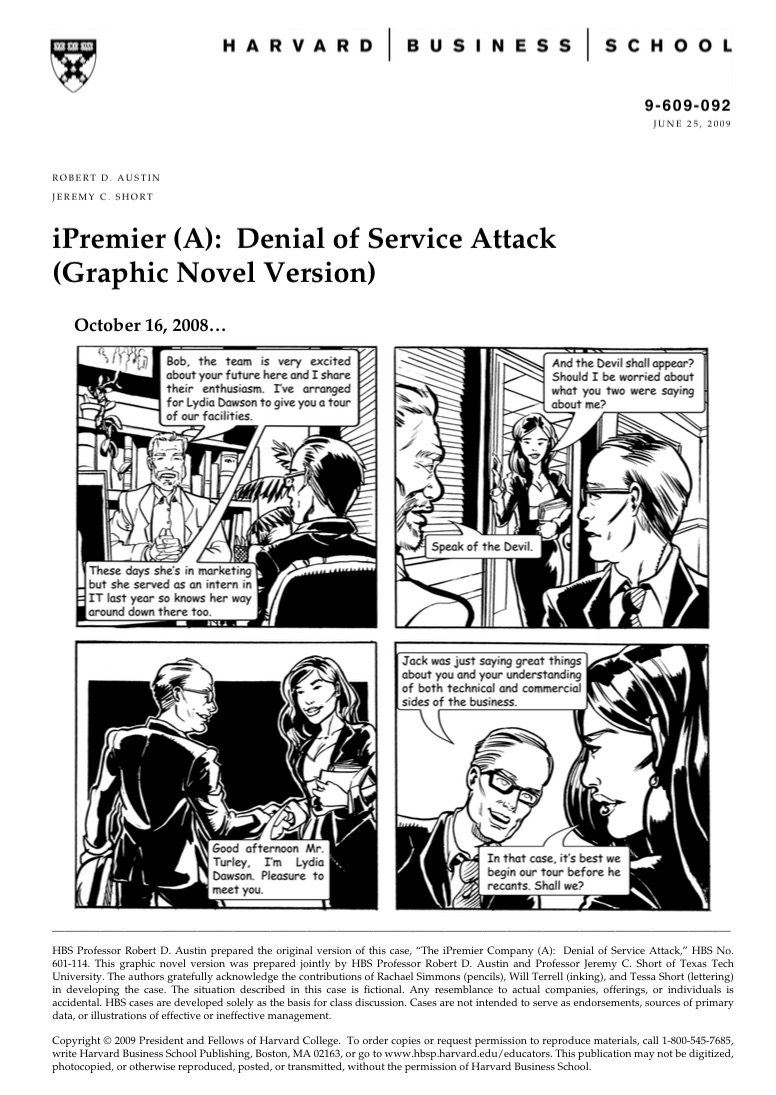
iPremier-front-pageA second case which shows quality and innovation is iPremier, written by Robert D. Austin and Jeremy C. Short, the first and only graphic novel (cartoon) case I am aware of. The story is about a small online gift company being attacked by hackers, exposing glaring gaps in their security procedures and forcing managers at various levels to make some really hard decisions. The graphic format is excellent in making the various characters real (though they, on average, tend to be way too good-looking for a normal business situation), illustrates technical issues in a way that is very understandable even by non-technology students, and has a cracking good storyline with a B and a C case. I like to introduce a few technical cases in my courses because, well, I don’t think there is enough technology in business schools, and this cases answers very well because it illustrates that certain technical decisions very much require top management attention – ignore (or mindlessly delegate) technology understanding and responsibility at your peril. The graphic format also provides a welcome break from the standard case verbiage, which can be a trifle dour on occasion.

Details, details, details!
Research cases – the kind that is published in refereed journals – tend to be written from a very specific viewpoint, and only facts pertaining to that perspective is included, often in a very abstract format. A teaching case is the direct opposite: It needs lots of details, frequently made available as exhibits (graphs, pictures, documents, tables, etc.) placed at the end, after the main text. A teaching case writer, when visiting a company to write about it, needs to notice the small details, much like a really good journalist does. I tell my students that they should prepare each case so well that they feel like they have worked in the case company – and to allow them to do that, you need to provide the operational details necessary. (Incidentally, having more details than strictly necessary has the added benefit of making the case realistic – in the real world, you have to decide what is important and what is not.)

Doing it – and reading about it.
grandongillI am not aware of many books about how to write a good teaching case, with one exception: Grandon Gill (pictured), professor at University of South Florida and an excellent case teacher, has written a book called Informing with the case method, which is available for free download in PDF, MOBI and EPUB format from his web site. It has lots of details, tips and tricks, not just about case writing, but also about case teaching and course planning. (For the latter, of course, I am duty bound to recommend Bill Schiano’s and my book Teaching with Cases: A Practical Guide.)

Last but definitely not least: Don’t underestimate how much work writing a proper business case is. Getting the details right, describing the dramatis personae, and making the storyline compelling is quite a challenge, in many dimensions different from the traditional academic article. On the other hand, should you get it right, you will have a very effective teaching tool for many years to come.

Good luck!

More worm than silk

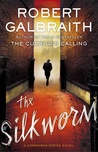
The Silkworm (Cormoran Strike, #2)The Silkworm by Robert Galbraith

My rating: 2 of 5 stars

Easy to finish, but this was rather a disappointment after having read comments that it was “even better” than the first book (Cuckoo’s Calling). The plot is rather predictable – after reading the description of the murder scene I thought I knew who had done it, at 70% through the book I was certain (and i was right, save some minor twists.) Things get rather clichéd (police targeting the likely but obviously guilty suspect and then refusing to talk to the private detective, the eager but inexperienced (and strangely one-dimensioned) assistant, the detective bedding a minor figure to fill things out) and the author even resorts to cheap plot twists a la Dan Brown (e.g., deliberately withholding information by cutting dialogue).

Not sure I will get the next one. This needs some wizardry to improve.

View all my reviews

Case book update

The case teaching book is, I have been reliably informed, selling well. It is currently in heavy rotation on Harvard Business Publishing’s web pages (see image below) and also available on Amazon.com.)

And that, well, makes my day a little brighter…

hbsp

ACM Ubiquity’s Singularity Symposium

ACM Ubiquity, of which I have the honor of serving as an Associate Editor for a number of years, has a symposium (a collection of essays around a theme) on the Technological Singularity. I have been the editor responsible for this one, and the essays are as follows (I’ll make these live links as they are published):

  1. Opening Statement by Espen Andersen
  2. The Singularity and the State of the Art in Artificial Intelligence by Ernest Davis, NYU
  3. Human Enhancement—The Way Ahead by Kevin Warwick, University of Reading
  4. Exponential Technology and The Singularity by Peter Cochrane
  5. Computers versus Humanity: Do we compete? by Liah Greenfeld and Mark Simes, Boston University
  6. What About an Unintelligent Singularity? by Peter J. Denning, Naval Postgraduate School, editor ACM Ubiqity
  7. Closing Statement: Reflections on A Singularity Symposium by Espen Andersen

You can read about the background for the symposium in my opening statement – but, in short, I could not get a clear and concise explanation of whether the singularity will happen (and when), so I set about getting a number of smart people to give their perspective. Enjoy!

A workaholic with a diary and many club memberships

More Fool MeMore Fool Me by Stephen Fry

My rating: 3 of 5 stars

Largely a diary of Fry’s life in the early 90s, after a recap of Moab Is My Washpot and The Fry Chronicles. Can get a bit tedious at times, but that is some of the point – the frantic descriptions of comedy, clubbing and cocaine and so much namedropping it starts to seem normal after a while makes it all the more understandable why a breakdown is in the works. Still, what a time he must have had.
View all my reviews

Call on me – by cancer patients

It’s been a secret for quite a while, but now I can share it: Jenny, our youngest daughter, lymph cancer survivor, has been to London to record a dance video with “Aktiv against cancer”. Here is the resulting video:

And here is a longer video with a bit of background and interviews with some of the participants, including Jenny:

Jenny has been a dancer all her life, and getting back to dancing through this video and the dancing classes she takes at her high school has been very important to her – a source of inspiration, as I think is evident.

The thinking robot, again.

Interesting video, nice summary of a projection:

The creativity part is a bit further out. As for the horses, the ones left have a much better life than they used to have….

(Thanks for the tip, Rick Holmen!)

Teaching with Cases: Detailed table of contents

bookcover2The Table of Contents in the paper and PDF version of Teaching with Cases: A Practical Guide is only at the chapter level. For readers wanting a more detailed overview of the book or to find something specific, here is the detailed table of contents:

Preface  vii
Acknowledgements     ix

Chapter 1: Introduction: Why you should read this book 1
Why case teaching?     2
How case classes and students vary     4
Class size     5
Core versus elective     5
Part-time versus full-time     5
Gender     5
Weekly versus  modular courses     6
Domestic versus international     6
Single versus multi-section     6
Executive versus graduate versus undergraduate     7
One of many case classes for students vs. only or one of few 7
In school versus other location     7
Practical Guidance for all Case-Teaching Faculty     7
The central framework: Foundation, flow, and feedback     8

Chapter 2: Foundations: Preparing for the course     11
Taking Ownership    12
Making a Contract     14
Developing Content     16
Structuring the syllabus     26
Selecting cases     18
Selecting readings and textbooks     24
Using guest speakers     26
Using assignments     28
Working with Students     29
Motivating Students     32
Enthusiasm and Engagement     33
Relevance     33
Opportunities to build valuable skills     33
Safe participation     34
Fun     34
Finding Information about Students’ Backgrounds     35
Helping the students prepare for case discussions    36
Classroom participation requirement     36
Establishing Infrastructure     38
Establishing seating arrangements     39
Using Name cards and seating charts     42
Setting length and frequency of class sessions     44
Session Length  45
Session Frequency  45
Wrapping up     46

Chapter 3: Flow During the Class Session    49
Preparing Yourself    51
Crafting a teaching plan     52
Demeanor in class     54
Dressing for class and impression management     55
Managing your anxiety     57
Preparation     57
Exercises     58
Rituals     59
Starting to Teach     59
The first class     59
Opening classes     62
Building trust in the class     64
Managing the Discussion     66
The Emcee: Calling on students and managing airtime     67
The Scribe: Using the board     70
Board plan     71
Writing on the board     74
The Conductor: Using body language, silence, and movement 76
Using the physical space   79
The TV Host: Asking questions   82
Giving up control     84
Time management     85
How long to let a discussion go     86
If you are running out of time     86
Breaks and other interruptions    87
Teaching long class days     88
Beyond Discussion     89
Using theory and other non-case material     89
Inductive versus deductive case use 90
Communicating Theory  91
Role-Playing     93
Multipart cases     94
Group work     95
Group Presentations     96
Group Discussions    98
Team teaching in the classroom    99
Are you getting the most from each student?     101
Humor in the classroom     102
Energy    103
Raising the energy level     104
Relationships among and with students     106
Concluding a Discussion     107

Chapter 4: Feedback: Assignments, Grading and Guidance 111
The Evaluative Mindset  112
Designing Evaluation   113
Designing assignments 115
Individual Oral Assignments   115
Individual Written Assignments 116
Group Oral Assignments  117
Group Written Assignments  118
Designing Exams     118
Selecting Cases for Exams   118
Writing Exam Questions  119
Take-Home Exams   121
Designing Term Papers  122
Term Papers as Research Method  124
Grading    125
A matter of scaling     125
How to structure feedback     127
Group Work  130
Final Exams  130
Class participation     131
Capturing Participation  133
Setting Expectations  134
Setting Expectations by Self-Evaluation  135
Exams  136
The dreaded extra-credit requests    139
Handling academic dishonesty     140
Conclusion     143

Chapter 5: Managing Classroom Issues     145
Issues with Individual Student    145
How do I manage students who hog airtime?     146
How do I manage combative students?     147
What can I do about students’ computer use in class?    148
What do I do if a student does not pay attention in class?   149
What do I do if a student complains?     150
How do I accommodate students with disabilities?     151
Issues with groups of students     152
What Do I Do When Students Are Not Well Prepared? 152
How do I get students to prepare better?     153
Reward Good Preparation 153
Help Them Along  154
Draw Out Prepared But Reticent Students 154
Require Case Write-ups or Give Pop Quizzes  154
Give a Stern Lecture  154
Make An Example of a Student or Two  154
How do I stop side conversations?     155
How Do I Manage Dysfunctional Class Behavior?  156
Hissing  156
Genuflection   156
Sharking  157
What if the class turns against me?     157
How is Teaching Executives Different?  159
How should I deal with student pranks?     161
How Do I Deal with Student Representatives?    163
How Do I Deal with Dysfunctional Groups? 164
Free-Riders  164
Personality Conflicts   165
Poor Project Management   165
Poor Performance   165
Issues Beyond Students     166
What if I can’t find enough cases that fit?     166
What do I do if I have lost track of the discussion?     167
What if I run out of questions?     168
How do I deal with problems in an intensive-format course? 137
Prepare Differently  169
Manage Expectations  169
Manage Process Closely  169
What can I do if I am low on energy?     170
What If the Administration Gets Involved?

Chapter 6 Quantitative and technical material     174
Flipping the Qualitative and Quantitative    175
Being Qualitative about the Quantitative  175
Being Quantitative about the Qualitative  176
Explicitly Teach Estimation   177
Quantify Anything   177
Know the Industry Data   177
Change Assumptions or Problems on the Fly  179
Teaching Quantitative Material   179
Making a Teaching Plan for a Quantitative Case   179
Pacing the Discussion  180
Asking for a Number at the Beginning   181
Managing Math Phobia and Aversion to Numbers   183
Making the value clear   182
Acknowledging the Phobic  182
Filling in the Holes  182
Fostering a Sense of Self-Efficacy  183
Using the Board  183
Making the best use of students     185
When Students Go Wrong  185
When No One Has the Correct Analysis  186
Discussing a Quantitative Case with Subjective Numbers or Estimates   187
Using Groups  188
Teaching Technical Material   189
Motivating the Study of Technology   189
Structuring the Teaching of Technology  190
Conclusion 192

Chapter 7 Adjusting for language and culture     195
The Foreign Student  197
Making Adjustments for Foreign Students   200
The Foreign Teacher   202
The Teacher Abroad  204
Expectations for teaching   205
Teacher power     206
Student behavior     207
Using Interpreters   208
Trust the locals     211

Chapter 8: Preparing for the next time     213
Debriefing a course     213
Interpreting and using student feedback     215
How to Read Student Feedback   215
Striving for High Evaluations   217
Reviewing Case Selection   217
Debriefing with a Teaching Group 218
Archiving Material   218
Evaluating case teachers, including yourself     219
Before Class  219
During Class  219
After Class  220
Managing relationships with alumni     220

Chapter 9: Fostering Case Teaching at the School Level  223
The Commoditized Business School  223
Relevance is Relevant   224
Integration is Integral   225
Institutionalizing Case Teaching   228
Recruiting, Incentives and Promotion   228
Teaching-Related Procedures   230
Getting Infrastructure Right   230
Classroom Design  231
Good, Abundant Board Space   231
Blackboards Rather Than Whiteboards   231
Seating   232
Making Cases Easy to Use and Produce   233
Case Production   234

Chapter 10 Technologies for Case Teaching  238
Take Control of the Technology  238
Technology for Teacher Productivity  239
Teacher’s Computer Use in Class   241
Presentation Software   243
Tools for Student-Teacher Interaction   246
Learning Management Systems     246
Build a Sandbox   246
Explore the System   247
Maintain Communication Norms   247
Create a FAQ Repository  247
Structure for Reuse  247
Facilitate Searching   247
Consider the User’s Experience   248
Maintain Structure   248
Automate Availability   248
Explore the Analytics   248
Seek and Accept Help  249
Other Technologies to Support Student Interaction  249
Social Media   249
In-Class Polling and Voting Tools   249
Questionnaires   250
Shared Documents   250
Analysis Tools   250
Online Simulations  251
Online Teaching   251
Teleconference Teaching   251
Get the Basic Technology Right 252
Communicate in a Way Suited to the Medium   252
Communicate via Side Channel and Back Channel  253
Get to Know the Students  254
Videoconferencing  254
Lighting and Background   255
Sound   256
The Video Camera   256
Concurrently Teaching Face-to-Face and Remotely   259
Teaching Asynchronously with Discussion Forums   260
Foundations: Designing the Course and Forming the Contract   262
Flow: Running the Discussion   265
Guidelines for Students   267
Feedback: Evaluating and Closing the Loop 269
Managing the inevitable technical failures   271
Conclusion   273

Index   275
About the Authors  293

Case teaching when you are not at Harvard

Our book is out!
bookcover2Bill Schiano and I have written a book, Teaching with Cases: A Practical Guide, officially launched today at Harvard Business Publishing, available as paperback or PDF (304 pages).

Bill and I are both passionate about case teaching and use it whenever possible. We have aimed the book at the kind of people we were 18 years ago: Teachers wanting to use case teaching, but finding ourselves in institutions where case teaching is not the dominant teaching method. (We actually wanted to name the book Case teaching when you are not at Harvard, but saner minds intervened.)

There are a few books on how to do case teaching available, but common to them is that they are a) rather philosophical and abstract in their advice, and b) take the institutional environment for granted – i.e., they assume that you are at a school, such as Harvard Business School, Wharton, INSEAD or University of Western Ontario, where case teaching is the norm, the students are brilliant and fiercely competitive, classrooms are made for case teaching and excellent teaching is valued by the administration (and the promotion committees.)

We wanted the book to be relentlessly practical – what to wear to class, how to deal with disruptive students, how to get students to prepare, how to grade participation. We also wanted the book to address how to create the necessary infrastructure for case teaching with little or no administrative support, down to how you create name cards (let the students do it or use a spreadsheet/mail-merge function) and class chart (take a photo of the students holding their name cards, print it in weak grayscale for after-class note-taking.)

The book is built around three concepts: Foundations (how to set up the course, contract with the students, and set up infrastructure); Flow (how to conduct the discussion in the classroom, manage time and boards, ask questions, and conclude discussions); and Feedback (how to design grading and feedback, especially participation grading.) We have extra chapters on dealing with difficult issues (much of it based on questions from participants in HBS’ case teaching seminars); how to teach quantitative and technical material; how to deal with differences in language and culture (foreign students and foreign teachers); how to prepare for the next course; how to foster case teaching at the school level (many business schools are now looking to better teaching, including case teaching, as a differentiator); and lastly, a long and detailed chapter on technologies for case teaching, including our views on how to teach cases online.

The book also includes a collection of online resources (sample syllabi, sample teaching plans, etc.) for teachers, available at teachingwithcases.hbsp.harvard.edu. We hope to grow this collection as we hear from readers and build more material ourselves.

That’s it for now – I’ll be back with excerpts, a full table of contents, and various other nuggets eventually. But given that this book has been on my mind for a couple of years now, it is a rather good day…

Being rational in the publishing debate

Book publishing is moving towards subscription models, and the tempers are (predictably) flaring, especially since writers cannot change their business model to giving performances rather than selling their works for self-consumption, as musicians can (and do).

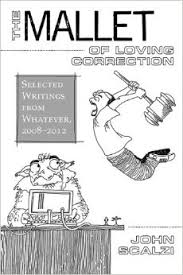
malletJohn Scalzi, sci-fi writer and blogger par excellence (he works his comment field using what he terms his Mallet of Loving Correction, which is also the title of his blog-generated book) has a reasoned response to the current subscription-or-not discussion, which I encourage everyone to read. Key phrase:

[…] every new distribution model offers opportunities tuned to that particular model of distribution — the question is whether one is smart enough to figure out what the strengths of any distribution model are, and then saavy (and lucky) enough to capitalize on them.

And there you are. Easier ways to publish will lead to more writing – it already does. It will also create new ways of making a living from writing – and, I suspect, new forms of writing (as it already has.) In the process, some will prosper that previously didn’t, others won’t. Digging oneself into a trench certainly won’t help.

Moon landing hoax rebuttal

For some reason, many people with very little brains believe the moon landings of Apollo 11 and others were faked in a giant conspiracy. This video shows why they could not be faked, and why it matters. (Another point: At no point did the Soviet Union dispute that the USA had made it to the moon – because they had their own manned missions and could see the landing site with their own eyes….)

Anyway, a brilliant piece of argumentation, for your enjoyment:

Elon, I want my data!

Last week I got a parking ticket. I stopped outside BI Norwegian Business School where I work, to run in and deliver some papers and pick up some computer equipment. There is a spot outside the school where you can stop for 10 minutes for deliveries. When I came out, I had a ticket, the attendant was nowhere in sight – and I am pretty sure I had not been there for 10 minutes. But how to prove that?

Then it dawned on me – I have a Tesla Model S, a very innovative car – not just because it is electric, but because it is constantly connected to the Internet and sold more as a service than a product (actually, sold as a very tight, proprietary-architecture product, much like whatever Apple is selling). Given that there is a great app where I can see the where the car is and how fast it is going, I should be able to get the log from Tesla and prove that I parked the car outside BI less than 10 minutes before the ticket was issued…

Well, not so fast. I called Tesla Norway and asked to see the log, and was politely turned down – they cannot give me the data (actually, they will not hand it over unless there is a court order, according to company policy.) A few emails back and forth have revealed that the location and speed data seen by the app is not kept by the internal system. But you can still find out what kind of driving has been done – as Elon Musk himself did when refuting a New York Times journalist’s bad review by showing that the journalist had driven the car harder and in different places than claimed. I could, for instance, use the data to find out precisely when I parked the car, even though I can’t show the location.

And this is where it gets interesting (and where I stop caring about the parking ticket and start caring about principles): Norway has a Personal Data Protection Act, which dictates that if a company is saving data about you, they not only have to tell you what they save, but you also have a “right of inspection” (something I confirmed with a quick call to the Norwegian Data Protection Authority). Furthermore, I am vice chairman of Digitalt Personvern,  an association working to repeal the EU data retention directive and know some of the best data privacy lawyers in Norway.

So I can probably set in motion a campaign to force Tesla Norway to give me access to my data, based on Norwegian law. Tesla’s policies may be American, but their Norwegian subsidiary has to obey Norwegian laws.

But I think I have a better idea: Why not, simply, ask Tesla to give me the data – not because I have a right to data generated by myself according to Norwegian law, but because it is a good business idea and also the Right Thing to do?

So, Elon Musk: Why not give us Tesla-owners direct access to our logs through the web site? We already have password-protected accounts there, storing documents and service information. I am sure some enterprising developer (come to think of it, I know a few myself, some with Teslas) will come up with some really cool and useful stuff to make use of the information, either as independent apps or via some sort of social media data pooling arrangement. While you are at it, how about an API?

Tesla has already shown that they understand business models and network externalities by doing such smart things as opening up their patent portfolio. The company is demonstrably nerdy – the stereo volume literally goes to 11. Now it is time to open up the data side – to make the car even more useful and personable.

PS: While I have your attention, could you please link the GPS to the pneumatic suspension, so I can set the car to automatically increase road clearance when I exit the highway onto the speed-bumpy road to my house? Being able to take snapshots with the reverse camera would be a nice hack as well, come to think of it. Thanks in advance! (And thanks for the Rdio, incidentally!)

Update a few hours later: Now on Boingboing!

Update Sept. 2: The parking company (Europark) dropped the ticket – didn’t give a reason, but probably not because I was parked too long but because I was making a delivery and could park there.

The disrupted history professor

Jill Lepore, Harvard HistorianProfessor Jill Lepore, chair of Harvard’s History and Literature program, has published an essay in the New Yorker, sharply critical of Clayton Christensen and his theory of disruptive innovations. The essay has generated quite some stir, including a rather head-shaking analysis by Will Oremus in Slate.

I find Lepore’s essay rather puzzling, and, quite frankly, unworthy of a professor of history, Harvard or not. At this point, I should say that I am not an unbiased observer here – clayClay is a personal friend of mine, we went through the doctoral program at Harvard Business School together (he started a year before me), he was on my thesis committee (having graduated three years ahead of me) and we have kept in touch, including him coming to Norway for a few visits and one family vacation including a great trip on Hurtigruten. Clay is commonly known as the “gentle giant” and one of the most considerate, open and thoughtful people I know, and seeing him subjected to vituperating commentary from morons quite frankly pains me.

Professor Lepore’s essay has one very valid point: Like any management idea, disruptive innovation is overapplied, with every technology company or web startup claiming that their offering is disruptive and therefore investment-worthy. As I previously have written: If a product is described as disruptive, it probably isn’t. A disruptive product is something your customers don’t care about, with worse performance than what you have, and with lower profit expectations. Why in the world would you want to describe your offering as disruptive?

That being said, professor Lepore’s (I will not call her Jill, because that seems to be a big issue for some people. But since I have met Clay (most recently last week, actually), I will refer to him as Clay)  essay shows some remarkable jumps to non-conclusions: She starts out with a very fine summary of what the theory of disruption says:

Christensen was interested in why companies fail. In his 1997 book, “The Innovator’s Dilemma,” he argued that, very often, it isn’t because their executives made bad decisions but because they made good decisions, the same kind of good decisions that had made those companies successful for decades. (The “innovator’s dilemma” is that “doing the right thing is the wrong thing.”) As Christensen saw it, the problem was the velocity of history, and it wasn’t so much a problem as a missed opportunity, like a plane that takes off without you, except that you didn’t even know there was a plane, and had wandered onto the airfield, which you thought was a meadow, and the plane ran you over during takeoff. Manufacturers of mainframe computers made good decisions about making and selling mainframe computers and devising important refinements to them in their R. & D. departments—“sustaining innovations,” Christensen called them—but, busy pleasing their mainframe customers, one tinker at a time, they missed what an entirely untapped customer wanted, personal computers, the market for which was created by what Christensen called “disruptive innovation”: the selling of a cheaper, poorer-quality product that initially reaches less profitable customers but eventually takes over and devours an entire industry.

She then goes on to say that the theory is mis- and overapplied, and I (and certainly Clay) couldn’t agree more. Everyone and their brother is on an innovation bandwagon and way too many consulting companies are peddling disruption just like they were peddling business process reengineering back in the nineties (I worked for CSC Index and caught the tail end of that mania. Following this, she points out that Clay’s work is based on cases (it is), is theory-building rather than theory-confirming (yep) and that you can find plenty of cases of things that were meant to be disruptive that weren’t, or companies that were disruptive but still didn’t succeed. All very well, though, I should say, much of this is addressed in Clay’s later books and various publications, including a special issue of Journal of Product Innovation Management.

(Curiously, she mentions that she has worked as an assistant to Michael Porter‘s assistant, apparently having a good time and seeing him as a real professor. She then goes on to criticise the theory of disruptive innovation as having no predictive power – but the framework that Porter is most famous for, the five forces, has no predictive power either: It is a very good way to describe the competitive situation in an industry by offers zero guidance as to what you actually should do if you are, say, in the airline industry, which scores very badly on all five dimensions. There is a current controversy between Clay and Michael Porter on where the Harvard Business School (and, by implication, business education in general) should go. The controversy is, according to Clay, mostly “ginned up” in order to make the Times article interesting, but I do wonder what professor Lepore’s stakes are here.)

The trouble with management ideas is that while they can be easily dismissed when commoditized and overapplied, most of them actually start out as very good ideas within their bounds. Lepore feels threatened by innovation, especially the disruptive kind, because it shows up both in her journalistic (she is a staff writer with the New Yorker) and academic career. I happen to think that the framework fits rather well in the newspaper industry, but then again, I have spent a lot of time with Schibsted, the only media company in the world that has managed to make it through the digital transition with top- and bottom-line growth, largely by applying Clay’s ideas. But for Lepore, innovation is a problem because it is a) unopposed by intellectuals, b) happening too fast, without giving said intellectuals time to think, and c) done by the wrong kind of people (that is, youngsters slouching on sofas, doing little work since most of their attention is spent on their insanely complicated coffee machines, which “look like dollhouse-size factories”.) I am reminded of “In the beginning…was the command line.”, Neal Stephenson‘s beautiful essay about technology and culture, where he points out that in

… the heyday of Communism and Socialism, [the] bourgeoisie were hated from both ends: by the proles, because they had all the money, and by the intelligentsia, because of their tendency to spend it on lawn ornaments.

And then Lepore turns bizarre, saying that disruptive innovation does not apply in journalism (and, by extention, academia) because “that doesn’t make them industries, which turn things into commodities and sell them for gain.” Apparently, newspapers and academia should be exempt from economic laws because, well, because they should. (I have had quite a few discussions with Norwegian publishing executives, who seem to think so for their industry, too.)

I think newspapers and academic institutions are industries – knowledge industries, operating in a knowledge economy, where things are very much turned into commodities these days, by rapidly advancing technology for generating, storing, finding and communicating information. The increased productivity of knowledge generation will mean that we will need fewer, but better, knowledge institutions. Some of the old ones will survive, even prosper. Some will be disrupted. Treating disruptive innovation as a myth certainly is one option, but I wish professor Lepore would base that decision on something more than what appears to be rhetorical comments, a not very careful reading of the real literature, and, quite frankly, wishful thinking.

But I guess time – if not the Times – will show us what happens in the future. As for disruption, I would rather be the disruptor than the disruptee. I would have less money and honor, but more fun. And I would get to write the epitaph.

But then again, I have an insanely complicated coffee machine. And now it is time to go and clean it.

This be the book

Karl Ove Knausgård‘s My Struggle has been quite the literary phenomenon here in Norway, selling more than 500,000 copies (it is a six-volume “novel”, but it is still one copy for every 10th Norwegian.) There has been much controversy about the book(s) – it is less a novel than an autobiography written by an extremely sensitive observer, pouring his soul into careful descriptions of minor scenes, much some of the indeterminable art films I remember from my youth, where the camera would linger forever on spiralling cigarette smoke or a car on a road, a boring sight but better than the dialogue, which often, in the words of Odd Eidem, sounded like “a line in a Norwegian movie or a scream in a church.”

Anyway, I haven’t read any of it, mostly because I don’t like literary bandwagons unless they contain wizards and can be read to children. But the books are now available in English on Amazon Kindle, and, well, I recently had a long flight, so now I have read the first one. And it is good – though long. As one commentator said, it seems Knausgård has mistaken the “Print” button for “Publish.” But it also, clearly, is a much needed catharsis for the author, a way of writing himself out of a childhood filled with much thinking and self-doubt. Sensitivity can be a burden, but coupled with an extraordinary ability of expression it can result in, well, lots of books.

I think the book, and possibly books, can be summed up very well with Philip Larkin‘s This be the verse1971:

They fuck you up, your mum and dad.
They may not mean to, but they do.
They fill you with the faults they had
And add some extra, just for you.

But they were fucked up in their turn
By fools in old-style hats and coats,
Who half the time were soppy-stern
And half at one another’s throats.

Man hands on misery to man.
It deepens like a coastal shelf.
Get out as early as you can,
And don’t have any kids yourself.

Having said that, I am not sure I wouldn’t electronically grab the next volume on the next long flight. If you were in the right mood, those old melancholy art films at least filled time. Knausgård himself has four children, so he clearly didn’t read (or heed) Larkin….

Travel tip: Traveltab

I am just back from a very fruitful trip to Boston, visiting friends, meeting various colleagues and business acquaintances, even giving presentations.

One problem when you are abroad is how to stay connected: I am used to checking email, messages, and do various surfing on my iPhone, or to use it to get an Internet connection via 3G or 4G. If you do that with a Norwegian (or any non-US) SIM card in USA, you will experience a very nasty sticker shock – I have heard of people being charged literally hundreds of dollars per day just because they forgot to turn off “data roaming” on their cell phones.

Anyway – here is a great solution which we stumbled upon when renting a car at Hertz. I ordered the car with GPS, and we were given a little bag which turned out to contain a Samsung Note with TravelTab. The GPS was excellent, clear and crisp and very good at choosing a fast route around traffic.

But the real boon came with we investigated the device a bit further and found that it a) could make telephone calls (standard price per minute for a call from your foreign cell phone is up to $2 per minute) and, best of all, a WiFi spot. Turn it on, and we had flawless WiFi (for up to 5 devices) in the car as we were bouncing down the highway (the car was a GMC Terrain, quite a contrast from the Tesla I have gotten used to.)

The price for the TravelTab was, I think, around $10/day, definitely worth it for the WiFi alone. Highly recommended!

A Boston letdown

I have always recommended my friends to finish their trips to Boston by a) checking into Logan at least 3 hours before the plane leaves, b) trek over to terminal C (from the international terminal E), and c) feast on excellent seafood at Legal Seafood at that very terminal.

After having spent a great two weeks in Boston, we set this script in motion, only to find that Legal Seafood, unfortunately, has moved their restaurant to terminal B – inside security. We morosely trotted back to terminal E, to see whether it was possible to find something good to eat there.

Well, what is there is essentially a tourist scam: Durgin Park, a “Yankee cooking” restaurant, featuring overpriced food ($26.95 for a tiny lobster roll, a sip of chowder, and some fries. I mean, what? For those prices I could go to Oslo and eat.) After standing in line for 20 minutes and waiting at the table for 20 minutes, a friendly but extremely overworked waitress served our food, which was adequate (we avoided the seafood, had steak, chicken salad, those kinds of things.) The bill came to 83 and change for a two chicken salads and a rudimentary steak, and three draft beers. For that kind of money I would eat lobster and have wine at Legal. Add to this that the restaurant was head-achingly noisy.

The problem here is that the crappy service at terminal E leaves customers with a bad memory as they leave Boston. Next time, we will pack food or eat at a restaurant before check-in (or, even better, check in four hours early and go to Legal Harborside). The trouble with airport restaurants is that you have a captive audience. Terminal E is understaffed, overcrowded, noisy and just tiresome. The WiFi is some ad-supported junk that just doesn’t work.

One positive experience: The wine bar Vino Volo, which is relatively (and that is relatively) quiet, prices are airport high but not insane, the staff is friendly and the WiFi really works. So, get your food before you come to the airport, and send yourself off to Europe with a nice Malbec.

As for Durgin Park – well, it is a tourist trap in Boston, and it is close to extortion at Logan. Truly something whoever is in charge of the customer experience at Logan needs to do something about. How about throwing them out and offering the concession to Legal Seafood?