Author Archives: Espen

Unknown's avatar

About Espen

For details, see www.espen.com.

Keep it simple, stupid–and elegant.

In Pursuit of EleganceIn Pursuit of Elegance: Why the Best Ideas Have Something Missing by Matthew May
My rating: 3 of 5 stars

A nice (I suppose you could say elegant) little book about why less often is more. Anecdotal, well-written, with at least some examples I found very interesting (the “shared space”, rule-free concept of traffic regulation exemplified in the Laweiplein crossing for example, as well as the Nigerian clay pot vegetable coolers,) some I found rather repetitious (the iPhone’s elegant simplicity) and others done better elsewhere (Christopher Alexander’s pattern language approach to architecture.)

Much to like, some to admire, and the book is summed up in the four elements of elegance: Symmetry, seduction, subtraction and sustainability. A nice little read, recommended.

View all my reviews

Quote for the day (Jaron Lanier edition)

“Separation anxiety is assuaged by constant connection. Young people announce every detail of their lives on services like Twitter not to show off, but to avoid the closed door at bedtime, the empty room, the screaming vacuum of an isolated mind.”

“On any given day, one might hear of tens or hundreds of millions of dollars flowing to a start-up company named Ublibudly or MeTickly. [..] At these companies one finds rooms full of MIT PhD engineers not seeking cancer cures or sources of safe drinking water for the underdeveloped world but schemes to send little digital pictures of teddy bears and dragons between adult members of social networks. At the end of the road of the pursuit of technological sophistication appears to lie a playhouse in which humankind regresses to nursery school.”

— Jaron Lanier (2010). You Are Not a Gadget: A Manifesto, ch. 14

Update May 9: I was going to review this book, and then Jon Battelle goes off and writes a review I completely agree with – though I would like to add that the book is also delightful for its creativity with language and sheer eclecticism.

Quite the revelation

One of the pleasures of living in Boston and having a dance-interested daughter is that you get to see Alvin Ailey American Dance Theatre. Highly recommended.

That is all. More videos here.

Short and wildly targeted notice

Just a message to say that last night was spent watching Wild Target with daughter #3. It is rather funny. Funnier than the trailer. And on Netflix.

That is all.

The banality of an attention-seeking killer

I have been following the opening of the court case against the mass murderer from Utøya in Norway. I really should not – I have better things to do – but it is hard not to, it strikes very close to home. I don’t know anyone directly involved (though, reportedly, 25% of Norwegians do), but the dry, factual and extremely professional reading by the prosecutor of the names of the victims and the circumstances of their deaths and injuries gets to me: Norway is a very small society, I know many people with the same last names, my daughter knows people directly involved, and the whole thing becomes very real. The court has seen films of people dying and a mobile phone call from a victim, where you could hear 10 shots being fired just outside the toilet door where she was hiding, but these are not included in the broadcast.

A psychiatrist describes the defendant as a psychopath with total lack of empathy – he cries when seeing his own Youtube propaganda video but tries to hide a smile during the description of his rampage. The sheer numbers and the cold-bloodedness of the defendant both then and now is deeply offensive. There have been two psychiatric evaluations of him, the first concluding that he was not responsible for his own actions, the second that he was. I think the second evaluation – in the first, the psychiatrists had little knowledge of right-wing environments and saw all his infantile anti-islam fantasies as a sign of madness in itself – will be the one standing.

Norway does not have life sentences or the death penalty. A “life sentence” is typically 20 years, for certain crimes (this one included) a 30 year sentence can be imposed. However, after a 30 year sentence, the prisoner has to be released – in fact, given good behavior in prison, a person has to be released before time. A second possibility is to sentence him to 20 years, followed by 10 years of “forvaring”, i.e. a continued prison sentence because the person may be a danger to society. This can be extended indefinitely, but is subject to a psychiatric review every 5 years. I think that is what will happen. It is probable that the Norwegian laws will be rewritten to include a life sentence for extremely serious crimes, but laws cannot be given retroactive effect.

I am deeply impressed by the professionalism shown by everyone involved in this – prosecutors, defenders and commentators alike. The main defending attorney, Geir Lippestad, took the job very reluctantly and holds a very straight face, but you can tell that he is disgusted by his client but determined to give him a defense as good as can be done – and to reign in his political tirades as much as possible. The press has been fairly careful in not showing too many details about the victims, but the sheer volume is a problem in itself – and the fact that the defendant gets the attention he seems to crave (he seems to have done this more to get attention than for any other results, political and quasi-religious justifications aside) – is rather revolting.

Oh well. Justice will be done, but it is at a very high price for the victims and their families and friends. The court case is held in a very dignified form, with the exception of the defendant, who obviously delights in the attention and will start his explanation tomorrow.

To me, he is not worthy of this court case and this country.

Best scanner I ever had

Just a short note to say that this scanner – the Fujitsu ScanSnap S1500 Instant PDF Sheet-Fed Scanner for PC – is one of the best products I have ever had. Bought it after reading Mark Frauenfelder’s plug on Boingboing, and found it every bit as good as he says. It scans both sides, does not scan a page if there is nothing on it, scans straight into Evernote (which OCRs the document and thus makes it searchable), to documents, to pictures, to email. Swallows thick stacks of paper without complaint.

It just works. Highly recommended!

Things to do in Boston

(This post is irregularly updated – a Norwegian version is also available.)

I have lived in the Boston area for about eight years altogether, not counting frequent shorter visits. Since there are many universities and conferences in that part of the world, I am often asked by colleagues and others what they should do when they are in Boston. This is a list of my personal recommendations. Note that these are my personal favorites – your mileage may vary.

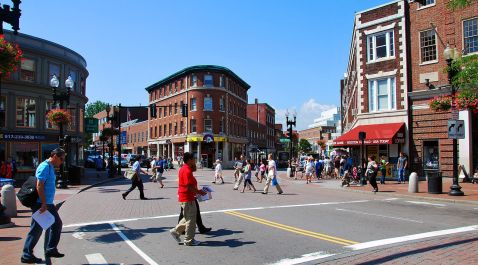
imageI will start at Harvard Square, not really Boston but in neighboring Cambridge. The Square is in the middle of the constantly expanding Harvard Campus and is one of my favorite places – though, as a slew of critics like to point out, it has become less personal and more mall-like over the years. I agree, but still like it.

  • Before bookstores go the way of video rentals: Take a deep dive into The Harvard COOP Bookstore (the large and “official” university bookstore) or the Harvard Bookstore (my favorite, an independent bookstore with great selection, competent staff and a great used book basement) Spend time browsing (nobody will bother you) and wearing down your credit card.
  • Amble around the Harvard Yard, and, if you want to see what an unlimited lawn care budget can do, the Harvard Business School.
  • Have a burger at Mr. Bartley’s Gourmet Burger Cottage (right next to the Harvard Bookstore.) No alcohol, but great lemonade, crispy onion rings and a huge selection of excellent burgers. Cash only, noise level can be high. If you are alone, ask for a seat in front of the kitchen – great entertainment! Have a frappe for dessert, if you can manage.
  • Buy Harvard paraphernalia for the kids and people back home at the COOP (cheap and good by Norwegian standards)
  • Have a coffee at Peet’s Coffee (worn locales but good coffee) at Brattle Square. This is the place to bring your newly purchased stacks of books and dig into them without feeling awkward.
  • GlassIris.jpgVisit the “glass flowers” at the Harvard Museum of Natural History and spend an hour or more at the Harvard Fogg Art museum (one of my Norwegian colleagues, an art buff, characterized it as “small and selective, just great for a relatively short visit.”)
  • Bring a bunch of friends and have a Tex-Mex dinner with much shouting and joking at the Border Cafe (which, unfortunately, have stopped serving John Steinbeck’s favorite Bohemia beer). The bar here is also good, try a Marguerita as an aperitif. No reservations, expect some wait.

You can take the T (i.e, tube or underground) to MIT/Kendall Square, where you can

  • Stata Center, MIT(nerd alert!) visit the MIT Press bookstore (not to be confused with MIT’s branch of the COOP, which is on the other side of the street.) MIT Press Bookstore is tiny and on the right side of the street when you look towards Boston, at Kendall Square. (Not that the MIT Coop is bad, that’s where you get your MIT souvenirs).
  • Take a tour of MIT (in my opinion, MIT’s tours are better than Harvard’s) – they are free and start at 11am and 3pm every day. MIT has lots of history, the tour includes strobe light demonstrations and many tales of student hacks. The architecture is also interesting – pictured is the Stata Center.

In Boston proper, you could

  • Start at the Mass General T stop and amble along Charles Street, with interesting stores and nice little coffee houses. Eventually, you will get to the Boston Public Garden, where you can admire the duckling sculptures and, in the summer, take a ride on a Swan boat. At the other end of the park you will find …
  • Newbury Street, Boston’s place for upscale shopping and showing off. Brand stores, of course, but on a Saturday this is where you see the beautiful people (many of them rich Eurotrash students from BU) ritzing down the street. Have a drink at Joe’s Bar (a chain restaurant, but the location is great.) If you want to do more shopping, swing south to Copley Place. If not, continue the amble down to the end of Newbury street and have a beer at The Other Side, a really great brewpub/café.
  • Visit the Museum of Fine Arts and The Isabella Stewart Gardner Museum
  • Stay away from Cheers, a bar that from the outside looks like the TV series. There are plenty of nice bars (especially Irish-looking pubs) down around Quincy Market – but be warned, this place is the 7th most visited tourist attraction in the USA and prices and milieu reflect it.
  • Have dinner in North End, the Italian district. Lots of good restaurants along Hannover Street and in the side streets. (My favorite is Gennaro’s at North Square). Cannoli for dessert is obligatory!
  • Have seafood at the Union Oyster House, USA’s second oldest continuously operating restaurant. It is regarded as a bit of a tourist trap by the locals, but it has been a huge hit with anyone from abroad I have taken there.
  • If you can get tickets, Boston has good teams in the four main US sports: Basket (Celtics), baseball (Red Sox at legendary Fenway Park), football (New England Patriots) and ice hockey (Boston Bruins).
  • In the Fall or Spring, take a walk in the Arnold Arboretum.
  • If you can get someone to lend you a bicycle, bike up and down the Charles River, past MIT, Harvard and Boston University.
  • Walk around and explore – Boston is a city of culture, with interesting stores and restaurants. A car is not necessary. It is very safe – there are a few dodgy areas, but they are out of the tourists’ way, for the most part.

Outside Boston (mostly requires a car, easily rented):Pilgrim Monument, Provincetown

  • Go to Newburyport and Plum Island. Eat seafood from one of the food joints.
  • Visit Concord, have lunch at the Concord Inn and take a walk around Walden Pond (Where Thoreau wrote his book). Or rent a canoe at the South Bridge Boathouse and go for a paddle on the Concord River (fantastic in the Fall, with colors you can only see in New England.)
  • Go to Marblehead for an ice cream, a stroll along the harbor, and some seafood.
  • If you have a short weekend or a long day, drive (or take the fast ferry) to Cape Cod, visit Provincetown (“P-town”, if you want to sound local) at the tip of the peninsula. P-town is also the gay capital of eastern US, and sitting at a cafe and watching all the gay couples walking up and down the main street on a Sunday can be quite entertaining – hetero middle-aged couples sometimes dress alike, but gay middle-aged couples take it to a new level. And the tower (pictured) is actually quite fun to climb.
  • If shopping is your thing, drive to Wrentham Village outlet mall– designer clothing, shoes and sports equipment at very low prices, 45 minutes from Boston. My trick is to position myself in the bar at Ruby Tuesday after I am done (they have big screens with sports) and take the job at keeper of the goods the family/entourage bring in.
  • If you have an oval weekend: Go to Marthas Vineyard or Nantucket. Needs a bit of planning, and can be expensive in the tourist season. But great.
  • If you want to shop sports/camping/fishing equipment, it might be worth it to drive to the L.L.Bean store in Freeport, Maine, which is open 24 hours – it has actually been open continually since 1951, except for two Sundays. L.L.Bean has a store in Burlington, just north of Boston, but it is rather small and not well stocked, in my opinion.

IMAG0492Lastly, my favorite way to end my stay in Boston [NOTE: Legal is no longer available in Terminal C! Your best bet it probably to eat somewhere outside the airport.]:

  • Most flights to Europe leave in the afternoon or evening. Check in three hours before the flight leaves (hence, no lines). Check-in is in terminal E, the international terminal. Then go to terminal C (long walk through corridors) and have a great seafood dinner at Legal Seafood, the best seafood chain restaurant in the USA. I recommend the lobster bake (a full lobster dinner with clams, chowder, chorizo) – but the signature dish is really the clam chowder (pronounced “chowdah”) which is great as an appetizer.

There are, of course, lots of other things to do and see, but these are some of the things I particularly like. I have deliberately not mentioned the most common tourist things (such as the Freedom Trail, the Constitution, etc.), mostly because, well, I’d rather do the things mentioned here.

Have a great trip!

Seriously cool robot

These two robots, developed by Boston Dynamics, are Youtooobing:

I can imagine this one (called the Sand Flea) being used by the military and police for sending in cameras and other spy equipment in an urban landscape. The Big Dog (below) is something I really could use when I am gardening – a container on its back, and a voice interface so I could tell it to go empty itself in the compost bin when it is full of garden refuse.

The dangerously bloodless war

War is not what it used to be. Both the implicit trends and explicit strategy has gone from large-army movements – the invasion of Iraq may be the last large-scale invasion we will see for quite a while – to smaller-unit conflict management and “surgical” actions, such as the raid on Osama bin Laden. This is partially a result of technological evolution (advanced weapons demand much training, making conscripted soldiers, who become civilians just as they have learned how to operate them), partially a change in warfare – more and more conflicts are asymmetric, with urban or rural guerillas facing a traditional military force, hiding among the civilians and forcing the regular army to either be ruthless or to win hearts and minds.

In both cases, war is expensive for the decision-makers. Today’s young men do not have four brothers and face a career of back-breaking work on the family farm or in a factory or mine – prospects that might make a military career, however the peril, look interesting. With less than two children per woman being the average in European countries, parents (and to a certain extent society, through education) have way to much invested in each individual to squander them on unnecessary and unimportant actions.

This might change: New weapons such as remote-controlled and even automatic drones with pilots sitting halfway around the world, out of harms way, means that the price for war (both in money and lives, of soldiers as well as innocent bystanders) has been significantly reduced. So far, this form of remote warfare has been an American forte, but the weapons are becoming available for smaller countries, first in NATO, then in other countries. I predict that Norway, for one, will scale back its very expensive and politically complicated purchase of advanced, manned F-35 fighters and instead see if more of their needs can be met with the cheaper drones – a disruptive innovation in more than one sense.

This evolution is slightly worrying, for a number of reasons: First, the lower cost of war may make military solutions more tempting to politicians – bloodless or not. Second (and in the longer term more scary) automated weapons can, like all automatic systems, malfunction in unpredictable ways and you can even envision them turning against you, as has happened with anti-aircraft missiles. You really don’t want rogue drones with malicious intent out there, whether it is inserted by hackers or come about through unintended systems interactions. Third, the low price and standard components of the weapon systems may mean that they, in time, will be available not just to large nations, but also to the guerillas and terrorists they were invented to confront. Imagine a home-made drone with cheap technology as the new Kalashnikov – solid, simple and able to make up in numbers what it lacks in sophistication.

I don’t know if remote weapons need a solid infrastructure of communications technology, in particular networks (satellites, cellphone networks, wi-fi) or if they can be controlled with direct radio transmission. There is quite a lot of data that needs to go across, in close to real time – but given the falling cost and increasing range of of digital wireless communication, it is not too hard to imagine that these weapons could be cheap, perhaps even built from standard parts by insurgents themselves, both for spying and for weapons delivery.

Small and cheap has a tendency to carry the day, and enemies learn from each other. Let’s just hope that Steven Pinker is right – and avoid thinking too much on the suppressive possibilities of autonomous weapon systems.

Original and cover–complementary, not competitive

This is the original version of Gotye’s Somebody That I Used to Know:

The video is elegant, sexy and interesting. How to improve it? Well, here is a cover version by a homegrown little band called Walk off the Earth:

I actually like this version of the song better – even without the video. But they are both great. And there you have it – the beauty of art, evolving where people take what others have done and put their own spin on it. Brilliant.

Incidentally, the reason I found these videos is entirely due to my youngest daughter. Just so you don’t think I have the first idea about music. Or anything else.

Computing’s cathedral history

Turing's Cathedral: The Origins of the Digital UniverseTuring’s Cathedral: The Origins of the Digital Universe by George Dyson
My rating: 5 of 5 stars

This is a tour de force history of the birth of the modern computer – and, specifically, the role of Princeton’s Institute of Advanced Study in it. Their “IAS machine” was a widely copied design, forming the basis for many research computers and IBM’s early 701 model.We hear of John von Neumann (who tragically died of cancer at 53), Alan Turing (stripped of his security clearing and probably driven to suicide at 41), Stan Ulam, and many others, some famous, some (quite undeservedly) less so. I continue to be amazed at how far ahead some of the thinkers were – Alan Turing discussed multiprocessor and evolutionary approaches to artificial intelligence in 1946, for example.

On a side note, I was pleased to see that a number of Norwegian academics, mostly within meteorology, played an important part in the development and use of the IAS computer. Nils Aall Baricelli, an Italian-Norwegian, was someone I previously had not heard of, one of those thinkers who is way ahead of his time and (perhaps because he was independently wealthy and led a somewhat nomadic academic existence, hence may have been considered something of a dilettante, though Dyson certainly don’t see him as such and credits him with the ability to see a possible way from programmed computer to independently learning mechanism (and, perhaps at some point, organism).

The book is a bit uneven – partly standard history, partly relatively deep computer science discussions (some of them certainly over my head), and partly – with no warning – brilliant leaps of extrapolating visioneering into both what computers have meant for us as a species and what they might mean in the future. It also shows some of the power struggles that take place in academics, and the important role IAS played in the development of the hydrogen bomb.

All in all, an excellent history of the early days of computing – a more recent history than many are aware of. As George Dyson says in his Ted lecture (below) in 2003: “If these people hadn’t done it, someone else would have. It was an idea whose time had come.” That may be true, but it takes nothing away from the tremendous achievements of the early pioneers.

View all my reviews

Reflections on teaching case teaching

On Friday and Saturday I had one of the most intense teaching experiences of my life – the Participant-Centered Learning seminar at the Harvard Business School. This two-day seminar, with about 50 students from more than 30 institutions, is an introduction into case teaching – but for the course leaders, it is an exercise in meta-thinking.

When you teach a case, you need monitor processes, in real time, on at least two levels: The case problem itself (and cases can be complicated, you need to know them well); and your own performance as a teacher – are you reaching your teaching objectives, and is the way you lead the discussion furthering them. Practice helps, but like with all things new, leading discussions takes a lot of thinking until it gradually becomes a habit and is done more by in central nervous system that the front cortex.

Teaching about case teaching, on the other hand, introduces many new levels. Not only do you have students who are watching your every step – i.e., how you teach, not to look for airtime opportunities – but the aim of the course it to use case teaching techniques to illustrate the teaching techniques that would deal with the problems outlined in the underlying case. (Adding to that, of course, as any good teacher should monitor him- or herself for ways you can make the teaching better the next time.)

At the end of the course, I felt as if I had just finished a long car drive in a car where the gears and pedals had been switched around, every direction decision and subsequent execution requiring copious amounts of conscious processing. Reputedly, the brain consumes 20-24% of the body’s energy, and I certainly felt that way when I got home, barely able to do anything more than sack out in front of the computer with a glass of good red wine and a few old Top Gear episodes.

That being said, however, the whole experience was also extremely invigorating. The students were interested, energetic, and from admirably diverse backgrounds, from US elite institutions through low-cost regional online educators to universities in China, Turkey and Denmark. It was also interesting to have the full resources of a Harvard case classroom at my disposal – in particular, having ample blackboards (9, as a matter of fact,) old-fashioned but so much better in every way, including sightlines. Having a great room changes how you teach – though I will have learn how to exploit the room better, especially the boards, should there be a next time.

But all in all, a most enjoyable experience. As I have previously written, I think good discussion teaching is a source of differentiation and competitive advantage for both teachers and institutions. I stand by that view, all the more so for my experience this weekend.

Boston perks

IMAG0492One of the joys of living in Boston is the seafood, which is deliciously and not too expensively (at least by Norwegian standards) available lots of places.

This picture is from today’s dinner with the MIT CISR team, shot by my eminent colleague Martin Mocker, and, I think, accurately conveys the splendor of the “lobster bake” and my appreciation of it. A “lobster bake” is a traditional New England lobster dinner with a delicious cup of “clam chowdah” as an appetizer and a plate of littlenecks, clams, chorizo (to give the sweet seafood a little contrast), corn on the cob and, of course, a medium-sized lobster.

Note – Legal is no longer available at terminal C! Your best bet is probably to eat somewhere outside the airport… This picture is from the Legal Seafood in Kendall Square – but the most convenient location for lobster, for me at least, is the Legal Seafood restaurant in terminal C at Logan airport. Since the flights to Europe normally leave at 8-8:30 pm, my preferred way to fly is was to check in early, walk over to Terminal C, and feast on inexpensive seafood and decent local beer or a dry white wine. This frees you from the need to eat airline food and puts you in a calm and collected and rather sleepy frame of mind before taking off.

Highly recommended!

Tips and tricks swap meet

Today I hosted a brown bag lunch with researchers from BI’s Technology Strategy group and MIT CISR. The objective was to get to know each other, but every meeting needs a topic, so I asked people to bring their computers and share a few smart things, useful web sites and other things they have discovered, that people wouldn’t know about.

Here is a list of some of the smart tricks and tools people came up with:

  • If you need to edit a large document in Word, create a table of contents, place it at the beginning of the document – and jump to the right chapter or subsection by control-clicking on the TOC. (Alternatively, use the document map feature, see this blog post.)
  • Pressing . (period) while in presentation mode in Powerpoint will give you a black screen, pressing the same key again gives you the slide back. Useful for making people listen to you rather than read the slide.
  • A tablet computer is useful for presentations: Draw on slides, use Windows Journal to sketch out diagrams and drawings – which you can then PDF and make available to students.
  • This article explains how to get rid of New York Times cookies with a bookmarklet.
  • Google Reader (since discontinued, use Newsblur instead) lets you read RSS feeds quickly and easily.
  • Clearly from Evernote is a great tool for reading webpages – removes unnecessary clutter and lets you save the page to Evernote.
  • Think-Cell is a great tool for creating charts in Powerpoint, faster and simpler and more good-looking than standard Excel.
  • Whenisgood.net is great for finding possible meeting times.
  • The Meeting Planner from timeanddate.com is useful.
  • If this then that lets you automate certain web tasks by monitoring information streams and taking action based on their results.
  • Hipmunk is great for finding flights quickly, has a great graphical display.
  • In Word, under the File/Open or File/Recent menu choice, there are little pushpin symbols that, if pushed, will make sure the document stays visible in the list.
    Very useful for keeping the position of frequently used documents that are stored in SharePoint without having to go through a lengthy access procedure.

The fun thing with a little meeting like this is that everyone comes away with at least one or two things they hadn’t thought about – which is more than you can say for most meetings.

Hawai’ian interlude

The week before last was spent on Hawai’i (Oahu, to be precise), courtesy of an old collection of American Airlines points, that fact that we are in the US and hence already have paid for half the flight, and a week’s break in daughter number three’s high school schedule.

The goal for the trip was simple: New Facebook profile pictures for father and daughter – standing up on a surfboard. To this end, we had signed up for two days of surf classes with Hawaiian Fire, an eminent surf school run by firefighters. Their classes take place on the southeast side of Oahu, at a beach where waves are consistent and the water reasonably shallow – as a novice, you can always jump off the board and stand on the bottom. (In practice, you want to be a little careful, always landing flat in the water, since there are rocks and corals on the bottom.)

To make a short story short, we both made it into vertical – daughter number three rather faster and better than her top-heavy father.

imageimage

And lastly, let it be said that despite, in certain aspects, feeling a bit like Las Vegas (at least the brand-name shopping areas of Waikiki), Hawai’i has a distinct culture, a refreshingly laid-back attitude, fantastic nature (we particularly enjoyed exploring the North Shore and the Tantalus/Round Top drive) and an extremely enjoyable climate. It is only to wonder that not many more people live there…

Thinking long and hard on fast and slow

Thinking, Fast and SlowThinking, Fast and Slow by Daniel Kahneman
My rating: 5 of 5 stars

If you are only going to read one book on psychology this decade – this should be it!

Daniel Kahneman’s new book Thinking Fast and Slow is one of those books you intend to read while taking notes, then just blow through it knowing full well you’ll have to go back and re-read it at least once per year just to swap it all in again. It sums up a lifetime of research into the surprisingly irrational ways we humans make decisions. Kahneman is a founder of experimental economics and received a Nobel price for it.

The book gives an overview of the various ways we make decisions, illustrated with many counterintuitive examples. Its central premise is that humans have two different decision systems: System 1, which is intuitive, fast, and easy, and System 2, which is rational, effortful, and lazy. We can also divide human models into two: Econs (classic Economic Man) and Humans (subject to all of Kahneman’s follies, and then some). And we have two selves: The experiencing self (living in the present) and the remembering self (living in the interpreted past).

Kahneman lays out these concepts, then show, through examples and research summaries, how they interact and influence our decisions. The intellectual stimulation and the practical implications for how we make the important and not so important decisions in our lives are immense – as an example, check this blog post on pricing experiments.

Highly recommended!

(more notes to follow, methinks)

(If you want a really good review – read Freeman Dyson in the New York Review of Books.)

View all my reviews

A case of teaching case teaching

I am rather passionate about case teaching. Not only does it provide a much richer learning experience for the student, especially within fields that involved in analyzing complex human situations, but it much more interesting for me as a teacher to do case discussions t hat it is to lecture. Not that I don’t enjoy lecturing – do it all the time – but after a while you start to feel like a DVD player on repeat, wondering how much the students get out of listening to you in person rather than seeing a video. In the give-and-take of the case classroom, you learn new things all the time, and so do the students. For example, by about the 15th time I taught a short case about outsourcing, a student came up with a solution neither I nor anyone else had thought about until then. And just a few weeks ago, in China, a mathematically inclined student surprised me with a new solution to a rather long-winded example I use to demonstrate certain aspects of telecommunications competition.

I share that passion with my friend and colleague Bill Schiano, and together we have worked for years on how to do case teaching in situations where you do not have the rich infrastructure, streamlined processes and shared culture of the Harvard Business School – including, in a modest way, trying to influence our colleagues to adopt the method, our students to accept it, and the administration and management of our respective schools to create the infrastructure and processes necessary for it.

In a few weeks (March 16-17, to be precise) we will get an opportunity to further spread the good word, by teaching the course The Art and Craft of Participant-Centered Learning, at the Harvard Business School. We will teach it together with Professor Jim Heskett, a true master of case teaching. The course is over two days – and as of today (March 2) there are still a few places available, details to be found here. (Note that the course is only open to teachers at degree-granting institutions.)

I am quite looking forward to the experience. I have taught classes on case teaching before, but not in this environment and to such an eclectic group (about 50 teachers from many universities and countries.) It feels like giving something back to the institution that taught me, but also as a rather enjoyable challenge, and quite an honor.

It is a sad fact in academia today that good teaching is under-rewarded, at least officially. I think this is a stage we are going through – and that good teaching, specifically discussion facilitation, will be much more important as the competitive climate between business schools hardens (as it will). Lectures and factual information can be delivered over the Internet, in the form of videos, animations, or voice-assisted slide shows. As information can be distributed more and more cost-free, the local lecturer stands in danger of being disrupted – rather than listen to some random teacher on a subject, why not see a video of the best in the field.

The complex interaction of the discussion class room can, as of yet, not be done remotely – at least not with the quality and intensity a co-located discussion warrants. Local institutions of learning, to maintain their competitive place and current pricing, will have to master discussion facilitation and participant-centered learning. Students will demand it, not just in business, but in an increasing number of fields – medicine and social services, public leadership and administration, military, political science, to a certain extent engineering and natural sciences. The case method may be the most explicit of form of participant-centered learning, with its tailored cases and specially built classrooms – but I firmly believe this method will spread out as a way for teachers – even the more average of us – to add value in a unique and enjoyable way way.

Bryson across Europe

Neither Here Nor There:: Travels in EuropeNeither Here Nor There:: Travels in Europe by Bill Bryson
My rating: 5 of 5 stars

My first Bill Bryson book, which lead to all the others. Recently reread it on a holiday – it is holding up pretty good, though parts of Europe have moved on a bit in 25 years (the lifting of the Berlin wall and the wars in Yugoslavia have yet to happen, for instance.) Highly recommended when you need to relax and laugh a bit.

Here is a taste of Bryson’s reflective and comical style:

There is this curiously durable myth that the European trains are wonderfully swift and smooth and a dream to travel on. The trains in Europe are in fact often tediously slow and for the most part the railways persist in the antiquated system of dividing the carriages into compartments. I used to think this was rather jolly and friendly, but you soon discover that it is like spending seven hours in a waiting-room waiting for a doctor who never arrives. You are forced into an awkward intimacy with strangers, which I always find unsettling. If you do anything at all – take something from your pocket, stifle a yawn, rummage in your rucksack – everyone looks over to see what you’re up to. There is no scope for privacy and of course there is nothing like being trapped in a train compartment on a long journey to bring all those unassuageable little frailties of the human body crowding to the front of your mind – the withheld fart, the three and a half square yards of boxer short that have somehow become concertinaed between your buttocks, the Kellogg’s cornflake that is teasingly and unaccountably lodged deep in your left nostril. It was the cornflake that I ached to get at. The itch was all-consuming. I longed to thrust a finger so far up my nose that it would look as if I were scratching the top of my head from the inside, but of course I was as powerless to deal with it as a man with no arms.
You even have to watch your thoughts. For no reason I can explain, except perhaps that I was inordinately preoccupied with bodily matters, I began to think of a sub-editor I used to work with on the business section of The Times. I shall call him Edward, since that was his name. Edward was crazy as fuck, which in those palmy pre-Murdoch days was no impediment to employment, or even promotion to higher office, on the paper, and he had a number of striking peculiarities, but the one I particularly remember was that late at night, after the New York market had shut and there was nothing much to do, he would straighten out half a dozen paper clips and probe his ears with them. And I don’t mean delicate little scratchings. He would really jam those paper clips home and then twirl them between two fingers, as if tuning in a radio station. It looked excruciating, but Edward seemed to derive immense satisfaction from it. Sometimes his eyes would roll up into his head and he would make ecstatic little gurgling noises. I suppose he thought no one was watching, but we all sat there fascinated. Once, during a particularly intensive session, when the paper clip went deeper and deeper and looked as if it might be stuck, John Price, the chief sub-editor, called out, “Would it help, Edward, if one of us pulled from the other side?”
I thought of this as we went tracketa-tracketa across the endless Austrian countryside and I laughed out loud – a sudden lunatic guffaw that startled me as much as my three companions. I covered my mouth with my hand, but more laughter – embarrassed, helpless – came leaking out. The other passengers looked at me as if I had just been sick down my shirt. It was only by staring out of the window and concentrating very hard for twenty minutes that I was able to compose myself and return once again to the more serious torments of the cornflake in my nostril.

View all my reviews

A value chain at work

This old footage (via egmCartTech) of the 1936 production process at Chevrolet’s plant in Flint, Michigan, shows a value chain at work – i.e., a process where value is added in small, repeatable, sequential steps. This is how many people still see companies…

It is notable for many things – the relative imprecision of the production (dents in parts being marked for later fixes), the simple design of the cars (two-box design built on a frame, soon to be overtaken by the monocoque design already introduced with Chryslers’ 1934 Airflow), and the notion of the human as the servant of the machine, doing simple things repetitively and to be attempted replaced by robots in the 70s and 80s as production became increasingly componentized. Toyota eventually introduced the Kan-Ban principle, where each worker is responsible for the quality control of previous work and can stop the process. But no wonder GM had quality problem as designs got more complex…