Author Archives: Espen

Unknown's avatar

About Espen

For details, see www.espen.com.

Collaborative online writing–some personal experience notes

I am currently spending a lot of my time in a collaborative writing project with my friend and colleague Bill Schiano – the details are not important at this point, but it is a book-length, somewhat complicated piece of text, and involves an editor. Bill is in Boston and I am in Oslo, usually a six-hour time difference. A relatively short deadline has necessitated finding a way to work together which is faster than the time-honored method of e-mailing drafts back and forth. Shouldn’t be hard in this day and age, with cloud-based software and 60-megabit Internet connections, right?

Well, it is. We started out with Google Docs, which is great for quickly setting up shared documents fast and handles multiple concurrent editors (you can actually see the other person writing almost in real time.) However, it turns out it lacks some of the nicer interface details of good old Word, such as comments in bubbles and a lot of the keyboard shortcuts. It also quickly gets very unwieldy as the document gets longer.

We then tried out Scrivener, an authoring (as opposed to word processing) tool which recently has become available for Windows and is touted as the best thing since sliced bread by a number of authors. We found it to be fantastic for authoring – if you are a single author. For two or more people working together (over a DropBox-shared directory) it lacks the version tracking and commenting features, meaning that we would have to be very disciplined about who wrote what where and have lots of supporting documents a la “Unifinished issues”. After a few screw-ups, we decided to try something else.

We then came up a with solution that really works, which we have been using for a few months now and gives us nearly everything we want: The venerable and much-maligned Microsoft Word. The difference is that the document we work with (which currently stands at 157 pages, nearly 63000 words, just over a megabyte storage) is stored on Microsoft OneDrive, and we can both edit it using Word on our computers. I will leave the actual setup of this as an exercise for the reader, but the short version is that you set up a OneDrive account at onedrive.live.com, open a new document in Word (must be at least the 2010 version) and save it to OneDrive. You then share by sending a link to your co-author, who opens the link and can then choose to edit it online (i.e., through a browser) or in Word on his or her own machine.

This gives us the best of both worlds. We can edit the document on our own machines, see the changes the other has made and accept them, write comments in the text that the other person can respond to. We do Skype meetings (with Skype Premium, so we can share screens) about twice per week to discuss things we cannot fix simply by shared editing, and the whole thing is progressing quite nicely.

As usual when you start using an old tool for something new, you learn a few tricks you hadn’t thought about – the best way to learn new tricks is always to watch someone else using the software: I learned that you can control-click on an item in the TOC to go directly to it by seeing Bill do it, and he learned that you can grab selected text pieces and drag them to new places (without doing Ctrl-x Ctrl-v.) That’s why I think every group working together should have an occasional “Tips and tricks swap meet.”

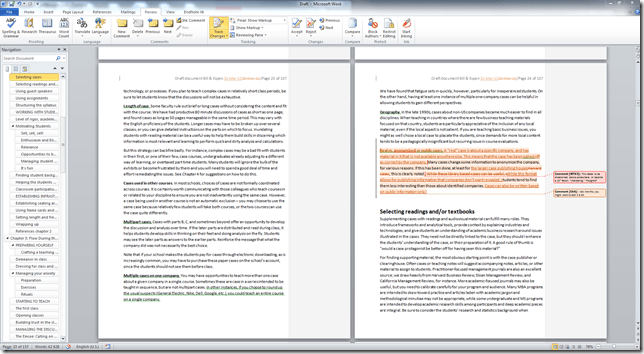
We have found that working with a large (at least 27”) screen as your primary tool is immensely useful. That allows a full-page view with two full pages and a navigation pane, like this:
image

If you are disciplined about heading styles (i.e., chapter headings being “Heading 1” etc.,) then the navigation pane works more or less like the outline or slide sorter in PowerPoint, allowing you to drag and drop chapters and sub-chapters around and promote or demote them, which is extremely useful when your work approach is to bung in a lot of text in sub-chapters and then sort out the structure later. (Word is a bit irritating in its use of styles, though – it should be easier to enforce a standard style set, unchanged when text is clipped in from other sources.)

Another useful trick is to go to the File>Recent screen, locate the shared draft, and press the little push-pin to the left of it. This places the document permanently at the top of your Recent files list – making it very easy to open without having to go to OneDrive etc. (Note 2014-01-9: This seems to only work on the Windows version of Office, not on the Mac. Another reason to get Parallels.)

When working together like this, you also need to come up with a shared notation for work – how to you mark some text as tentative, for instance. The standard comment and track changes settings are OK (but change the standard for Track Changes so it does not track changes in formatting) but you need more than that. We have defaulted to marking spurious text with {curly brackets} and reference points with “zzzz”. (I have heard other writers, such as Cory Doctorow, use “tk” because that particular letter combination does not appear often in the English language, unless you write about the Atkins diet.) The idea is that even with a large document, you can search through it until you have fixed all issues, i.e., gotten rid of all the curlies and zzzz’s.

There are, of course, a few issues you need to deal with. That a document is shared does not mean it is backed up, so we both do local, dated backups every now and then, just to stay on the safe side. The more users are editing the document, the slower it updates, so we try to be disciplined about a) saving often, and b) exiting the document when we are not editing it. If not (as Bill found when Espen had done a lot of small edits and then, in Norway, gone off to bed while leaving the unsaved document on his workstation,) the edited paragraphs become inaccessible to the other author. So, save and exit whenever you can.

And that’s it so far – just sharing experiences here, but this approach really works. Our next challenge is bringing our editor on board – so far we have been sending him chapters as they have become ready. I am now going to set this up for collaboratively writing with a couple of other colleagues, on shorter pieces, and we’ll see how that goes.

Keep you posted – and tips and tricks are appreciated!

Update 2014/4/30: SkyDrive has become OneDrive, so I have adjusted for that.
UPdate 2016/7/18: You can now open a document in Word using Google Chrome.

A day in the life of a Computer Expert

(Julie linked to this article, which made me remember that I actually wrote something similar in 1989 or thereabouts, when I was running user support for the Norwegian Business School)

Report from the trenches: Scenes from the life of a computer expert

The onslaught of user-friendly personal computers, where the user points and clicks his or her way to computational satisfaction, is hailed by many as the beginning to the end of the in-house computer expert (also known as the Local Guru). As this field report will show, there is no reason to look at the classifieds yet. Relax, guys.

The dominant source of computer problems is finger trouble. Finger trouble is the term computer experts (loosely defined as anyone who knows the approximate location of the power switch) have coined for problems inexperienced users get themselves into by way of the keyboard. While this source of job security and discretionary income may be reduced due to graphical user interfaces, there are still plenty of hardware errors to keep us occupied. Hardware errors are part of the everyday life of all computer experts, and show no sign of abating.

Let us examine a typical case, in order to gain an appreciation of the current state of things: The setting is a medium-sized company with high ambitions, a ubiquity of PCs and a Computer Expert (hereafter called E.). E. is sitting in his office, consumed with the difficulty of reaching level 42 in the 486 version of the “The Hitch-Hikers Guide to the Galaxy” when the telephone rings. Having recently cleared his office, E. manages to find the telephone before the caller gives up. The voice in the other end informs him, with audible consternation, how that darned printer, again, won’t do what it’s supposed to. Can E., with his long-standing reputation as a technical wizard, do something about it? The Voice (hereafter dubbed V.) assures E. that the matter isn’t pressing – but if he has the time…. (Somehow V. manages to convey a message of great need, sort of “you just take your time, we don’t mind sitting here rolling our thumbs and wasting the company’s money etc.”). E., when airing a suspicion that the equipment in question probably isn’t switched on, is informed by V. (with audible consternation) that they have in fact been using computers for several years now etc.

The setting 10 minutes later: E. arrives in the manner and style of a 20th century doctor making a house call on a farm far away from civilization (or like a veterinarian in Yorkshire). From every nook and cranny the office personnel come running to witness an Expert’s modus operandi (please bear with me if I’m carried away a bit here). E. eyes the printer and sees that the cable between it and the PC is present – and that the switch, indeed, is turned to ON. Still, the thing is as dead as a post- Format C: hard disk.

With a supreme air of confidence E. grasps the power cord and begins to pull. A veritable birds’ nest of cables appears (the premises were constructed long before information technology made its cheerful appearance in organizational life). Dangling inside the cable web is a power plug, its prongs conspicuously devoid of physical contact with anything electric. E., with an air of quiet achievement, lifts it high in the air for examination in a gesture reminiscent of a surgeon in a 1950’s war movie (the scene where the bullet has just been removed from the young soldier’s chest).

The reaction of V. and colleagues at this point depends on a number of variables, chief among them their rank in the organizational hierarchy. The range of reactions varies from “how could I be so stupid (again)” to “who the hell loosened that plug”. Suddenly the preferred topic of conversation is anything but office automation – frantic discussion of the quality of the local cafeteria coffee ensues, accompanied with a noticeable rise in body temperature above the 6th vertebrae.

E.’s reaction depends mainly on the tone of the initial telephone conversation, the distance covered in order to reach the culprit, and what he could have done instead. (The number of times this has happened before might also have some effect, but as V. normally has a choice between several E.s it is not likely that the scene will repeat itself with the same E. very often.).

If E. is a really experienced technical wizard, he will refrain from sarcastic comments, quietly lay down the power plug, and disappear into the sunset. The lonely hero has done it again. He has for the nth time shown who is the boss – who is in command of this omnipresent technology, incomprehensible to mere mortals.

But he knows this cannot last. There will come a day when the users will check for loose power plugs – a day when no carefully choreographed searches beneath desks will be enough to sustain his reputation as a technological superhero.

That will be the day he will have to learn how to change printer paper.

Crowdfunding ME research!

image_thumbME – officially called ME/CFS, often called chronic fatigue syndrome – is a horrible disease: It doesn’t kill you, but it takes your life away. Unfortunately, the causes and symptoms are so vague that both treatment and research is not prioritized, many doctors have unsubstantiated opinions about the illness (“we don’t know what it is, so it is probably psychological”,) and the ME patients cannot themselves fight for their rights, since they are so deadly tired. As a father of a daughter with ME I have many times been distraught by how little is done, and the degree to which the patient (and sometimes the relatives) are treated with indifference and suspicion in a health system that does not know how to nor has any interest in dealing with them.

But things are moving slowly for the better. There are more and more indications that this, at least for a large percent of the sufferers, is an autoimmune disease. Ola Didrik Saugstad, Norway’s most cited pediatrician, says that in a few years, ME will be like stomach ulcers – initially seen as the patient’s fault (too much stress and/or spicy food,) until two physicians, Robin Warren and Barry J. Marshall, showed that it was a bacterial colonization that could be treated with medicines.

Two doctors at the cancer ward of Haukeland research hospital in Bergen has had very interesting results in treating ME patients with Rituximab, a medicine used against certain cancer types, such as leukemia. They now need to do a study of 140 patients. This is, as far as I know, the first real, bona fide research projects on using medicines to fight ME – the medicine is there, the initial results are very promising, and what is needed is a proper double-blind test with enough subjects. Unfortunately, the medicine is expensive, and for inexplicable reasons, this study was not prioritized by the Norwegian Research Board, even though it was deemed very worthy application.

Maria Gjerpe (www.mariasmetode.no), a physician suffering from ME herself, has taken the initiative to crowdfund this project. 7 million NOK ($1.2m) is needed, and you can donate from their home page (via PayPal or bank transfer.)

You can see a video (Norwegian, subtitles) below: Maria explains some of the background, and there are contributions by Ola Didrik Saugstad, MP Erna Solberg (probably Norway’s next Prime Minister) and MP Laila Dåvøy:

ME/CFS has for too long been a disease where quacks of all kinds have been allowed to prey on patients with nowhere else to go. Rituximab and other medicines can be the solution for at least some patients with this disease. Donate today – this is both solid medical research and, if we can get some patients back to a productive life, a very worthwhile investment!

Forrest Gump from Sweden

The 100-Year-Old Man Who Climbed Out the Window and DisappearedThe 100-Year-Old Man Who Climbed Out the Window and Disappeared by Jonas Jonasson
My rating: 4 of 5 stars

This is a Swedish Forrest Gump story, and like the movie, it is great fun, though you can’t really put your finger on why.

Allan Karlsson absconds from the nursing home in his slippers a few hours before his 100-year birthday is to be celebrated. Within minutes, he is on the run with a suitcase full of money, chased by gangsters and acquiring a motley assortment of friends (including an elephant) as he goes. Interspersed with this are chapters detailing his life as a global, slack-jawed globetrotter, forever stumbling in on historical figures at opportune moments.

Great fun – and some of the Swedishness of the very understated humor makes it through the translation as well.

View all my reviews

MIT CISR Research Briefing on Enterprise Search

imageLast year I had the pleasure of spending time as a visiting scholar at MIT Center for Information Systems Research, and here is one of the results, now available from CISR’s website (free, but you have to register. Absolutely worth it, lots of great material):

Research Briefing: Making Enterprise Search Work: From Simple Search Box to Big Data Navigation; Andersen; Nov 15, 2012

Most executives believe that their companies would perform better if “we only knew what we knew.” One path to such an objective is enhanced enterprise search. In this month’s briefing, “Making Enterprise Search Work: From Simple Search Box to Big Data Navigation,” Visiting Scholar Espen Andersen highlights findings from his research on enterprise search. He notes that enterprise search plays a different role from general web or site-specific searches and it comes with its own unique set of challenges – most notably privacy. But companies trying to capitalize on their knowledge will invariably find search an essential tool. Espen offers practical advice on how to develop a more powerful search capability in your firm.

Finding Nemo, unsurprisingly, again

(Intially posted as a comment to Dave Weinberger’s blog, but expanded/edited into a bona fide rant here. Update, Feb. 13: Dave continues the discussion in his column at CNN.com.)

New England has just had a snowstorm, predicted to be of historic proportions, but eventually ending up, as always, as nothing much, except a staggeringly incompetent number of people (400,000 or so in Massachusetts alone) losing power. As a Norwegian currently in Oslo (but with nine winters in Boston (Arlington and Brookline)): New England snowstorms, despite their ferocity, are not aberrations of nature but a failure to prepare a systemic level.

It is just snow. Not a lot (well, a lot, but for a short time, as illustrated by the photo.) It shows up fast, and leaves again equally fast. It doesn’t stay the whole winter, from November until March, as it does here in the south (get it – south!) of Norway.

The fact that New England panics every time there is a flurry is due to lack of preparedness at the infrastructure level. In most of Norway power and telephone lines are underground, it is illegal not to have snow tires on your car after December 1st or thereabouts (if you drive in the snow with regular tires and go in the ditch, you are fined quite severely) and during my own and my children’s school days we have never had a snow day or any other interruption due to the weather (and we have plenty of weather). In Norway you cannot get a driver’s license without passing a driving-on-slick-surface course. The Oslo subway (or buses – what kind of drivers to you have?) has never been closed due to snow. I have never been to the store to stock up on batteries and water. (I have been to the gas station to buy gas for the snow blower ahead of a storm, though.) Our airport does not close down for snow, though there can be delays. In New England, there are public service announcements (from Thomas Menino’s office) saying “When clearing motor vehicles, remove snow around the muffler/exhaust system before starting the car”. How stupid can you get?

I just can’t get used to the New England oh-my-God-here-it-comes-again-flip-to-channel-5 attitude. I attribute this to lack of far-sightedness in planning – rather than taking the cost of modernizing the power grid and change the telephone lines to fiber all around, incrementalism wins. (Then again, I have found myself being the only driver (in a VW Vanagon with worn tires) on the 128, and the only person coming in  to work (in a Chevy Caprice).) Instead of driving responsibly you salt the roads until they are white and dogs can’t go out due to the pain the salt inflicts on their paws. Instead of having a public works division outfitted to fix things with proper equipment you resort to an army of contractors with F-250s barging out to power-plow 2 inches of wet snow that will disappear at 9am the next day anyway, just to get paid.

imageI drove (with wife and three kids) from Florida to MA during the blizzard of 96, which closed down NY and NJ. In Georgia, we saw 200 cars in the ditch, including an 18-wheeler cab-up in a tree. It looked like an 8-year old had emptied out his toy car crate. On an Interstate in North Carolina I saw a police cruiser (who had tried to cross from one direction to the other via those little police-only paths) nosed into and completely buried a six-foot pile, the blue lights forlornly spinning through the snow. Driving around Richmond, I saw people pass me doing 75 in their Cherokees on the highway, only to see them buried in a drift two miles later. In Washington (Metro population 5.6m, number of snowplows: 1) I drove around (in a Dodge Caravan with a not very advanced AWD system) a Chevy Suburban spinning on all four wheels as the owner moronically pumped the gas pedal. (Incidentally, the only institution open was the Norwegian embassy, whose employees arrived on cross-country skis.) When we got to the NJ border, we were stopped, as the turnpike was closed. I stupidly tried to argue with the cop that I was Norwegian, had 4WD, and was a former instructor in 4WD driving in the Norwegian army, that driving in the snow was easy if you went slowly and gently. He was, needless to say, not swayed. We spent the night in a motel.

Why doesn’t New England harden the grid and communications systems, put winter tires on school buses, mandate winter tires in snowy conditions, and just get rid of this stupid idea of snow days? It is winter, it happens almost every year. It is just something to get used to, minimize the consequences of and then get on with a productive life.

On the other hand, most Americans work way too much, so perhaps it is just nature’s way of giving you a much-needed break. In the meantime, you are providing quite the entertainment at Norwegian TV, for which I suppose I should be thankful.

(Images from TriStateWeather)

Update Feb. 13: Somewhat related, here is an infographic (from Curtis Whaley via Boingboing) on how to walk on ice. Put on your tailcoats and waddle away…:

The political process of getting innovation done

Innovation is often about politics. Together with my excellent colleague Ragnvald Sannes I run a course called Strategic Business Development and Innovation (it is done in Norwegian, but if you are interested, we would be glad to export the concept, in English), where we take groups of students through an innovation process (with their own, very real, projects) over two semesters. The course is done in cooperation with Accenture’s Technology Lab in Sophia Antipolis and is one of the most enjoyable things I do as a teacher.

Anyway. This note is to discuss something which came up in a web conference today – the political side of doing innovation. Many of the students we have come from public organizations, from the health care industry, or from educational or research-based institutions. In all of them (well, actually, in all organizations, but more so in those where profit is not the yardstick that trumps everything) politics are important, to the point where a project’s success depends on it. Since a number of our students also are engineers and/or IT people, with a very straightforward and rationalistic view of how things should be done (if the solution is better than the current one, well, then why don’t we adopt it?), I need to explain the nature of political processes in organizations.

I am not an expert in that particular field, but I have been involved in a few projects where politics have been important – and have found the work of March, Cohen and Olsen very useful – not just as theory, but also as a very practical checklist. These three professors are famous for the Garbage Can Model, explained in the classic article Cohen, M. D., J. G. March and J. P. Olsen (1972). “A Garbage Can Model of Organizational Choice.” Administrative Science Quarterly 17(1). This article (which can be found here) is cited more than 6000 times and makes a lot of sense to me, but the it is not easy to understand (and that is not just because the specification of the model is in Fortran source code.) It posits that politically oriented organizations (they studied universities in particular, which for most purposes are anarchies) makes decisions by constructing “garbage cans” (one for each decision) and that the garbage can is a meeting point for choices, problems, solutions, and decision makers (participants), heavily dependent on energy. Decisions seek decision makers, solutions seek problems, and vice versa. Getting things done in such an environment means constructing these garbage cans and filling them with the right combination of problems, solutions, choices and participants.

This sounds rather theoretical, and is. Fortunately, March and Olsen wrote an (in my opinion) excellent book (Cohen, M. D. and J. G. March (1986). Leadership and Ambiguity: The American College President. Boston, MA, Harvard Business School Press.) a few years later, with less theory and more application. Based on interviews with a number of university presidents as well as their garbage can model, they discuss the nature of getting things done in a university environment, where there is ambiguity of purpose, power, experience and success. They finish with a list of eight basic tactics for getting things done – probably at the instigation of Harvard Business School Press, which primarily caters to business people and want applicability, not just description.

I have found this list tremendously useful when trying to get decisions made – and have observed others doing this both very well and very badly. Here it is, with their points in boldface and my (probably imperfect, it is a few years since I read this) interpretation appended:

  1. Spend time. Getting things done will take time – you need to talk to people, create language, make people see your point. If you are not willing to spend that time, you might make some decisions, but people will not follow them. Decision making is social, so decision makers in these environments need to be. The winners in political organizations are often those with the most time – which is why many universities are dominated by the administration rather than the faculty, who have other calls for their time and do not come in to the office every day. (See this cartoon for an excellent description).
  2. Persist. One of the most frustrating things (I have seen this when businessmen come in to lead political organizations, several times) in a political setting is the decisions seldom seem to really be taken – there might be a decision, but every time it comes up, it get revisited. In other words, a decision made can always be raised again – so never give up, you can always get the organization to reconsider, either the same decision directly or the same decision dressed up in new language.
  3. Exchange status for substance. As someone said at some point, it is amazing what you can get done if you are prepared to forgo recognition for it. There are many leaders who want to look good and make decisions, but don’t have the knowledge or energy to do so. Make decisions easy for them – you can get a lot done if you make decision-makers look good in the process.
  4. Facilitate opposition participation. Rather than trying to overpower the opposition, find ways for them to participate in the new way of doing things. This is one of the reason why processes and fields frequently get renamed – to allow groups to continue doing what they are doing or want to do, but in new contexts.
  5. Overload the system (to change decision making style). Decision-making time expands to fill the entire time available (alternatively, a normal meeting is over when everything is said, an academic meeting is over when everything has been said by everyone.) By giving the system lots of decisions to make (i.e., many ), this style changes – and you can get your decision through because nobody has enough time or energy to give it the full treatment.
  6. Provide garbage cans. Provide arenas for discussion as distractions, to consume energy from decision-makers.
  7. Manage unobtrusively. You can get things changed by changing small things, and in succession. I have seen examples where you get a strategic goal set up that everyone can agree to but few define (“make us a more knowledge-based organization”), get resources allocated to it, and then propose lots of projects under this heading – which now is about fulfillment of a strategy (albeit redefined) rather than an entirely new strategic direction.
  8. Interpret history. Volunteer to write meeting minutes, and distribute them late enough that most participants have forgotten the details. History, traditionally, is written by the winners (except, perhaps, for the Spanish Civil War,) but you can make it the other way around – that you become the winner by writing history.

Understanding politics is very much about recognizing these tactics and using them. It may seem Machiavellian, but then Machiavelli was one of the first political theorists and knew what he was talking about.

Testing blogging from iPhone 5

This post is written using my little Think Outside keyboard and my iPhone 5, via the WordPress app. The app is not very good (it lacks the immediacy of Windows LIve Writer, as well as the WYSIWYG interface). I wanted to buy the BlogPress app, which apparently offers a better experience, including better picture and video integration, but apparently Apple thinks I am in the US and will not let me enter a Norwegian credit card. Just when you thought the world was going global…then it is not (and yes, I have a slight keyboard issue here as well, working on it.)

Anyway, seems this works. Barely. If only there was a blogging extension to Evernote….

Think outside the iPhone

I recently got myself an iPhone 5 – despite researching technology, I am rather slow in adopting it. One advantage of never throwing old technology away, however, is that accessories sometimes work – and I just discovered that my old Think Outside bluetooth keyboard works, originally intended for my Palm Pilot V, may it rest in peace, work rather nicely with the iPhone. (Here’s how to do it, in case you’ve got one lying around.)

Meaning that, once again, I can go to meeting carrying stuff only in my suit pockets and still be able to take notes using all ten fingers. Now, all Apple needs to do is to lengthen the battery time on the iPhone to match the Palm Pilot, and we will have gotten past the “Concorde moment”* that was the Palm Pilot…

*A situation where technology regresses – the Palm V had lots of functionality that has since disappeared, like week-long battery time and the Graffiti sign-recognition software. First uttered by James May on Top Gear.

Peter G. Neumann in New York Times

Peter G. Neumann is one of my heroes – a computer science and security expert with a sense of humor (his dry comments on the Risks Digest are legendary), inventive solutions to problems (he once built a keyboard with two pedals (for “alt” and “ctrl”) to deal with carpal tunnel syndrome) and far-reaching views on most things. He is currently profiled in New York Times, including the story of the RTM Worm, which I remember clearly, and where the RISKS Forum played a role in analyzing and stopping it.

I remember an email exchange with Peter in the mid-nineties, when I was writing a research report on knowledge management for CSC Research Services. Peter has been running the email list RISKS forever (I signed up for it sometime in 1985) and when asked about how to find people to do such a job in a corporate setting he replied:

The bottom line is that moderating a newsgroup wisely takes serious dedication to, familiarity with, and commitment to the subject matter and willingness to put oneself into an intrinsically sensitive position. It does not work well if someone is arbitrarily assigned to the task.

In other words – if you want social media to work in a company, let people loose and then support the leaders that emerge, rather than try to replicate the current organization in the new medium. Not a bad insight to have 15 years ago – before this social media thing started.

Not quite the game I hoped for

Playing the GamePlaying the Game by Alan Lelchuk
My rating: 2 of 5 stars

I was lent this by my daughter’s very capable history teacher on the assumption that, since I am interested in both basketball and history, this would be interesting. I love the premise – an obscure history professor and assistant basketball coach at an Ivy League college gets appointed as head coach, with nobody expecting much. By recruiting disadvantaged youth and reading passages of American history to them, he brings the team to the NCAA finals.

It should work, but it doesn’t. The main character is not believable, the history excerpts are too long-winded, and the adversities encountered (racist faculty, an NCAA looking askance at the newcomers and plotting against them, etc.) seem rather contrived. In the end, you start wondering whether the whole story is a figment of the main character’s imagination – not just the author’s.

Pity, it had so much going for it…watch Danny DeVito in Renaissance Man instead – it has humor and compassion, and a slightly similar subject. And the academic comes out on top.

View all my reviews

Assignment for Essec-Mannheim class

To:       Students Essec-Mannheim EMBA module
From:   Espen Andersen & Hermann Kopp
Date:    October 2012
Subj.:   Evaluation session, Friday October 5, 2012

Dear students,

For the evaluation, we will have each study group prepare a case analysis and present it to the class. Since listening to 7 groups on the same case would not be very productive, we have assigned two cases, Daksh and Glamox – groups 1, 3, 5, and 7 will present the Daksh case, 2, 4 and 6 Glamox.

Daksh case:

  • Daksh (A): 1999 Business Plan(Stanford case E-251A), Arippol/Wendell)
    Study questions:

    • From an investor’s perspective (and without the benefit of hindsight), in general, how attractive would you find the opportunity, what are its attractive and unattractive features? What do you think of the compnay’s 1999-2000 market entry plan?
    • Regarding making an investment, which would be the more important decision factor for you: The founding team (the “jockeys”), or the opportunity itself (the “horse”)?
    • How do you evaluate the growth and financial projections for Daksh contained in exhibit 11? Realistic? Conservative? Overstated?

Assignment for group 1, 3, 5 and 7: Prepare and give a 10-minute presentation (please limit the number of slides to no more than 5, the fewer the better), evaluating the Daksh business plan as if you were a financial consulting company advising a group of investors. What would your recommendation be to Daksh? To the investors?

Glamox case:

  • eBusiness from within: The organizational transformation of Glamox (NBS case, Andersen et al.)
    This case describes the reengineering of a small manufacturing company in Norway, and is useful in seeing how IT can be a vehicle of change. It also shows many of the difficult decisions that a CEO has to face in situations with hard competition and falling markets.This case will be prepared as a group. Here some questions you can think about to help you analyze the case by yourself:

    • What are the differences between the ”old” Glamox and the new?
    • How does the new technology change the role of the sales person?
    • How does the new technology change production?
    • Why isn’t the company making money after the e-Business project?
    • What did Christian Thommesen do wrong?
    • What should he do now?

Assignment for group 2, 4, and 6: Prepare and give a 10-minute presentation (please limit the number of slides to no more than 5, the fewer the better), evaluating the turnaround process as if you were a strategic consulting company advising the Board: What worked, what didn’t (and why), and what should Christian Thommesen do now?

The complicated path from innovation to acceptance

One of my favorite essays is Elting Morison’s Gunfire at Sea: A Case Study of Innovation, from his book Men, Machines and Modern Times (1950, MIT Press, PDF here). In it, he details the story of Captain Percy, US Navy, who by making changes to the sights and elevation mechanisms of the cannons on his ship increased the accuracy by about 3000%, which should be considered relevant. Subsequently, his innovation took a long time to be accepted throughout the Navy, for reasons having to do with the innovator himself (he was a rather controversial figure), the rate of innovation (simply too good to be believed) and the fact that the innovation went against certain organizational and cultural norms (no news there, I am afraid.) One of his conclusions is that no military service should be allowed to reform itself, a point I think we can extend far beyond the military.

But this well told and well documented story is not the only reason this essay is one I keep coming back to. I also like (and frequently retell) the introductory story, which goes like this:

In the early days of the last war [i.e., WWI] when armaments of all kinds were in short supply, the British, I am told, made use of a venerable field piece that had come down to them from previous generations.  The honorable past of this light artillery stretched back, in fact, to the Boer War.  In the days of uncertainty after the fall of France, these guns, hitched to trucks, served as useful mobile units in the coast defense.  But it was felt that the rapidity of fire could be increased.  A time-motion expert was, therefore, called in to suggest ways to simplify the firing procedures.  He watched one of the gun crews of five men at practice in the field for some time.  Puzzled by certain aspects of the procedures, he took some slow-motion pictures of the soldiers performing the loading, aiming, and firing routines.

When he ran these pictures over once or twice, he noticed something that appeared odd to him.  A moment before the firing, two members of the gun crew ceased all activity and came to attention for a three-second interval extending throughout the discharge of the gun.  He summoned an old colonel of artillery, showed him the pictures and pointed out his strange behavior.  What, he asked the colonel, did it mean.  The colonel, too, was puzzled.  He asked to see the pictures again.  “Ah,” he said when the performance was over, “I have it.  They are holding the horses.”

And there you have it – people just don’t want change (unless it is more of the same). Let me illustrate this with the following story, from back in the 80s when I ran user support for the Norwegian Business School:

One user came running up to the IT department’s help desk informing us that “the printer has gone”. The printer in question was an IBM mainframe printer, roughly the size of a large freezer, and was situated, all by itself, in a small (about 2 x 3 meters) dedicated room, like this:

image

The help desk person consulted his terminal, which after a few keystrokes reported the printer as present and ready. Still, the user maintained that the printer was no longer there. An investigation was launched, and a small investigation party, consisting of the user and two or three incongruous IT people set out for the printer room. After a few minutes, the IT people returned, reporting that a) IBM’s service personnel had been there and serviced the printer, and b) for reasons unknown, they had changed its position thusly (and note, the printer and a few cases of paper were the only things in this room):

image

This episode proved to me that Morison definitely was right – most people cannot handle change, and get rather upset when things are in any way out of the normal.

Furthermore, most people do not think about why the world is the way it is, but that is the subject of another essay.

May the change be with you – mostly, it is good…

Knocking off early today…

…to go to Stockholm for a three day dance event called The Stockholm Dance Heat, where Lena and I will receive dance instruction from, amongst others, these two:

(Keep in mind that what they are doing here is improvised, strictly lead and follow – though Jordan Frisbee and Tatiana Mollmann have danced together for years.)

So, have a great weekend – I sure will!

Doc Searls on the market of one

I quite liked Doc Searls’ piece in the Wall Street Journal on the market of one – or as he calls it, power to individuals to broadcast their intents until they find a vendor that matches what they want, not what the vendor wants to sell:

Since the Industrial Revolution, the only way a company could scale up in productivity and profit was by treating customers as populations rather than as individuals—and by treating employees as positions on an organization chart rather than as unique sources of talent and ideas. Anything that stood in the way of larger scale tended to be dismissed.

The Internet has challenged that system by giving individuals the same power. Any of us can now communicate with anybody else, anywhere in the world, at costs close to zero. We can set up our own websites. We can produce, publish, syndicate and do other influential things, with global reach. Each of us can be valuable as unique individuals and not only as members of groups.

According to David Weinberger, the caption “Customer as God” was not something Searls wrote himself – it does look a bit over the top. But customer power is increasingly on the rise – though it has come much longer in the USA than it has in Europe, no matter how much legislation EU has as opposed to the USA. The wonders of competition and falling transaction costs…

Slow afternoon

Today I am in Barcelona, to give a talk. the plane was very crowded, so little sleep, and consequently, jet lag city. Then it is nice to listen to something relaxed and drawn out – such as this Bruce Springsteen concert clip, from 2009:

Or, even better, this jazzy version of “The River”:

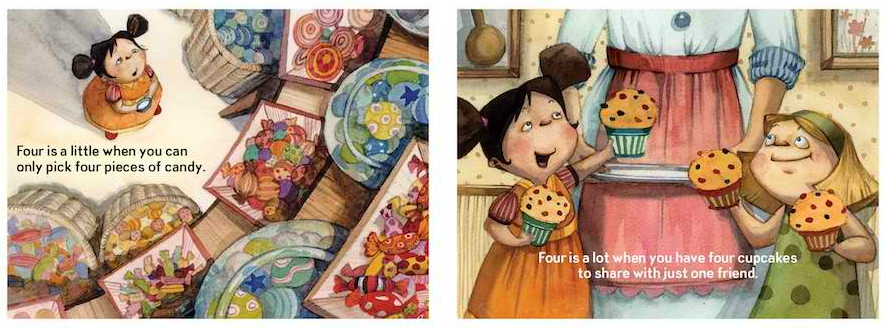
Four is a little, four is a LOT!

imageMy friend Cheska Komissar is quite a character. Not only does she make a peanut sauce that restores my faith in humanity, she is also the bubbliest person alive and, as of a few months ago, a children’s book author. Her delightful Four is a little, four is a lot is just the thing to get someone turning four – and wondering, as children do: Is four a lot or just a little?

The book has four illustrators (of course), but you would be hard pressed to see the difference in styles – though the collaboration has been remote, the drawings are remarkably close in coloring and style and the underscores the text excellently.

image

So, count up the number of three-year-olds you know, surf you way over to the Four Dollar Books website and get the requisite number of books (at four dollars each, of course.) They also have birthday cards featuring illustrations from the book – and the combination will be both four-midable and four-tunate…

Highly recommended!

Great apartment, car and furniture in Brookline

Update June 25th: The apartment is now rented, but the furniture/kitchen stuff and car is still for sale…

Update July 31st: All gone, I am afraid….

I am currently on a sabbatical at MIT, will go back to Norway around August 1. I’ve lived in Boston for a total of bout 8 years, so I have some experience procuring and furnishing apartments – and now I am looking for an academic family/couple/some friends/colleagues who would want to take over my (rented) apartment with furniture and all. I also have a great car for sale.

IMG_4056The apartment is, I think, about 1,700 square feet (158 square meters, gross figures, including a large walk-in closet / attic that can be used as a bedroom in a pinch.) The rent is $ 2400 a month (not including electricity / gas / oil, but my American friends think it is a bargain.) The apartment is located in the top two floors of a four-story house in a small dead-end street (18 East Milton Road, CambridgeBrookline, MA, but maps.google.com shows the wrong house, it is the second last on the north side of the street). Very safe area with an excellent “walk IMG_4057score“. The distance to Brookline High School, an excellent high school with many international students is a 5 minute walk. According to the landlord, there are two good grade schools nearby. The MBTA (subway) is four minutes away. It takes about 10 minutes to Boston University and the Longwood area (where all research hospitals), 25 minutes to MIT, 30 minutes to Harvard. I bike to MIT in 19 minutes, slow enough that I don’t break a sweat.

IMG_4067The apartment has two bathrooms (one with bathtub, the other with a shower cubicle with door,) a large bedroom downstairs, large and very nice living room / kitchen, two bedrooms (one with a slightly odd layout, loft-like, but private) high. Large loft / walk-in closet, which can also be used as a bedroom in a pinch (for short-term visitors, for example.) Reserved parking for one car on the street – nice, since renting IMG_4063a parking space in Brookline can cost $ 80-200 per month. Oil heating, fireplace, nice and toasty (and cheap!) pellets-oven in the kitchen, hardwood floors downstairs, carpets on top floor. Bright and airy, painted white, very nice for having guests and parties.

Kitchen with dishwasher, two ovens, microwave, gas stove, sink with in-sink grinder (or whatever they call those things that chew up food scraps). Washer and dryer IMG_4058the bathroom next to kitchen. Dryer and washing machines are relatively quiet, which is not a matter of course in the United States. We have bought kitchen utensils from IKEA, and various electric kitchen weapons (toaster oven, blender, etc.)

Very friendly landlord who lives in the 1st floor and helps if you have any questions or issues. The apartment is flexible – fits nicely for a couple with 1-2 children. But it’s perfectly possible to be many – for Christmas IMG_4059we were, we were seven people (me, wife, daughter #3, and daughters #1 and #2, each with boyfriend) + two dogs for four weeks, worked really well.

I am hoping for someone in the same situation as me to come in – the plan is that you take all our equipment (full kitchenware, sofa, two armchairs, a kitchen table with chairs for six, two wide comfortable beds, two leather office chairs, lamps, vacuum cleaner, toaster oven, etc.) Everything is bought at IKEA at considerably lower prices than we have in Norway, and my price is half of what we paid (I have most of the receipts).

imageThe car is a silver 2002 Mercedes E320 station wagon with four-wheel drive (big advantage when it snows here) with seven seats (folding seat in the back), leather interior, air conditioning, automatic, built-in GPS, heated seats in front, electric memory front seats, sunroof, everything one could wish for. It has 150000 miles and I have had it maintained by the best Mercedes garage in Massachusetts, European Auto Solutions (www.virtualeas.com) in Waltham – these guys are so good it is a reason to get a Mercedes in itself. (I am rather partial to Mercedeses, have a classic veteran MercedesI bought here a few years ago.)

The car I bought for $7200, and I am hoping to sell it for around the same price, since I have put in approx. $2200 (new alternator and water pump, a few more fixes). There is little rust (Mercedes had some rust problems from 1999 to 2004, this is completely clean except for a spot on the back door.) Runs like a dream, lots of horsepower and comfort. The only drawback is that the left channel of the stereo does not work, I have not bothered fixing it, but EAS told me that a new stereo part (the amplifier) would be about $550 to put in.

We also have a men’s hybrid bicycle and a retro lady bike for sale, bought used, in very good condition.

So there you are – if you are in for a sabbatical in Boston, here is your chance to take over a ready-made apartment and not have to spend time running around shopping for basics. The apartment is perfect for Harvard, MIT, BU, Northeastern, many other universities, all of the major research hospitals in the Longwood area, and downtown Boston.

Send me email (self@espen.com) is you are interested.

Introduction to GRA6834

This is an intro to a course (GRA6834 Business Development and Innovation Management) I am giving in the Fall, open to M.Sc. students at BI Norwegian School of Management, posted here because, well, I couldn’t be there to do the presentation myself. The course description is here, my presentation slides are here, I forgot to say when to turn to the next slide in the presentation (so you’ll have to guess from circumstance), and I do apologize for the rather booming voice, but this is what I could do on rather short notice…

If you have any questions, please email me.