Author Archives: Espen

Unknown's avatar

About Espen

For details, see www.espen.com.

Professor BowTie

My Chinese students (in the BI-Fudan “best-of-both” MBA program) refer to me as “Professor Bow Tie), for obvious reasons (though not in my presence – there, I am “Professor Espen”). On a couple of occasions, they have even showed up wearing bow ties themselves – and looking out over a room with 60 bow ties is rather distracting….

Anyway, since almost all Chinese students have a self-chosen English name in order to make life easy for foreigners, I think it is only fair that I should have a Chinese name for the same reason. So, with a bit of help from the BI-Fudan liaison office, here it is: Băo Tài, pronounced with a very sharp T:

professor-bow-tieI have, obviously, no clue as to what it means (and I am pretty sure mispronouncing it could lead to some hilarity), but have been assured by the office that it is OK. Perhaps someone out there could translate it for me?


We Travel Alone

Ole Paus is a Norwegian singer-songwriter with a very sarcastic bent – essentially, a Norwegian Tom Lehrer with a guitar and a much longer career – frequently referred to as Norway’s best text writer. This is a loose translation of one of his best, a song called “Jeg reiser alene” – about children shuttling back and forth on airplanes between their divorced parents. I listened to it coming home from Shanghai, and thought it deserves a wider audience:

I travel alone
(Ole Paus, 1994)

I travel alone
I fly over land and town
children used to come with the stork
now they come by plane

I travel alone
I fly over mountains and fjords
from Mommy in the south
to Daddy up north

And under me is the whole earth
where grownups and children have their home
but if you ask me where I live
well, it’s in SK305

We travel alone
a flying army of children
equipped with teddy bears
and a suitcase with clothes

And in front of the plane lives the General
he takes all the children from home to home
and down on earth in the terminal
awaits Mommy or Daddy or God knows who

I travel alone
the stars are coming out
they are many
but we are many more than them

We are so many that you would not believe it
and the purser he is my best friend
and then we land on a spinning earth
and then we go up again

I travel alone
I fly over land and town
children used to come with the stork
now they come by plane

Car-ried away a bit

I really should not be writing this – I have numerous other demands on my time, sitting in my home office and writing outlines for a couple of new courses, doing my taxes and preparing for a class in Shanghai next week. But I just read this column by Bob Cringely and, well, last Friday I picked up this beauty:

2014-03-14 12.41.36 

Now, this is a $100,000 car and you might be asking yourself why on earth a not too well paid academic should go out and purchase something like that. The answer is complicated and very Norwegian. We needed to update the Andersen car fleet (have a 1996 Mercedes C class and a 2002 Toyota Previa, both due for an upgrade). The kids are moving out, eventually, so we no longer need the minivan, and we were thinking about an SUV or perhaps a Volvo station wagon, about 5 years old. The problem is that a car like that costs $40-50,000 in Norway, due to the 200% taxes levied on almost all cars when they arrive in the country (more, if it is sportier.)

Anyway, for electric cars, there is no tax. Moreover, if you take it as a company car (I have my own consulting company), the assessed benefit is only half of what it would be for a regular car (or even a hybrid.) Moreover, you can park for free in Oslo, drive in bus lanes, get a free E-Z-Pass (i.e., the Oslo equivalent), there are free charging stations around and there is no annual road tax. Electric energy is clean and plentiful in Norway. The upshot is that this great GT car will cost me just a little bit more per year than our 12 year old Toyota. In short, a no-brainer. The Tesla S is a very cheap car in Norway, and consequently, Norway is the second largest market in the world for it. The dealer told me they were taking delivery of almost one thousand of them only in March.

It drives wonderfully, as Cringely says. After having driven it for a few days I have a permanent grin on my face. The effect is similar to driving my veteran Mercedes 6.9 – smooth and effortless power and comfort – but without the $2/mile fuel cost. In fact, driving the Tesla 100 km (60 miles) costs around $2.30 in electricity if I charge it at home, which is quite manageable, thank you very much. Now I make up excuses to drive somewhere, and constantly have to watch the speedometer, since there is no motor noise to help you estimate the speed.

iPhone Screenshot 1Right now, of course, I am not driving the car, since I am slaving away at my keyboard. But there is an app that allows me to see where it is – and currently my wife and youngest daughter have driven it to Sweden to do some shopping. With the app, I can see where the car is, how much juice it is consuming, and its speed. Great for constructing annoying messages to my wife commenting on her driving…

There has been an interesting debate in the Norwegian media the last few months about the subsidies for electric cars. The first electric cars were really not very practical – range and speed limited to 50 miles and 50 mph, respectively – and so the tax incentives where set up. Then the Tesla comes along with technology blowing everything else out of the water, and now you can be environmental and have fun at the same time. This constitutes an almost existential crisis for a number of people, who write angry articles about these monster cars that, well, don’t pollute (at least not in the use phase) and, well, should not be that good. We are, apparently, meant to suffer for the environment in order to save it, not enjoy our cake and eat it, too. (I am, of course, a technology researcher and can make the excuse that I should be familiar with new technology – in fact, perhaps I should charge the thing to my research budget…)

But I am not suffering at all at the moment. Instead, I am looking forward to tomorrow when my wife, perhaps, will not need the car and I’ll get to drive it.

If you need a Toyota and a Mercedes or two, just send me an email….

Notes from OECD 2014 Norway report presentation

(This was presented at the Norwegian Business School following the initial presentation to the government. These are my quick notes.)

Patrick Lenain, Head of Division, OECD:

Norway is doing well!

Overview of OECD organization and general reports.

Paul O’Brien: The Norway survey

See executive summary for main points and recommendations. Main points:

  • tertiary education more subsidized in Norway more than most places – perhaps time to start charging for it. There is a resource cost of education, has to be financed, comes through tax. But most of the benefits of education accrue to the individual, hence they should pay. In Norway, the income distribution is very even, however, and hence tax may work. This depends on returns and skills, intergenerational mobility, etc.
  • Productivity growth level has slowed in Norway, as in other countries, because of the crisis. Could be a problem in the long run, especially since the productivity growth has slowed down more in Norway.
  • Wage growth a problem? Little slack, unemployment rate is low, hour worked low (this is a choice), not really a problem because it is running at full tilt. Bit of a puzzle because price signal in the labor market is subdued, not using labor market signals to tell people where to do.
  • Are you ready to pay the price for many schools, one in every village?

I had a question about Norway’s raising Gini coefficient and what the government could do to translate that into higher employment for the 20% of Norway’s workforce that is outside the job market, but did not really get an answer outside the issue of too high tax rates.

Disruptive is not quite as disruptive, it seems

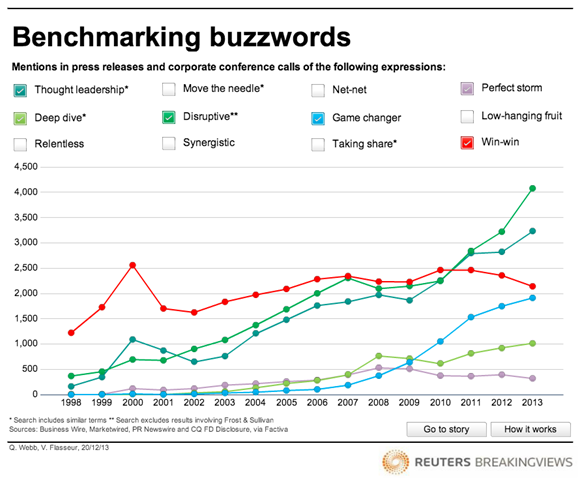
Reuters has a great little tool showing the evolution of various buzzwords (via Boingboing). One of the worrying things is that “disruptive” is showing a remarkable growth:

image

I see this tendency (as it is with most buzzwords) that anything new (be it a technology or something else) that replaces something old is termed “disruptive”. A disruptive technology or innovation, however, as coined by Clayton Christensen, is an innovation where the incumbent companies are the ones least able to respond to it. This tends to be because the new product or service has these characteristics:

  1. Your best customers don’t want it. These demanding customers (and you want demanding customers, right?) are willing to pay top dollar for a better product – hence you try to make your product better to suit them. You then ignore the customers who does not need, nor are willing to pay, for the performance.
  2. Its performance is worse – at least in the dimensions traditionally used to measure performance. In Christensen’s original example – the disk drive industry – the existing customers wanted hard drives with more storage and higher access speed. They initially ignored the physical size of the disk drive, allowing new companies to gain dominance as new, physically smaller disk drives became available.
  3. If you entered that market, you would lose money. A disruptive innovation attacks from below – with lower profit margins. A former CEO of a minicomputer company expressed it this way: “When the PCs came, we had a choice: Selling $200,000 minicomputers with 60% profit margins, or $4,000 PCs with 20% profit margins. What would you choose?”

The funny thing is, companies launching new products keep calling them “disruptive” – do they really want to say that their products are undesirable, poor and offering low profit margins? They might want to say that, but in my view most real disruptors prefer to keep their mouths shut and build their profitability under the radar of their entrenched competitors.

In other words, if a product is launched as disruptive, it probably isn’t.

25 reasons to visit Norway

As some of our friends, who to our delight turn up almost every summer, have already found: 25 reasons Norway Is The Greatest Place On Earth.

I’ll add a 26th: The Gulf Stream, which ensures that the water in the Oslo fjord reaches 23 Celsius at least once every summer, and then I can swim (my wife will happily swim until it freezes over.)

And while we are at it, how about a 27th: Prekestolen (Pulpit Rock), not only for the view of and from it, but because it is devoid of safety fences, warning signs and concession stands. Caveat emptor…

image

Notice: Regular carping about living in a small and remote country will resume shortly.

New workstation setup

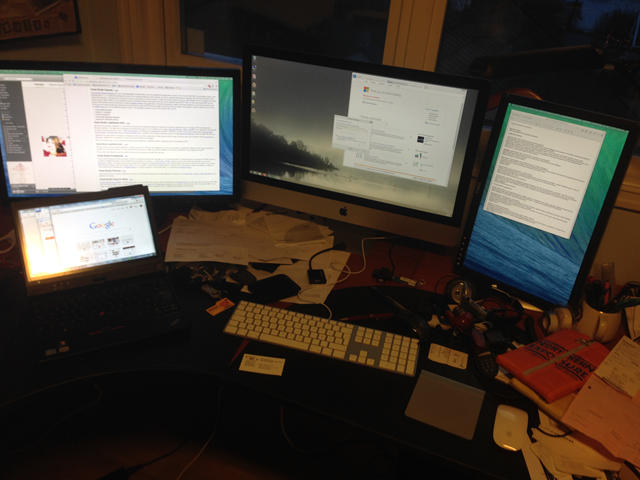
This is quite bit on the “not really interesting to anyone else” side, but, anyway, I have gone off and spent quite a bit of my research budget on new hardware, specifically a new workstation for myself. As of a few days ago, I am the proud owner (well, user) of a fully spec’ed out iMac, rendering my home working space thusly:

image

(I first thought about getting the new Mac Pro, but after reading this article and taking a more realistic look at my own needs I decided for the iMac.)

I have also installed Parallels, because a) I like Microsoft Live Writer, Komposer and a few other tools that are only available in Windows, because my employer demands Windows (yes, I am working on changing that) and because the Office package works better in a Windows environment, as I found out recently when trying to use Office for Mac and PC interchangeably in a mail merge setting and ending up doing everything twice. Parallels seems to work fine, with the exception of some keyboard issues (necessitating fiddling with configuration files and various three-finger keyboard combinations) and a not very intuitive screen management system. Oh well.

The build quality and performance of the iMac is quite something to behold – wonderfully crisp screen, makes my two older screens look quite shabby in comparison. Every other connection (network, Scansnap, Brother wireless printer Just Works, which is the way it is supposed to be. The Mac keyboard is nice to the touch, but the key combinations are a bit tricky, and reprogramming them to be more compatible across the two different environments will be, I suspect, quite a bit of fiddling in the years to come.

Anyway, I am now fully Mac’ed up, but with Windows compatibility, in a nod to the environment I primarily have worked in the last 20 years or so. The hardware quality of the Mac is extremely high, as is the design factor, but the software still leaves some to be desired – the differences are not great, but they are there, and I want the flexibility. One of my colleagues actually has a late model iMac and uses it almost exclusively as a Windows machine (he boots into Windows with Bootcamp). I would like to explore the native Mac apps (Pages, Numbers and Keynote, especially Keynote) but given that I write and develop things collaboratively I cannot base myself on them entirely.

My main reason for getting the iMac, however, is that I want to start fiddling a bit with video editing. I did an interview on the future of technology and computing in the next 5 years (in Norwegian), and asked to get the raw material for my own purposes – time to see to what extent I can use the technology to be in more than one place at once, flip the classroom, fiddle with a MOOC (or, well, more like a SPOC), or perhaps just animate some presentations. There certainly should be enough horsepower for the foreseeable future…and a rather cool home office. All I need now is an Aeron chair (ordered), a desk with a glass top with someone to polish it, a cleaner for all the dust and junk, a black turtleneck sweater, a head shaver and a personal trainer, and I should be well on my way to digital guru status.

Oh well, if it only was that easy…

Write, that I may find thee

A Google Dance – when Google changes its rankings of web sites – used to be something that happened infrequently enough that each “dance” had a name – Boston, Fritz and Brandy, for instance – but are now happening more than 500 times per year, with names like Panda #25 and Penguin 2.0, to name a few relatively recent ones. (There is even a Google algorithm change “weather report”, as many of the updates now are unnamed and very frequent.) As a consequence, search engine optimization seems to me to be changing – and funny enough, is less and less about optimization and more and more about origination and creation.

It turns out that Google is now more and more about original content – that means, for instance, that you can no longer boost your web site simply by using Google Translate to create a French or Korean version of your content. Nor can you create lots of stuff that nobody reads – and by nobody, I mean not just that nobody reads your article, but that the incoming links are from, well, nobodies. According to my sources, Google’s algorithms have now evolved to the point where there are just two main mechanisms for generating the good Google juice (and they are related):

  1. Write something original and good, not seen anywhere else on the web.
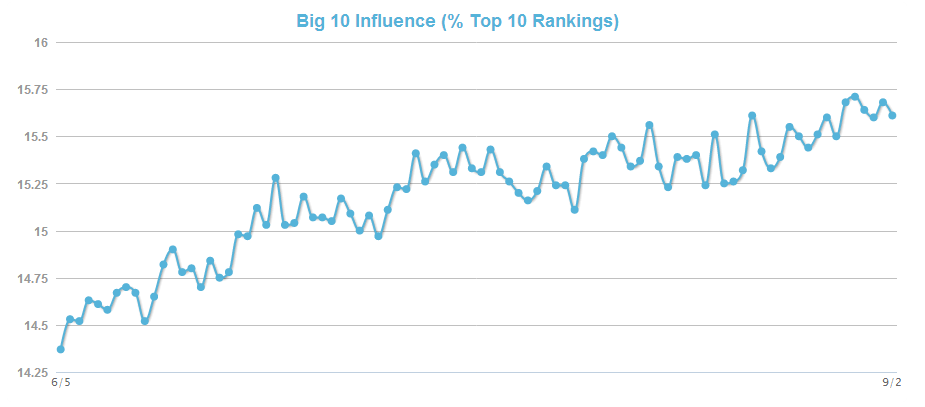
  2. Get some incoming links from web sites with good Google-juice, such as the New York Times, Boing Boing, a well-known university or, well, any of the “Big 10” domains (Wikipedia, Amazon, Youtube, Facebook, eBay (2 versions), Yelp, WebMD, Walmart, and Target.)

The importance of the top domains is increasing, as seen by this chart from mozcast.com:

image

In other words, search engines are moving towards the same strategy for determining what is important as the rest of the world has – if it garners the attention of the movers and shakers (and, importantly, is not a copy of something else) it must be important and hence, worthy of your attention.

For the serious companies (and publishers) out there, this is good news: Write well and interesting, and you will be rewarded with more readers and more influence. This also means that companies seeking to boost their web presence may be well advised to hire good writers and create good content, rather than resort to all kinds of shady tricks – duplication of content, acquired traffic (including hiring people to search Google and click on your links and ads), and backlinks from serially created WordPress sites.

For writers, this may be good news – perhaps there is a future for good writing and serious journalism after all. The difference is that now you write to be found original by a search engine – and should a more august publication with a human behind it see what you write and publish it, that will just be a nice bonus.

NeXT and the voice from the future.

The NeXT at CERN that started the WWW

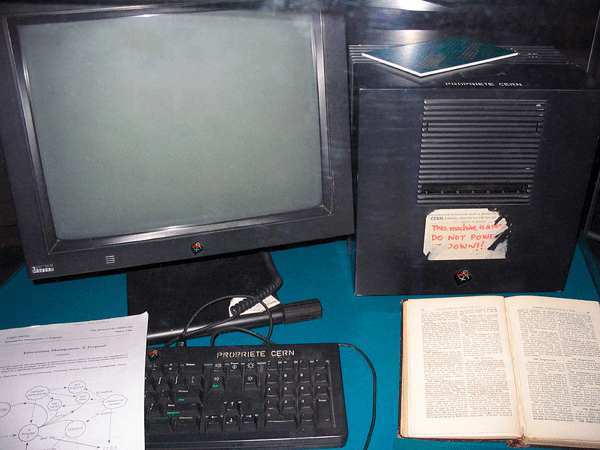
I am currently watching a rerun of a BBC documentary about Apple and Steve Jobs, which made me think of the first (and only) NeXT machine I ever had. (The NeXT was what Steve Jobs did after he was fired from Apple – and the picture here is the NeXT machine at CERN that Tim Berners-Lee wrote the first web browser on.)

Anyway, the year was 1990, I was a doctoral student in my first year at Harvard Business School, and had a large office to myself (I was sharing it with other doctoral students, but for some reason they were seldom in.) One of the MBA students worked for NeXT and got us a loaner machine, and, well, it was just standing there.

At a time when computers either went “beep” with text-based displays (that would be the 386-based Intel computers) or made a lot of noises with graphic but rather crude displays (that would, mainly, be the Mac II), the NeXT stood out – a black cube made of magnesium, a connected laser printer (most of the processing was done on the computer), and an excellent screen using Display PostScript, which meant that there was no difference between what you saw on the screen and what came out on paper – it was, quite literally, the same technology.

I dicked about with that machine far more than I should have done, given my course load, but on the other hand I wrote some papers on the importance of object orientation for complex business applications – as well as a few Smalltalk programs. The NeXT cube really was not that useful – not because it wasn’t good (it was excellent) but because it was very much a network machine – and I had no network to connect it to. Neither could I get hold of the CDs necessary to store the information from the computer. I could print, but that was about it – so the machine became a highly desirable but not really useful toy.

But it managed to give me a scare, once. It had a digital signals processor – a DSP – and a good speaker system, at a time when most computers could not play video and had tinny little speakers that mostly beeped. I was sitting in the office reading something, and the NeXT machine was on, but I wasn’t using it.

Suddenly I heard a very attractive woman’s voice saying with a certain British crispness: “The printer is out of paper.” I was startled and literally looked around in the room to see if anyone was there. It took me a while to understand that it was the computer speaking – and then, of course, I couldn’t reproduce the sentence.

I still remember that confused feeling. Now most of our music and half the dialogue we hear come out of computers, but back then it was, literally, a voice from the future. And it was just a little bit scary.

Interview by Peter Lorange


Peter Lorange has posted an interview (in German) with me on his blog. (Trust me, I don’t speak much German beyond “Bitte, bitte Kellner, noch ein Bier.” I can sort of read it, though.) I will be teaching a class (with Margherita Pagani) at his institute in a couple weeks.

I am posting the English version of the interview below – good questions, and I am happy with the answers, too.

1. There is no single business which is not affected by information technology in whatsoever way. Is there a general rule of thumb to follow in the e-commerce?

No – except, possibly, don’t ignore it or treat it as an afterthought to your regular business. E-commerce is increasingly the “normal” way to do things, and companies that are successful devote much time and resource to making sure that their value proposition online is as well thought out and delivered as anything else they do.

A persistent problem in many businesses is that, faced with new, Internet-enabled competition, they try to preserve their existing distribution channels and business models by mimicking them online. In some instances, this is the right thing to do, but surprisingly often, doing so leaves you open to competitors that have no existing business to defend. Competition online is often subject to strong network effects, meaning that it can be extremely important to establish a dominant position early – before the economics of the market financially justifies it.

2. Some businesses are quite successful although they are not working with the newest, latest technology. Why, to quote the title of one of your papers, does the best technology not always win?

My point about the best technology not always winning is more directed at technologists – who often things that the technology that is “best” in a technical sense (most advanced, say, or most adherent to the principles of technology the technologist believes in) deserves to win. If it doesn’t, the technologist concludes that this is due to a conspiracy, most commonly arranged by whoever ended up winning the market – be it Microsoft, Google, Facebook, or whoever.

For every new technology that comes along, you will always find a number of initiatives and companies that didn’t quite cut it, even though their ideas were right and the implementation beautiful. Perhaps their timing was wrong. Perhaps they chose the wrong initial market. Perhaps they were part of a larger company that didn’t understand the importance of the new technology or were fearful of its consequences. Or perhaps they just had bad luck.

3. Conversion is a keyword in today’s e-commerce. How can a merchant convert visits on his website into sales?

To a large extent, what makes you successful online no different from what makes you successful in any business: Offering a good product or service at a price the customer is willing to pay. Being online, however, allows plenty of opportunities to surround your existing product or service with electronically enabled experiences and extensions.

A big problem with many online offerings, in addition, is that they impose complicated procedures for the customer, especially around payment. Sometimes these complications are deliberate – to make sure online sales do not harm traditional sales, for instance. Sometimes they are a result of thinking too much about security. Sometimes they come from an insistence on making electronic commerce simple for the company rather than the customer. Small differences in design, especially of the process the customer has to go through, can make a big difference.

4. Design is not just what it looks like. Design is how it works, said Apple co-founder Steve Jobs. You claim that the presence on the web is no longer determined by having a nice web site only. And yet, contemporary web-based design can be used to generate business. Where do you see specific triggers at the interface between design, usability and conversion?

In general, design of a web site matters – but content matters more than colors, pictures and logos. Specifically, many companies forget that customers will enter their web site not through the front door – i.e., through the home page – but directly into any page visible, often through search engines. This means that you must design your web page not just to be esthetically pleasant – it must also be logical in its structure, be consistent in its message and quality no matter where the customers come from, and, most importantly, easy to find and link to for customers. If you type in the name of your product or your product category in a search engine, your site better be the one that pops up on top – or you have done something wrong.

5. For a few years already another buzzword has been on everyone’s lips: social media. In brief, where do you see the most poignant relation between higher sales and social media – if there is any at all?

Social media can be important – especially if you sell branded, high-end goods and services. They can enhance your value offering by providing customers contact with each other –many technology companies, for instance, use electronic forums to let customers help each other use, fix and even extend their offerings. They can also be a threat – news travels extremely fast on social networks, and you certainly don’t want to be the company whose poor service or stiff prices everyone is talking about. That being said, social networks offer you a chance to quickly fix mistakes – and to communicate how fast you fixed them. In short, social media offers you and your reputation everything a small town offers – only on a much larger and much faster scale.

6. Online business and e-commerce promises opportunities. On the downside, like everything, ecommerce is not only related with opportunities, but also with threats.

For most companies, e-commerce is a good opportunity, but for many it can be the first chink in the armor, the first sign that an industry upheaval is on its way. For the music industry, for publishers, for newspapers and for anyone selling access to information or entertainment, e-commerce can, long-term, be a threat to the company’s whole existence. The key lies in recognizing this threat early and turning the digital marketplace into an opportunity. For every industry facing a disruptive innovation threat such as e-commerce, there are companies that go out of existence, but also existing companies that seize the initiative and thrive in a digital environment. Often, these companies owe their existence to executives who had the foresight to see what was going to happen before it showed up in the financial results – and the legitimacy with their shareholders and their workforce to take action before everyone could see that it was necessary. Surprisingly often, these executives were not technical specialists – but they understood their business thoroughly, and that makes all the difference.

Board meeting for Masterstudies.com

I’m at a very interesting board meeting with Masterstudies in surprisingly good weather at Tjøme. We are planning strategies for further growth in traffic and customers, as well as new and exciting services to existing customers. Lots of ideas flying back and forth. And yes, there will be time for some socializing later on…

Still here?

No blog post since May 4… Well, my excuse is that a) I got sick for a couple weeks, which has slowed things down, and b) I then embarked on a 3-week teaching/speaking/travelling marathon that consumed all time, was very interesting and will earn me an SAS Gold card as soon as the points get processed.

Over the last three weeks, I have taught a four-day executive EMBA class at BI, two full-day PCL sessions for Harvard Business Publishing (at ESSEC in Paris and ESADE in Barcelona, both very enjoyable), participated in two oral exams, given presentations and facilitated sessions in a few companies that shall remain nameless, and held a session on technology tools for teaching for my colleagues. One more whole-day session to go, and then summer can begin.

For various reasons I have been working from home almost the whole semester, acquiring the odd hours and sloppy clothing habits of a hermit scribe (except when videoconferencing, where a hastily added shirt and some clever camera positioning is required). You can get very addicted to your cluttered home office and the view from the front window – and find that tutoring students over Skype is, if anything, more efficient than being in the office. It only takes me 30-45 minutes to get to work (car, bus or bicycle) but I have begun to see the 1.5 hours wasted as an unbearable intrusion on my productivity.

But you do find that there are wide discrepancies in people’s attitude to video- and teleconferencing. Consultants, engineers and some academics barely bat an eyebrow when I suggest Skype. Others – including some foreign clients – absolutely insist that I have to be there in person, even for fairly routine matters. Some official meeting don’t do teleconferencing, for some reason. And don’t get me started on the bureaucratic hassles of various exam-, medical and visa-related matters, which apparently were designed for parchment, quill pens and post diligences.

SAS appThere is progress. After some hiccups my SAS app worked beautifully, meaning that paper boarding passes and check-in lines (even at machines) is a thing of the past. I relearned where the lounge is at Arlanda airport. I rediscovered my system for where to store things so I don’t forget them, and started feeling like a flying consultant again.

And for three weeks, it was rather fun. Now I am happy to go back to the reclusive hermit style. Ahhhh…where was that white wine again?

Body language essentials for teachers

Amy Cuddy teaches at the Harvard Business School and studies, among other things, the effect of body language – not just on others, but on ourselves. In this TED video, she demonstrates the effect of consciously using body language to change your own mindset:

I occasionally teach teachers how to teach, especially case teaching or discussion-based teaching. A recurring problem for many teachers – particularly the younger ones, when they start out – is a feeling of nervousness, sometimes quite severe. This nervousness makes them want to take control in the classroom, to script their presentations, to make sure that they have every angle covered – precisely the behavior that is most detrimental to running a good discussion-based class, where the teacher trusts the class and relies on the students to provide drive and perspective, facilitating rather than driving the discussion.

Overcoming nervousness is not easy, but I have found that the techniques mentioned by Cuddy work. For instance, I tell teachers to check out the classroom, lecture hall, meeting room, whatever, ahead of time – and make a change to something. When I am giving a speech or teaching a class, I will almost always change something in the room when I come it: I’ll set the boards just so, adjust the lighting, get rid of the “protection table” that so many teachers put between themselves and the students, grab a stack of books or a soda crate to build a stand for my laptop. These changes I do because I want them, but also because they are my way of asserting power in the room – telling myself that I own this room for the duration.

The two-minute power stances advocated by Cuddy work well and should be used by any teacher – go to the bathroom before class, lock the door and stand tall by yourself for a little. The difference can be quite dramatic – and the students will notice it. This is especially important if it is the first time they see you – research has found that the first 30 seconds students see a teacher are extremely important for their opinion about him or her.

Stand tall, that you may teach well. Just a little will go a long way.

The Death Of Blogs? Or Of Magazines?

According to Andrew Sullivan, it isn’t blogs that are dying, but magazines with titles such as “the death of blogs.” I agree – like the Internet now reflects a whole society rather than the thinking of the early pioneers, the blogosphere has evolved into many distinct segments. It is natural, things take time, and we are still at the beginning.
(Incidentally, this is a reblogging test )

Andrew Sullivan's avatarThe Dish

photo-22

As part of his “eulogy for the blog”, Marc Tracy touches upon the evolution of the Dish – which he praises as “a soap opera pegged to the news cycle”:

[T]oday, Google Reader is dying, Media Decoder is dead, and Andrew Sullivan’s The Daily Dish is alive in new form. This year, Sullivan decided that he was a big enough brand, commanding enough attention and traffic, to strike out on his own. At the beginning of the last decade, the institutions didn’t need him. Today, he feels his best chance for survival is by becoming one of the institutions, complete with a staff and a variety of content. What wasn’t going to work was continuing to have, merely, a blog.

We will still have blogs, of course, if only because the word is flexible enough to encompass a very wide range of publishing platforms: Basically, anything that contains a scrollable stream…

View original post 758 more words

Boston Marathon Bombing

This hits home – it is very bad. Boston is our family’s second home town, where our youngest was born and the other two had formative years (as did we all.) Boylston street certainly is familiar and so is every Boston reference and place name now being repeated on CNN.

I am impressed by the police and various spectators and marathon officials – they immediately run to help the wounded, acting very sensibly, quickly coordinating to gain access to the bomb site and get to the wounded.

Let’s hope the aftermath of this event is characterized by the same calmness, relevance and restraint. The bombings in Oslo and shootings at Utøya two years ago gave rise to very solemn reactions and a surprisingly thorough and measured debate about immigration, extremism and the role of religion in Norway – as well as a thorough examination of security routines and the response of the police (which, unfortunately, was not as quick and coordinated as in Boston.

Let’s hope this can be an event to learn from, whoever the perpetrators may be. The Boston Marathon is very much an outdoor celebration – people happily cheering the runners along the route and everyone having a great time. It would just be too sad to have it changed and locked down by the insanities of people who think violence will gain them anything at all.

MOOC and me: Reflections on a Coursera course

On April 10, I signed up for a course on network theory and analysis with professor Matthew Jackson of Stanford University. That was about one week into the course, which started April 1, so I will have to hurry to finish some of the assignments. The course is both a test in online coursing for me – not that I think I am at a stage where I should create on, but it could be interesting to try – and I chose this particular one because it is a field in which I have brushing knowledge (I have read Burt’s Structural Holes: The Social Structure of Competition, for instance) but never have systematically undertaken any training or done any math.
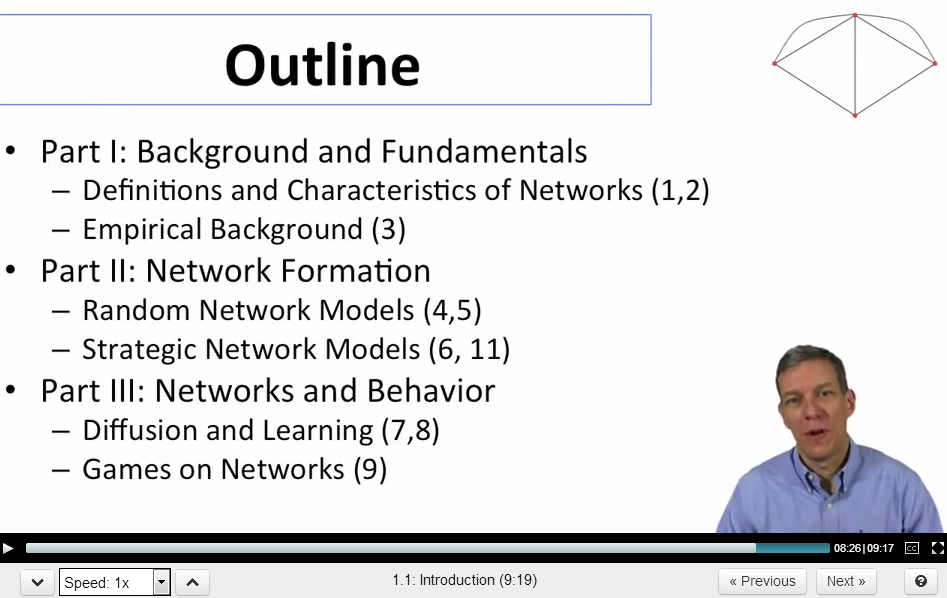
Signing up was very easy: Name, email address and a password, no cost, off we go. The web site is very simple, well, here we go. Estimated work 3-6 hours per week. Will see if I can make that, especially if I am blogging on the side…

image

The course (at least the intro) is delivered with a set of slides and the instructor superimposed over them, using on-screen drawing (using a tablet pen, it looks like) drawing lines around or between concepts. The ability to speed up the presentation is useful – I can still follow it at 1.5x normal speed, and used that to rush through some of the examples I had heard before and some of the more self-explanatory slides. There are some problems with the transmission – occasionally, the screen will be garbled (especially when there is movement on the screen, such as the instructor drawing on the slides, which means that I will have to print out the slides for the next week’s lectures, when the formulas become more complicated. i will also have to start taking notes by hand, since my typed comments can’t keep up with the presentation when it comes to creating formulas and drawing diagrams.

The course uses open-source network software (Pajek) and the first homework assignment dealt with basic network attributes such as diameter, density, and average paths. Not too hard so far, but i have a graduate education from an English-speaking university and some intuitive understanding of the topic (plus experience in fiddling with software until it works, including screwing up the Pajek configuration and fixing it by simply erasing the config file and starting over.)

On the positive side, I might be just in the right market segment: Someone who is interested in the topic but does not have the time to sign up for a course in it. Wonder how many other academics there are out there who see MOOCs as a great way to update themselves on a related field…

I’ll be back with more observations in a few weeks, assuming I haven’t dropped out – which many students tend to do in these courses.

Newsblur–an alternative to Google Reader

The best way to find new tools and work tips is to see what other people are doing – which is why I spend time writing up experiences with various tools. It is even better when you can read the experiences and work tips of someone you admire – such as this Lifehacker interview with the frighteningly articulate and productive Cory Doctorow.

From this interview I noted that Cory, like many of us, has to leave Google Reader – as he says, probably for Newsblur. I promptly went there, plonked down $20 for a year’s subscription, choose “import Google Reader subscriptions”, and wondered why I hadn’t heard of this gem before. In addition to RSS feeds, Doubt if I will ever open Google Reader again…. Newsblur seems more elegant, gives me the option of reading the blog in original format, and has a great interface for adding and deleting blogs. And it is trainable – i.e., it observes what you read and asks your opinion – though I haven’t used it long enough to see how this works.

Highly recommended – and the fact that a) this is fee-supported, hence not subject to arbitrary facing-out decisions that leave a loyal following with no tools, and b) recommended by Cory and now – gasp – me, should make this a very viable tool in the future. The creator, Samuel Clay, is a bit overwhelmed with demand right now (hence no free test subscriptions), but that will change as the site firms up its infrastructure and gets more optimized, I am sure.

Highly recommended!

Collaborative online writing–some personal experience notes

I am currently spending a lot of my time in a collaborative writing project with my friend and colleague Bill Schiano – the details are not important at this point, but it is a book-length, somewhat complicated piece of text, and involves an editor. Bill is in Boston and I am in Oslo, usually a six-hour time difference. A relatively short deadline has necessitated finding a way to work together which is faster than the time-honored method of e-mailing drafts back and forth. Shouldn’t be hard in this day and age, with cloud-based software and 60-megabit Internet connections, right?
Well, it is. We started out with Google Docs, which is great for quickly setting up shared documents fast and handles multiple concurrent editors (you can actually see the other person writing almost in real time.) However, it turns out it lacks some of the nicer interface details of good old Word, such as comments in bubbles and a lot of the keyboard shortcuts. It also quickly gets very unwieldy as the document gets longer.

We then tried out Scrivener, an authoring (as opposed to word processing) tool which recently has become available for Windows and is touted as the best thing since sliced bread by a number of authors. We found it to be fantastic for authoring – if you are a single author. For two or more people working together (over a DropBox-shared directory) it lacks the version tracking and commenting features, meaning that we would have to be very disciplined about who wrote what where and have lots of supporting documents a la “Unifinished issues”. After a few screw-ups, we decided to try something else.

We then came up a with solution that really works, which we have been using for a few months now and gives us nearly everything we want: The venerable and much-maligned Microsoft Word. The difference is that the document we work with (which currently stands at 157 pages, nearly 63000 words, just over a megabyte storage) is stored on Microsoft OneDrive, and we can both edit it using Word on our computers. I will leave the actual setup of this as an exercise for the reader, but the short version is that you set up a OneDrive account at onedrive.live.com, open a new document in Word (must be at least the 2010 version) and save it to OneDrive. You then share by sending a link to your co-author, who opens the link and can then choose to edit it online (i.e., through a browser) or in Word on his or her own machine.

This gives us the best of both worlds. We can edit the document on our own machines, see the changes the other has made and accept them, write comments in the text that the other person can respond to. We do Skype meetings (with Skype Premium, so we can share screens) about twice per week to discuss things we cannot fix simply by shared editing, and the whole thing is progressing quite nicely.

As usual when you start using an old tool for something new, you learn a few tricks you hadn’t thought about – the best way to learn new tricks is always to watch someone else using the software: I learned that you can control-click on an item in the TOC to go directly to it by seeing Bill do it, and he learned that you can grab selected text pieces and drag them to new places (without doing Ctrl-x Ctrl-v.) That’s why I think every group working together should have an occasional “Tips and tricks swap meet.”

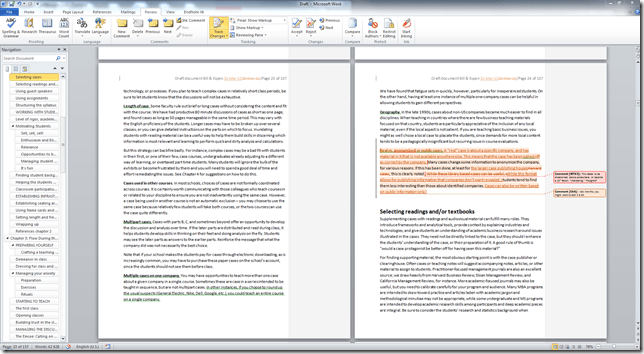
We have found that working with a large (at least 27”) screen as your primary tool is immensely useful. That allows a full-page view with two full pages and a navigation pane, like this:

image

If you are disciplined about heading styles (i.e., chapter headings being “Heading 1” etc.,) then the navigation pane works more or less like the outline or slide sorter in PowerPoint, allowing you to drag and drop chapters and sub-chapters around and promote or demote them, which is extremely useful when your work approach is to bung in a lot of text in sub-chapters and then sort out the structure later. (Word is a bit irritating in its use of styles, though – it should be easier to enforce a standard style set, unchanged when text is clipped in from other sources.)

Another useful trick is to go to the File>Recent screen, locate the shared draft, and press the little push-pin to the left of it. This places the document permanently at the top of your Recent files list – making it very easy to open without having to go to OneDrive etc. (Note 2014-01-9: This seems to only work on the Windows version of Office, not on the Mac. Another reason to get Parallels.)

When working together like this, you also need to come up with a shared notation for work – how to you mark some text as tentative, for instance. The standard comment and track changes settings are OK (but change the standard for Track Changes so it does not track changes in formatting) but you need more than that. We have defaulted to marking spurious text with {curly brackets} and reference points with “zzzz”. (I have heard other writers, such as Cory Doctorow, use “tk” because that particular letter combination does not appear often in the English language, unless you write about the Atkins diet.) The idea is that even with a large document, you can search through it until you have fixed all issues, i.e., gotten rid of all the curlies and zzzz’s.

There are, of course, a few issues you need to deal with. That a document is shared does not mean it is backed up, so we both do local, dated backups every now and then, just to stay on the safe side. The more users are editing the document, the slower it updates, so we try to be disciplined about a) saving often, and b) exiting the document when we are not editing it. If not (as Bill found when Espen had done a lot of small edits and then, in Norway, gone off to bed while leaving the unsaved document on his workstation,) the edited paragraphs become inaccessible to the other author. So, save and exit whenever you can.

And that’s it so far – just sharing experiences here, but this approach really works. Our next challenge is bringing our editor on board – so far we have been sending him chapters as they have become ready. I am now going to set this up for collaboratively writing with a couple of other colleagues, on shorter pieces, and we’ll see how that goes.

Keep you posted – and tips and tricks are appreciated!

Update 2014/4/30: SkyDrive has become OneDrive, so I have adjusted for that.
UPdate 2016/7/18: You can now open a document in Word using Google Chrome.

A day in the life of a Computer Expert

(Julie linked to this article, which made me remember that I actually wrote something similar in 1989 or thereabouts, when I was running user support for the Norwegian Business School)

Report from the trenches: Scenes from the life of a computer expert

The onslaught of user-friendly personal computers, where the user points and clicks his or her way to computational satisfaction, is hailed by many as the beginning to the end of the in-house computer expert (also known as the Local Guru). As this field report will show, there is no reason to look at the classifieds yet. Relax, guys.

The dominant source of computer problems is finger trouble. Finger trouble is the term computer experts (loosely defined as anyone who knows the approximate location of the power switch) have coined for problems inexperienced users get themselves into by way of the keyboard. While this source of job security and discretionary income may be reduced due to graphical user interfaces, there are still plenty of hardware errors to keep us occupied. Hardware errors are part of the everyday life of all computer experts, and show no sign of abating.

Let us examine a typical case, in order to gain an appreciation of the current state of things: The setting is a medium-sized company with high ambitions, a ubiquity of PCs and a Computer Expert (hereafter called E.). E. is sitting in his office, consumed with the difficulty of reaching level 42 in the 486 version of the “The Hitch-Hikers Guide to the Galaxy” when the telephone rings. Having recently cleared his office, E. manages to find the telephone before the caller gives up. The voice in the other end informs him, with audible consternation, how that darned printer, again, won’t do what it’s supposed to. Can E., with his long-standing reputation as a technical wizard, do something about it? The Voice (hereafter dubbed V.) assures E. that the matter isn’t pressing – but if he has the time…. (Somehow V. manages to convey a message of great need, sort of “you just take your time, we don’t mind sitting here rolling our thumbs and wasting the company’s money etc.”). E., when airing a suspicion that the equipment in question probably isn’t switched on, is informed by V. (with audible consternation) that they have in fact been using computers for several years now etc.

The setting 10 minutes later: E. arrives in the manner and style of a 20th century doctor making a house call on a farm far away from civilization (or like a veterinarian in Yorkshire). From every nook and cranny the office personnel come running to witness an Expert’s modus operandi (please bear with me if I’m carried away a bit here). E. eyes the printer and sees that the cable between it and the PC is present – and that the switch, indeed, is turned to ON. Still, the thing is as dead as a post- Format C: hard disk.

With a supreme air of confidence E. grasps the power cord and begins to pull. A veritable birds’ nest of cables appears (the premises were constructed long before information technology made its cheerful appearance in organizational life). Dangling inside the cable web is a power plug, its prongs conspicuously devoid of physical contact with anything electric. E., with an air of quiet achievement, lifts it high in the air for examination in a gesture reminiscent of a surgeon in a 1950’s war movie (the scene where the bullet has just been removed from the young soldier’s chest).

The reaction of V. and colleagues at this point depends on a number of variables, chief among them their rank in the organizational hierarchy. The range of reactions varies from “how could I be so stupid (again)” to “who the hell loosened that plug”. Suddenly the preferred topic of conversation is anything but office automation – frantic discussion of the quality of the local cafeteria coffee ensues, accompanied with a noticeable rise in body temperature above the 6th vertebrae.

E.’s reaction depends mainly on the tone of the initial telephone conversation, the distance covered in order to reach the culprit, and what he could have done instead. (The number of times this has happened before might also have some effect, but as V. normally has a choice between several E.s it is not likely that the scene will repeat itself with the same E. very often.).

If E. is a really experienced technical wizard, he will refrain from sarcastic comments, quietly lay down the power plug, and disappear into the sunset. The lonely hero has done it again. He has for the nth time shown who is the boss – who is in command of this omnipresent technology, incomprehensible to mere mortals.

But he knows this cannot last. There will come a day when the users will check for loose power plugs – a day when no carefully choreographed searches beneath desks will be enough to sustain his reputation as a technological superhero.

That will be the day he will have to learn how to change printer paper.

Crowdfunding ME research!

image_thumbME – officially called ME/CFS, often called chronic fatigue syndrome – is a horrible disease: It doesn’t kill you, but it takes your life away. Unfortunately, the causes and symptoms are so vague that both treatment and research is not prioritized, many doctors have unsubstantiated opinions about the illness (“we don’t know what it is, so it is probably psychological”,) and the ME patients cannot themselves fight for their rights, since they are so deadly tired. As a father of a daughter with ME I have many times been distraught by how little is done, and the degree to which the patient (and sometimes the relatives) are treated with indifference and suspicion in a health system that does not know how to nor has any interest in dealing with them.

But things are moving slowly for the better. There are more and more indications that this, at least for a large percent of the sufferers, is an autoimmune disease. Ola Didrik Saugstad, Norway’s most cited pediatrician, says that in a few years, ME will be like stomach ulcers – initially seen as the patient’s fault (too much stress and/or spicy food,) until two physicians, Robin Warren and Barry J. Marshall, showed that it was a bacterial colonization that could be treated with medicines.

Two doctors at the cancer ward of Haukeland research hospital in Bergen has had very interesting results in treating ME patients with Rituximab, a medicine used against certain cancer types, such as leukemia. They now need to do a study of 140 patients. This is, as far as I know, the first real, bona fide research projects on using medicines to fight ME – the medicine is there, the initial results are very promising, and what is needed is a proper double-blind test with enough subjects. Unfortunately, the medicine is expensive, and for inexplicable reasons, this study was not prioritized by the Norwegian Research Board, even though it was deemed very worthy application.

Maria Gjerpe (www.mariasmetode.no), a physician suffering from ME herself, has taken the initiative to crowdfund this project. 7 million NOK ($1.2m) is needed, and you can donate from their home page (via PayPal or bank transfer.)

You can see a video (Norwegian, subtitles) below: Maria explains some of the background, and there are contributions by Ola Didrik Saugstad, MP Erna Solberg (probably Norway’s next Prime Minister) and MP Laila Dåvøy:

ME/CFS has for too long been a disease where quacks of all kinds have been allowed to prey on patients with nowhere else to go. Rituximab and other medicines can be the solution for at least some patients with this disease. Donate today – this is both solid medical research and, if we can get some patients back to a productive life, a very worthwhile investment!