Author Archives: Espen

Unknown's avatar

About Espen

For details, see www.espen.com.

Myers-Briggs and me

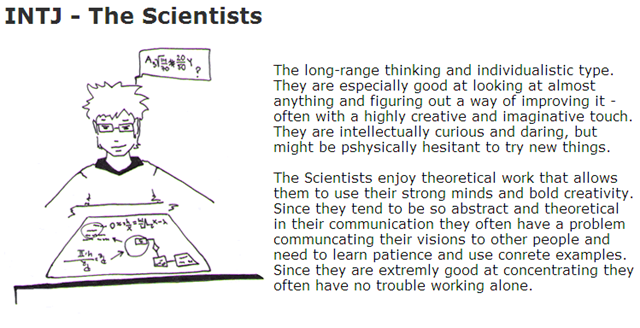
Typealyzer is a service that classifies your blog (and, by extension, you) into the Myers-Briggs personality classification framework. Based on Appliedabstractions.com, I am an INTJ, which is fine by me, though I thought I was more over towards ENTJ:

image

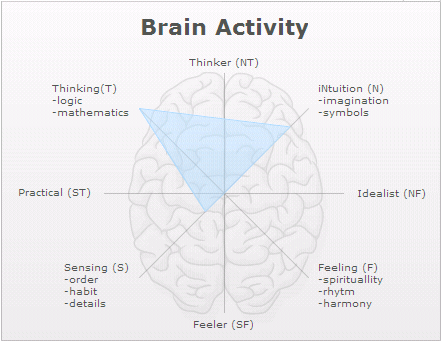
OK. Not sure I have difficulty communicating, but that may just be that I mostly sit by myself pontificating to the wall or similar-minded people who find my communicating style compatible. Anyway, what I really liked was this brain chart:

image

In other words, little chance that I will survive in a world like the one described in Ben Elton’s Blind Faith….

(Hat tip to Vaughan and Kimberly for this one.)

Blowhard

Until 2003, I lived in a part of Norway that gets about 7 ft of snow every year, so after a brief period of sweaty and aching mornings I invested in a small snow-blower. Then I moved to a place about 20 ft above sea level, where snowfalls are few and far between. But my little snow blower has brought unexpected benefits.

The first winter here was bare and cold until late January, when I woke up one morning to about a foot of snow. It was before seven in the morning and the office beckoned, so I dressed warmly and got to it.

I was a little worried, though. My next-door neighbor, with whom I share the driveway, is unofficial Norwegian champion sleeper and likes to delay the vertical part of life as long as possible. I wondered how he would react to the noise from the snow-blower at a time he considered to be just after bedtime. But I had to get to work, so I pulled the cord and started.

Half an hour later I was done, garaged my little machine (which is more like a motorized broom than a real snow-blower, except in the noise-making department) and got inside for a brief thaw-out and the day’s first coffee.

Then the doorbell rang. I prepared for the worst and nervously opened the door. There stood my neighbor, in slippers and morning coat and with his hair in all directions.

He had woke up, seen the snow and resigned himself to having to get up and do something about it when he heard me start the engine. He didn’t know I had a snow blower, and explained with an ecstatic expression that little snow-blower with a missing muffler was "the most beautiful sound he had ever heard."

Whereupon he handed me a bottle of Cognac and returned to bed.

PS: We have since formalized the arrangement. I blow the driveway, and he buys one bottle of wine per snowfall, which we consume with a delightful dinner sometime in April.

The oil rule: Whoever has the oil makes the rules

Tom Friedman, in his new book Hot, Flat, and Crowded, makes a pretty powerful argument that the US’s addiction to oil helps finance fundamentalist Islam and represses democracy. The main point: Having oil means dictators can finance repressive institutions (police etc.) and bribe the populace into apathy.

Here is a graphical telling of the same story:

World oil reserves chart

Looks pretty persuasive to me. Tom Friedman argued for a "patriotic" gas tax in the US back in 2001. Seems as good an idea now as it was then. (Chart from Daily Galaxy, via Jon Udell)

Tom also says that no country with more than 50% of its income from oil is a democracy. I am not totally sure of the numbers here, but I wouldn’t call Norway undemocratic. Update, thanks to Twit from mgjosefsen: Norwegian exports of oil and natural gas was 52% of total Norwegian exports in 2005. Share of GNP was about 25 %. We seem to be an exception, in other words.

Jazzcode

 Jazzcode is a concert/presentation held by Carl Størmer and a jazz band, typically put together for each venue. Carl, who has been traveling around the world with this presentation and has written a case about Miles Davis for the Harvard Business School, explains how jazz musicians are able to come together and play without having played together or even met before,  largely because they listen to each other, have shared references, and adhere to a pretty strict pattern in how they play through a piece. Carl, very effectively, uses the metaphor of a jazz band to illustrate certain principles and requirements for collaboration in teams.

Today I had the great fortune of attending a private JazzCode concert in Oslo, the band consisting of Carl (drums), Georg "Jojje" Wadenius (guitar), Rob Waring (vibraphone) and Edvard Askeland (base). Though I suspect this concert was heavier on the music and lighter on the management thinking – half the audience was volunteers of the Oslo Jazz Festival – I can easily see how this approach can be both an entertaining and instructing part of a company retreat or meeting.

I saw the show with my father-in-law, Ludvig Mathiesen, who in addition to everything else was Norwegian Champion of Amateur Jazz in 1956, playing the piano. For me it was an introduction to jazz – and that, I suppose, is the added benefit of having JazzCode at your event: A helping of culture with the managerial pointers.

Highly recommended.

Liveblogging from Sophia Antipolis

This are my running notes from visiting Accenture’s Technology Labs in Sophia Antipolis, as part of a Master of Management program called "Strategic Business Development and Innovation" for the Norwegian School of Management.

Accenture’s Technology Labs is a relatively small organization: 200 researchers, 180000 employees in Accenture. There are four tech labs: Silicon Valley, Chicago (the largest), Sophia Antipolis, Bangalore, they should be able to do everything, but in practice there is specialization. The four main activities of the tech labs are technology visioning, research, development of specific platforms, and innovation workshops (with clients, press, consultants etc.) The themes pursued are mobility and sensors; analytics and insight; human interaction & performance; Systems Integration (architecture, development methods); and infrastructure (virtualization, cloud computing).

Kelly Dempski: Power Shift: Accenture Technology vision

The visioning used to be far-thinking, visionary etc., now have a much more immediate focus, want to look at things that you can implement today, make it much more "grounded in reality"

Eight critical trends:

  • 1: Cloud computing and SaaS: Hardware cloud (amazon.com, IBM, Google (now the third largest producer of servers in the world)), desktop cloud (Google, Zimbra, MS Office Live Workspace), SaaS cloud (Netsuite, CrownPeak, salesforce.com), and services cloud (Google Checkout, Amazon web services, eBay, Yahoo)
    • examples: Flextronics has changed over their HR applications to an SaaS model. AMD emulates chips on software for testing purposes, now contract with Sun to do that in the cloud. New York Times had 4Tb of articles that they wanted to translate to PDF: Translated it all twice (because there was a bug the first time), someone went on Amazon with their credit card, uploaded 4Tb, processed it (24h), there was a bug, had to do it again, 48h, total cost $250 on someone’s credit card.
    • issues:
      • data location (where is the data)
      • privacy and security
      • performance
  • 2: Systems – regular and lite
    • SOA as the integration paradigm (regular), mashups (lite)
    • traditional back-end apps vs. end-user apps
    • small number of apps maintained by CIOs vs. large number of User and user-group created applications (long tail)
    • examples:
      • REST is a light architectural approach for interoperability & data extraction
      • Mashups (JackMe (trading platform tools), Serena, Duet (SAP and Microsoft), IBM) becoming more important in the enterprise arena
      • Widgets and gadgets are light-weight desktop UIs that continually update some data
  • 3: Enterprise intelligence at scale
    • combination of internet-scale computing, petabytes of data, and new algorithms
    • almost all the large systems vendors have partnered with or acquired some analytics oriented software company (such as Microsoft acquiring FAST)
    • rampant use of data: evolution through access, reporting, external & internal, unstructured etc.
  • Trends 1-2-3 together: The new CIO
    • hardware and software procured from the cloud
    • business units, end-users create their own lightweight apps
    • The new CIO:
      • "Data Fort Commander" – ensure security, privacy, integrity of corporate data and manage back-end apps
      • "Chief Intelligence Officer" – provide data analysis services & insights to business units
  • 4: Continuous access
    • mobile device "first class" IT object
    • No concept of enterprise desktop/laptop
    • location-based services
  • 5: Social computing
    • amplify and support the value of the community
    • three major directions: Platformization, inter-operability, identity management
  • 6: User-generated content
    • community-based CRM (users making videos about how to run certain kinds of software or build something from IKEA)
    • new forms of entertainment
    • revenue erosion of traditional media companies
    • this has marketing implications: You can measure the sentiment out there in the user community. You switch from advertising to engaging.
  • 7: Industrialization of software development
    • converging trends will increase integration: Predictive metrics, model-driven development, domain-specific languages, service-oriented architecture, agile-development & Forever Beta.
  • 8: Green computing
    • global warming, energy prices, consumer pressure, compliance and valuation
    • switch out energy-intensive processes for information-intensive processes: Electronic collaboration; Warehousing, supply chain & logistics optimization; Smart factories, plants, buildings & homes; and new businesses such as carbon auditing and trading

Cyrille Bataller: Biometric Identity Management

Biometric identification is coming, driven by increasing demand and technological progress. Biometric identification is defined as "automated recognition of individuals based on their physiological and/or behavioral characteristics. Physiological can be face, iris, fingerprint; behavioral can be signature, voice, or walk. Involves a tradeoff, as with all security systems, between the level of security and the convenience of the system. Fingerprint is most used (38%), face is the most natural, iris the most accurate. Many others: Finger/hand vein, gait, ear shape, electricity, heat signature, hand geometry and so on…

Balance between FMR (false (positive identification) m rate) and FNMR, called equal error rate. Iris has an EER of .002%, 10 fingerprints .01%, fingerprint .4%, signature 3%, face recognition 6%, voice 8%. Many parameters in addition to this.

Securimetrix has something called HIIDE, a mobile unit that does a number of biometrics, used in Iran. Voice is very interesting because it can be done over the phone, interesting for call centers, banks etc. Multimodal important, because it is hard to spoof.

Airports is a good example of what you can do with proper identification: You can move 99.9% of the check-in away from the airport. Bag drop can also be almost fully automated. Portugal is the leader in the EU, have automated passport control with facial recognition (scan, use electronic passport etc.). Most people are not concerned very much with privacy given some assurance and convenience. Likely to see lost of automated border clearance for the masses, but also registered travelers that go through even quicker and are interoperable across many airports. One common misunderstanding is that automated identity checking is moving away from 100% accuracy, but human passport/security control is an error-ridden process and mostly automated processes are more accurate.

Antoine Caner: Next Generation Branch

This is a showcase exhibit of best practice banking technology and processes. This showroom has about 40 companies (banks, mostly) visits per year.

Most banks have a multi-channel strategy, have returned from a strategy of getting rid of branches but want to redefine it. Rather than doing low-value transactions, the branches are seen as a mesh network for business development.

Key principles behind the branch of the future:

  • generating and taking advantage of the traffic
  • flexibility throughout the day
  • adaptation to client’s value
  • sell & service oriented
  • modular space according
  • entertaining and attractive
  • focused on customer experience

Examples:

  • turning the branch windows into an interactive display (realty, for instance)
  • Bluetooth-enabled push information
  • swipe card at entrance to let branch know you are there, let your account manager know, apply Amazon-like features
  • digital displays for marketing
  • avatar-based teller services
  • biometric-based ATMs to allow for more advanced transactions, as well as more opportunistic sales applications
  • do both identification and authentication
  • digital pen user interface for capturing data from forms
  • RFID-based or NFC (Near Field Communication) in brochures, swipe and get info on screen
  • "interactive wall" for interaction with clients in information seeking mode
  • visual tracking of movement in the branch
  • modular office that can change shape during the day, reconfigurable furniture

What impressed me was not the individual applications per se – though they were impressive – but way everything had been put together, with a back-office application that can be used by the branch manager to track how this whole customer interface  (i.e., the whole bank branch) works.

Alexandre Naressi: Emerging Web Technologies

Alexandre leads the rich Internet applications community of interest within Accenture. He started off giving some background on Web 2.0 and used Flickr as an example of a Web 2.0 application, where a company use user-generated content and tagging to get network effects on their side. Important here is not only the user interface but also having APIs that allow anyone to create applications and to have your content or services embedded into other platforms. Dimpls is another example. More than one billion people have Internet access, 50% of the world has broadband access, which allows for richer applications. Customers’ behavior is changing – it is now a "read-write" web. It has also gotten so much cheaper to launch something: Excite cost $3m, JotSpot $200k, Digg cost $200.

Rich Internet Application and Social Software represent low-hanging fruit in this scenario. RIA allows the functionality of a fat client in a browser interface, with very rich and capable components for programmmers to play around with.

Two families of technologies: Jacascript/Ajax (doesn’t require a plugin, advocated by Google), and three different plugin-based platforms: Silverlight (Microsoft), Flash/Flex from Adobe, and JavaFX from Sun. All of them have offline clients that can be downloaded as well. A good example is Searchme.com, which gives a better user interface – Accenture has developed something similar for their internal enterprisesearch.

Social Software: Accenture has its own internal version of Facebook. Youtube is also a possible corporate platform where people can contribute screencasts of all kinds of interesting demos and prototypes.

Kirsti Kierulf: Nordic Innovation Model for Accenture and Microsoft

Accenture and Microsoft collaborating (own a company, Avanade, together), and have set up an Innovation lab in Oslo called the Accenture Innovation Lab on Microsoft Enterprise Search. Three agendas: Network services, enterprise search (iAD), and service innovation. Running a number of innovation processes internally. This happens on a Nordic level, so collaboration is with academic institutions and companies all over.

Have made a number of tools to support innovation methodologies: InnovateIT, InnovoteIT, and InnomindIT (mind maps), as well as a method for making quick prototypes of systems and concepts for testing and experimentation: 6 weeks from idea to test.

Current innovation models are not working for long-term, risky projects. Closed models do not work – hence, looser, more informal and open innovation models with shorter innovation cycles. Pull people in, share costs throughout the network, Try to avoid the funnel which closes down projects with no clear business case and NIH. Try to park ideas rather than kill them.

Important: Ask for advice, stay in the question, maintain relationships, don’t spend time on legalities and financials.

Yes!

Yes!

As I said after reading his book in in 2005:

In an age of seemingly simpleminded politics and increasingly spin-oriented politicians, it is rather reassuring to know that at least one US senator has the experience of life in the less privileged lane; the perseverance and intellectual capability to analyze deeply entrenched issues and work at resolving them; and the willingness to keep the complex issues complex and […] the simple things simple.

Best sentence I read today

(and yes, the title and concept is a steal from Tyler Cowen et al.) From Michael Kinsley in New York Times:

"[Sarah Palin] was the last, victorious shot in a revolution she doesn’t support."

Language Fryed and paroled

There are language bloggers, language nuts, language nitpickers, language experts, and then, deliciously, there is Stephen Fry.

Practicing what you preach (The business school edition)

I am a board member of Masterstudies.com (prior description here) a startup company that offers a recruitment service for universities, primarily those offering master programs in business or related fields. The company now has a number of universities and business schools signed up, and we have begun to  learn something about the market that we (or, at least, I) did not know before, even though I have worked for a large, private business school for many years.

The thing is, it seems (many) business schools do not practice what they preach – i.e., many of them fail to apply some rather basic strategies, sales practices and web practices. Here are a few observations I have made so far:

1. Business schools say they differentiate, but they don’t

The classic. Porteresque view of competitive strategy says that there are only three generic strategies you can apply: Cost leadership, differentiation (i.e., being unique in some way), or segmentation (i.e., addressing specific sub-markets based on attributes of the customer). The latter, of course, is merely a more granular and partially combined version of the two first ones. Even though business schools should know competitive strategy well (it is, after all, one of their most important subjects), most of them do not pursue any one of these strategies. Or, rather, they say that they pursue a differentiation strategy but don’t. In that sense, they are neither strategic nor different.

The test for whether you have a strategy that truly is strategic is that you have chosen not to do something that you could have done. The test for whether you are differentiated is whether you can take away the school name (and things the school cannot change easily, such as nationality and location) from its description and then see whether you can determine which school it is based on its marketing material.

The reason I say this is that I have played around with the course and school descriptions found in our database, and been struck by how similar they look. Do the test yourself – go into the Masterstudies database, look up a few schools, and ask yourself: Which student segments are this school deliberately not trying to get – and what part of its offering is sufficiently different that you can see to what extent they are doing this in practice or just in Powerpoint.

Most of them are looking for the future leaders who see the challenges of  globalization, new technology and a constantly changing marketplace as opportunity to employ innovative strategies to build flexible learning companies that create value for their customers, shareholders and employees while displaying a sense of diversity and social responsibility. Hmmmm…. I wonder how large that segment really is – and to what extent the school really can serve this mythological student once he or she shows up?

The net result, of course, is a power law distribution of interest, with about 10 schools, the Harvards and Stanfords and MITs and Kelloggs of the world, getting all the attention; a near-first tier that is deadly afraid of doing something that the best schools do not, lest they be criticized for it; and a medium body and eventually long tail of schools that really do some differentiation but dare not talk about what it really consists of – for instance, explicitly targeting those who did not make it into the first tier schools but still are good students.

2. Business schools talk about market analysis, but many don’t do it well, or at all

Recruiting a student of sufficient quality and interest is a complicated process: You have to create enough awareness so you get enough applications so you can send out enough qualified to get enough accepts. To do this, you have to track

a) the number of leads (expressions of interests) you get

b) how many who actually send in an application (conversion rate)

c) how many of these are qualified and will get an offer (acceptance rate)

d) how many who accept the offer when they get it (yield)

My thoughts were that every Dean of Admission in the world eagerly tracked these numbers (they are, after all, also pretty good for measuring the level of effort of the sales team) but no, there are some indications that a number of schools, in fact, do not even know them. Depending on where in the distribution of schools you are, you ought to track different numbers: If you are top-ten, you track yield rate; if you are new, you track earlier in the process. (Incidentally, what Masterstudies offer is a filtered version of the first one, where schools can set up criteria for what kind of leads they want, thereby filtering out the clearly unqualified and enable some geographical or gender balancing – the difference between carpet-bombing and surgical strikes, as it were).

These numbers are not hard to get, but fewer schools than I thought actively manage them. (Not that I have formal statistics or would share them if I had them.).

Schools differ widely in their attitude to prospective students as well. We tested the response rate of schools and found that it varied widely – some schools did not respond at all, whereas some schools were on the phone with our prospective students in less than 30 minutes. That makes a difference as to whether the students will send in an application or not. (And no, there was no quality difference between these schools in terms of rankings and so on – we could not detect any pattern at all.)

3. Business schools know little about why they don’t get the students they want

There is a classical study by Abraham Wald of the location of bullet holes in bomb planes to find out where to add armor. Wald looked at where the airplanes were shot up and then concluded (not in the referenced paper, though) that more armor should be in the places with no bullet holes. The reason was simple enough: The planes that returned were the survivors, with bullet holes in places that could take the damage.

I wonder if not some of the same bias comes through with business schools. I wonder how many of them systematically interview or otherwise try to elicit responses from those students that did not chose their offering – at any point in the process. There are some schools that are clever – for instance, one school makes sure that the lack of a GMAT is not a hindrance to start studying if your grades and other academic performance indicators are good, by allowing the student to start and having time and resources set aside for GMAT certification. But I wonder how many take the time to find out whether it is lack of awareness, interest, timing, geography, content, structure, reputation or finance that makes promising student choose a different school. For those that interview candidates, I assume some of this comes out in discussions, but I have my doubts as to how well defined and executed these processes are.

I also have a sneaking suspicion that many students choose a business school for more mundane reasons that they tell school officials. It sounds better to say you chose this particular program because you like its specific focus on subjects or teaching philosophy (differentiation again – see point 1 above) than because the school is conveniently situated or your friends go there.

4. Business Schools make their web sites viewable, but not findable

Findability refers to the degree to which your web site or specific page can be found  by a search engine. As search technology more and more becomes the preferred interface to information, having a findable web site becomes very important. But more and more schools are finding that when you Google their specific master programs, the description of the the program found at Masterstudies.com comes up higher than their own description.

This is because schools spend a lot of money creating nice-looking web sites, but not much on making them findable. I think this is because the school has an understanding of how to create nice exclusive-looking brochures, but don’t know much about search engine optimization. The visual design of a site is outsourced to an ad agency, and the maintenance of it done through some content management package that does not use descriptive directory and file names, instead hiding new and interesting programs behind cryptic URLs. Perhaps each business school thinks their brand equity is so strong that students will know about them and come in the front door (i.e., the home page) like they used to do 10 years ago?

I have always wondered why business school web sites are done in such an overadministered and cumbersome fashion – for instance, few business schools set up ways for faculty to have blogs, instead requiring them to have official-looking web pages that are pain to maintain and leaving blogging to those who either set up their own blog outside school premises or have the technical gumption and political power to install the software on school infrastructure themselves. There are simple and cheap solutions around – Drupal, for instance – that allow descriptive directories and simple, shared content management. And when it comes to content – why not just use Movable Type or WordPress and the underlying software for faculty and other writers? In that way, the content would be plugged into what is beginning to look like the Semantic Web almost by default.

Conclusion

Given that I am on the Board of a company that tries to help business schools recruit internationally, I personally think this is just swell: Lots of business extension possibilities for us. But there is low-hanging fruit here: Simple, effective strategies and practices that business schools ought to execute on, with or without our help.

As marketing and recruiting increasingly goes on line (and, after that, into communities such as LinkedIn and Facebook), business schools will have to understand and change their marketing to make themselves much more differentiated and findable. In the meantime, there is room for first (or, rather, fast second) movers.

May your school be one of them.

Demotivators Fall Catalogue

…has arrived. And they are keeping up with the times:


I guess I like the procrastination one as well, as evidenced….

Come to think of it, there is no demotivator for strategy, and I need one for a project I am working on with nGenera – and because it would be wonderful on the wall of the department of Strategy and Logistics here at NSM….

Fun page on statistics

I was looking for a reference to the story about bullet holes in bomb planes, and came across this fun page on statistical lore. My favorite:

Question: How many people have more legs than the average?
Answer: Almost everyone. This is because the number of three-legged people are greatly outnumbered by one-legged people, so the mean (i.e. the posh mathematical way of saying that which most people think of as the ‘average’ [total sum divided by number of values]) number of legs is a little bit lower than 2.

I also liked the fact that, statistically speaking, there are 2 popes per square kilometer in the Vatican….

Plus ca change….

I clipped this from ACM Technews, an email service of the ACM:

Looking for Job Security? Try Cobol
IDG News Service (10/23/08) Sullivan, Tom
A Cobol programmer may be one of the most secure and steady jobs in IT. Analysts report that Cobol salaries are rising due to a healthy demand for Cobol skills, and there are few offshore Cobol programmers. The troubled economy also bodes well for Cobol programmers, says Interop Systems director of research Jeff Gould, as long as they are working for an organization that intends to keep its legacy Cobol applications. "Many mainframe customers with large mission-critical Cobol apps are locked into the mainframe platform," Gould says. "Often there is no equivalent packaged app, and it proves to be just too expensive to port the legacy Cobol to newer platforms like Intel or AMD servers." Deloitte’s William Conner says salaries for Cobol programmers are rising because many Cobol programmers are reaching retirement age and colleges are focusing on Java, XML, and other modern languages instead of Cobol. Dextrys CEO Brain Keane says Cobol programmers are less likely to have their jobs outsourced because the Chinese do not have mainframe experience and recent Chinese computer science graduates have focused on the latest architectures and systems and do not have experience with legacy languages and systems. Meanwhile, warnings that mainframes would disappear have proven to be untrue, particularly because mainframes are very reliable at handling high-volume transaction processing, and companies are increasingly benefiting from integrating legacy mainframe Cobol applications with the rest of their enterprise.

(Full article here.) With the exception of the part about offshoring, this article could have been written 10 years ago, and be just as true then. There are, of course, a number of programmers in India that know COBOL – converting legacy apps for the year 2000 was one of the jobs that got the Indian IT service industry started.

Come to think of it, I never really learned COBOL, myself. But I was a decent REXX programmer….

Tim O’Reilly nails it on cloud computing

In this long and very interesting post, Tim O’Reilly divides cloud computing into three types: Utility, platform and end-user applications, and underscores that network effects rather than cost advantages will be what drives economics in this area. (This in contrast to the Economist’s piece this week, which places relatively little emphasis on this, instead talking about the simplification of corporate data centers – though the Economist piece is focused on corporate IT.)

Network effects happen when having new users on a platform or service are a benefit to the other users. This benefit can come from platform integration – for instance, if we both share the same service we can do things within that service that may not be possible between services, due to differences in implementation or lack of translating standards.

Another benefit comes when the shared service can leverage individual users’ activities. Google’s Gmail, for instance, has a wonderful spam filter, which is very reliable because it tracks millions of users’ selections on what is spam and what isn’t.

Tim focuses on the network effects of developers, which is an important reason why Microsoft, not Apple, won the microcomputer war. When Steve Ballmer jumped around shouting "developers, developers, developers", he was demonstrating a sound understanding of what made his business take off – and was willing to make a fool of himself to prove it.

Tim also invokes Clay Christensen’s "law of conservation of attractive profits", arguing that as software becomes commoditized, opportunities for profits will spring up in adjacent markets. In other words, someone (Jeff Bezos? Larry and Sergei?) need to start jumping up and down, shouting "mashupers, mashupers, mashupers" or perhaps "interactors, interactors, interactors" and, more importantly, provide a business model for those that build value-added services on top of the widely shared platforms and easily available applications they provide.

One way to do that could be to make available some of the data generated by user activities, which today most of these companies keep closely to themselves.  That will require balancing on a sharp edge between providing useful data, taking care of user privacy, and not giving away your profitability too much. As my colleague Øystein Fjeldstad and I wrote in an article a few years ago – the companies playing in this field will have to make some hard decisions between growing the pie and securing the biggest piece for themselves.

If we cannot harness network effects, cloud computing becomes a cost play, and after awhile about as interesting, in terms of technical evolution, as utilities are now. USA is behind Europe and Asia in mobile phone systems partially because US cellphone companies were late in developing advanced interconnect and roaming agreements, instead trying to herd customers into their own network. Let’s hope the cloud computing companies have learned something from this….

The Economist on cloud computing

The Economist has a nice feature on corporate IT, mostly about how it is evolving towards cloud computing. Like everything the Econonomist does, it is nicely worded, measuredly opinionated, and contains nothing new to those in the know. But the article is a very good introduction to the current state of at least the technical and market side of corporate IT provisioning, so I mark it for future courses on just that topic. It includes an audio interview with Ludwig Siegeler as well.

CACM becomes much more readable

CACM (Communications of the ACM) is one of my favorite journals – and it is currently in the throes of an editorial upheaval that I think is very positive. In addition to scholarly articles, it is moving in the direction of essays and more generally accessible articles, without loosening the quality criteria. Ever since BYTE disappeared (a victim of the need for targeted advertising) I have missed a general, quite technical yet accessible journal – CACM is now getting closer to what I am looking for.

Here are two articles I found very interesting:

  • "Will the Future of Software be Open Source?, a well reasoned reflection by Martin Campbell-Kelly, giving a very terse, yet comprehensive and useful description of the evolution of software markets. Answer: OS is a tempting conclusion if you extrapolate, but extrapolation has not been a very successful prediction technique so far…
  • "Searching the Deep Web", by Alex Wright, which explores two different approaches to searching beyond static web pages – the trawling approach, which relies on local storage, and the angling approach, which produces targeted results in real time.

Anathematics

Brad Templeton has a long and good analysis (containing spoilers) of Neal Stephenson’s Anathem, which I read a couple weeks ago and have yet to make up my mind about. On the one hand, it sets up a great world with Concets of Avout who devote themselves to science rather than Praxis, it invents a number of words and does quite a bit of philosophic reasoning on topics Stephenson has explored before, such as multiple universe models. I like the first 200 pages or so really well. Then it becomes a picaresque, and not a good one at that – similar to the tour around the world in the middle book in the Baroque trilogy. Lastly, it becomes a tad puerile, with people flying around in space suits and boarding spaceships.

I love the language that Stephenson creates, and the notion of scientific communities locked in for either 1, 10, 100 or 1000 years (depending on how dangerous their exploits are, it seems) is very interesting. But the plot line could do with some sharpening, and the character descriptions are shallow at best. As is usual with Stephenson, mind you.

So, make up your own mind. I still think Cryptonomicon is Stephenson’s best, but maybe that is just me.

(Minor quibble: I think I found an error, and am enough of a nerd to report it. On page 512-13, we find the sentence "Late yesterday, Yul had shattered the calm by starting the engine of Cord’s fetch, and …." But Cord’s fetch was left on the other side of the pole, wasn’t it (on page 416)? Oh well…..maybe I should update the Anathem Wiki. On the other hand, I have a life.)

Incidentally, Anathem may be the only book published so far that has its own video trailer without first being made into a film. Here it is:

The World of Anathem
http://mediaservices.myspace.com/services/media/embed.aspx/m=41718483,t=1,mt=video

Airport insecurity

I am thinking a lot about security now, since a discussion last week on security in the 2.0 Enterprise – where the conclusion was that we need to get away from perimeter security and over towards something asset-based, i.e. securing what really matters and not faking security by having showy and inconvenient moats and drawbridges.

This funny but deeply serious article in The Atlantic takes on the example of airport security with all its symbols and holes. As Bruce Schneier (a real security expert) repeatedly has pointed out, hijackers can no longer get into the cockpit. Furthermore, passengers would attack hijackers on sight, rather than cooperate with them. Hence, the bluff that got the 9/11 hijackers in control of four airplanes will no longer work.

But we persist in implementing security that does little but increase the cost of flying, inconveniencing everyone, and, ironically, making flying (or, at least, turning up at the airport) less secure. As the article points out, the most dangerous place in the airport is where many people are waiting closely together in an unsecured area. In other words, in the security control line, perfect in case somebody wants to repeat the Lod airport massacre.

Andrew Sullivan on blogging and essaying

Andrew Sullivan has a thoughtful essay in The Atlantic on blogging and what it does for writing – his own and others’. Blogging is a substitute that frees the writer’s mind and increases the premium on orderly thinking:

A blogger will air a variety of thoughts or facts on any subject in no particular order other than that dictated by the passing of time. A writer will instead use time, synthesizing these thoughts, ordering them, weighing which points count more than others, seeing how his views evolved in the writing process itself, and responding to an editor’s perusal of a draft or two. The result is almost always more measured, more satisfying, and more enduring than a blizzard of posts. The triumphalist notion that blogging should somehow replace traditional writing is as foolish as it is pernicious. In some ways, blogging’s gifts to our discourse make the skills of a good traditional writer much more valuable, not less. The torrent of blogospheric insights, ideas, and arguments places a greater premium on the person who can finally make sense of it all, turning it into something more solid, and lasting, and rewarding.

Good stuff. Read it.

Back to Firefox again….

Google Chrome was great – but for some reason, a number of web sites I use almost daily (such as my Internet bank and pbwiki.com) did not function well with it. In addition, I have had some unexplained bluescreens since I started using it (having 30 windows open at the same time may have had something to do with that.) Lastly, a number of plugins, most importantly Zotero, are not available for Chrome.

So it is back to Firefox again. Still some issues, and I will miss the search-like interface of Chrome (write "af", hit enter, and it takes you to aftenposten.no). Still, ideas (and code) of Chrome is open source, so I expect to see a number of Chrome features in Firefox fairly soon – here is a preview of what is to come.