Author Archives: Espen

Unknown's avatar

About Espen

For details, see www.espen.com.

End of database one-size?

Memo to self: Interesting benchmark paper on general vs. specialized database architectures. With search engines beginning to compete with database query engines as the preferred interface to structured information, this may be a viable strategy for the database engine companies.

(Via Slashdot.) 

The Historian and the Wikipedia

Excellent article by Roy Rosenzweig on Wikipedia and history. Very good discussion of the importance of synthetic writing in history, and to what extent the Wikipedia model can provide it. This is at the heart of the coming discussion of whether textbooks and other material for traditional learning can be created through social production.

(Via Paal Lykkja

Words to live by

Since it is Friday, the beginning of a new year (and I need the quotation to answer a charge of being a technological optimist (guilty!)): Here are the concluding paragraphs of David S. Landes incomparable The Wealth and Poverty of Nations (Abacus, 1998):

In this world the optimists have it, not because they are always right, but because they are positive.  Even when wrong, they are positive, and that is the way of achievement, correction, improvement, and success.  Educated, eyes-open optimism pays; pessimism can only offer the empty consolation of being right.

The one lesson that emerges is the need to keep trying.  No miracles.  No perfection.  No millennium.  No apocalypse.  We must cultivate a skeptical faith, avoid dogma, listen and watch well, try to clarify and define ends, the better to choose means.

Free software for almost anything

Hard to think of anything else you would need when you are done downloading this list. I am going for note-taking software first, Firefox and Thunderbird are already my favorites, and I have used Audacity and a couple of others. What a collection. Anyone with experience of Clamwin? It can’t possible consumer more resources than F-Secure, which is what I currently have installed.

(Via Marginal Revolution

Disruptive titling

InformationWEEK is an IT magazine that sometimes displays astonishing ability to not get it. This article is a case in point. Not so much the article – it is basically a description of five new "hot" technologies that in my view are, at best, lukewarm – but the title.

To make it clear: A technology is not disruptive because it is new. It is not disruptive because it might displace the currenlty used technology. It is not disruptive because it comes suddenly on the market.

A technology is disruptive if it replaces an old technology by adressing an unmet need in the market in such a way that the incumbent technology cannot compete because doing so would invalidate the business model of the incumbent technology. This is normally because the new, disruptive technology is worse than the old technology (according to the old measures), because the most valuable customers don’t want it, and because it would be less profitable for the incumbent companies to offer it.

None of the five technologies listed here qualifies according that those criteria. In fairness to the writer, David Strom: He doesn’t use the term "disruptive" anywhere in the text. That moniker has, I assume, been slapped on by some clueless editor with an urge to use fancy words. Too bad. But not the first time for InformationWEEK.

Broken by design?

Peter Gutmann, a very reputable computer scientist, has written a highly critical analysis of the content protection features of Microsoft Vista, which is currently being discussed on Slashdot (1, 2) and essentially every other place in the known blogosphere. It seems like Microsoft is trying to close the "analog hole" by using market fiat to require all hardware vendors to downgrade performance unless all devices are certified as DRM-capable. Here’s the executive summary:

Windows Vista includes an extensive reworking of core OS elements in order to provide content protection for so-called "premium content", typically HD data from Blu-Ray and HD-DVD sources. Providing this protection incurs considerable costs in terms of system performance, system stability, technical support overhead, and hardware and software cost. These issues affect not only users of Vista but the entire PC industry, since the effects of the protection measures extend to cover all hardware and software that will ever come into contact with Vista, even if it’s not used directly with Vista (for example hardware in a Macintosh computer or on a Linux server). This document analyses the cost involved in Vista’s content protection, and the collateral damage that this incurs throughout the computer industry.

[…] The Vista Content Protection specification could very well constitute the longest suicide note in history.

I’ll withhold judgement until I hear from people who know hardware design better than me, but this sounds like a major stumbling block for Vista adoption. The underlying market dynamics in the computer market, as Nick Carr recently said it, is that "hardware wants to be software, and software wants to be free." The Vista content protection specs seem to want to reverse that. I don’t think it will work, long-term: As Gutmann points out, cheap and single-use hardware devices can be created that circumvent premium content protection quite easily.

And to think that I just went out and bought a Media Center PC. Arrgh. I have been thinking about buying a Macintosh as my next laptop, this just about clinches the decision. 

(Via Hugh McLeod)

Update Dec 31st: This is turning out to be an interesting discussion, see Joho and Bob Cringely for viewpoints. What a pity Scoble has left Microsoft.

Update Jan. 14, 2007: There is a good interview with Peter Gutmann at Tvit.tv. Amongst other things, he says he got the phrase "longest suicide note in history" from a bad political program – and that you could not listen to the podcast of the interview without having parts of your PC either shut down or intentionally lose performance. The interviewer describes Vista, with it’s 30-times-per-second system authentication check as "insanely paranoid".

Somehow I don’t think this will fly, and not just because hackers will fix it. It has never been good strategy to go to war against your customers. 

The short guide to English writing

John Scalzi, sci-fi author and prolific blogger, has a list of his best posts for 2006. It is worth visiting, and this non-writers guide to writing English (or, for that matter, any other language) is excellent and will be standard reading for all my courses from now on. Here’s an excerpt:

9. When in doubt, simplify: Worried you’re not using the right words? Use simpler words. Worried that your sentence isn’t clear? Make a simpler sentence. Worried that people won’t see your point? Make your point simpler. Nearly every writing problem you have can be solved by making things simpler.

This should be obvious, but people don’t like hearing it because there’s the assumption that simple = stupid. But it’s not true; indeed, I find from personal experience that the stupidest writers are the ones whose writing is positively baroque in form. All that compensating, you know. Besides, I’m not telling you to boil everything down to "see spot run" simplicity. I am telling you to make it so people can get what you’re trying to say.

If I could only do that consistently myself. His points about grammar are also interesting – one of the few things Norwegian schools do better than US or English schools. I have experienced myself, not infrequently, that I will know correct English usage better than native English speakers because I know some grammatical principles.

Anyway: Key point for non-writers: Speak what you write. If you can’t speak it, don’t write it. Simple indeed.

Grading techniques

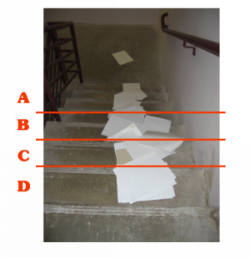
1ec8969A few years ago, most European universities began using letter grades (A, B, C, D, E and F). This actually made grading harder than before. We used to have numeric grades, on a scale from 1 to 6, with 1 as the best grade. Then I would grade reports simply by measuring their thickness and multiplying with a factor (the thinner the report, the better the grade). Sorting exams into categories is much more complicated, with lots of if..then statements in your spreadsheet.

Luckily, Daniel Solove has, very collegially, shared his robust method of grading. Continuing the tradition of learning from Law School faculty (after all, they invented the case method), I think this will be my preferred method from now on.

Christmas is approaching, and our new building has plenty of staircases which seem purpose-built for this grading method. The only problem is that more and more students submit exams electronically. I think it is inefficient and costly to print out all the papers before grading them. Could there be a market for an electronic grading toss simulator?

(Via Volokh)

Pitfalls for the US speaker in Scandinavia

(To be updated, I hope. Suggestions?) 

One of the reasons one has a blog is that it is a great place to put things to refer back to. I recently hosted Dan Pink at a conference here. Before the conference, we had a conversation, and I outlined some errors I often see European management speakers make when visiting Scandinavia (or even Europe in general). It occurred to me that this was something I could put here for the benefit of others and to save myself having to repeat it. (Dan, incidentally, didn’t hit a single one of these. Excellent.):

  • Don’t use big-name US companies (General Motors, General Electric) as examples without explaning who they are. Outside top management echelons, most people will only know their brand names (incidentally, for GM in Scandinavia, that is Opel) and not the companies themselves.
  • Never use the US mobile telecommunications industry as an example of something good or advanced (or, at least, be very careful). Mobile communications in Scandinavia outshines the US mobile phone industry by a factor to high to compute – you can essentially get into your car in Northern Norway and drive to Rome while continually being on your cellphone. Try that in the US. (This comparison isn’t fair, there are many pockets of innovation in the US cellphone industry, but most people will judge the industry in terms of connectivity and coverage when they go to the US themselves.)
  • Be very careful about using banking examples – US banking is seen as very backward by Europeans, because of the continued use of paper checks. In reality, the US banking industry probably leads the world in technical innovations, but services between banks are not nearly as integrated as in Europe – and therefore are seen as backward. Plus, European banks have a wider range of services in the payment area – services that credit card companies and PayPal do in the US.
  • Be careful that you don’t talk about Europe as if it was a country like the USA. There is much more variation between countries in Europe than between states in the US – language, history, culture, attitudes, economics, etc. Check each country on Wikipedia (particularly economics if you are speaking to a business audience) and make sure you don’t say things that are wrong about a country.
  • Don’t refer to going to church in your talk (for example, refer to someone as "we belong to the same church" or similar). In Scandinavia, at least, less than 10% of the population goes to church regularly, and religion is a very personal thing. You will be seen as belonging to some strange cult or something.
  • In general, Europeans are less inhibited in the off-color joke department than Americans –  not that it takes much – but there is considerable geographical variation. However,  this apparent frivolity comes with subtle pitfalls: If you tell something that can be construed as demeaning to women, for instance, it will fall very flat even in an all-male audience. The telling of off-color jokes should not be attempted unless you really know your audience (or if you possess an English accent more pronouced than Stephen Fry’s.)
  • In general, Scandinavian business people are less formally dressed than Americans during daytime, but they dress up (or keep their business suits) for dinner. Quite the opposite from the US, so don’t change into jeans for that after-work restaurant thing. Unless you work in software, which is thorougly Americanized. (If in doubt, ask. Preceed it with an "In the US we do this, what’s the custom here?")
  • No US-only sports metaphors! (Which, incidentally, for most US speakers will mean no sports metaphors.) Though Europeans know what American football, baseball and basketball is, they generally don’t know these sports well enough to understand individual terms such as touch-down, loaded bases or rebound (though they might understand "slam-dunk" from context.) So, unless you are throughoughly familiar with soccer, handball or (in Scandinavia) cross-country skiing, ski jumping or biathlon, don’t use sports metaphors. They simply aren’t used as much in Europe as in the US. (As seen in Henrik Lindstad’s comment below, though, no rule without an exception.)
  • Some opinions which are labeled "conservative" in the US, are considered fascistic or simply crazy in most of Europe. The "right to carry arms", anti-abortionist sentiments, and, quite frankly, much of what George W. Bush is doing at the moment is viewed with horror by many Europeans. While most audiences will view an American speaker as a any speaker on a specific topic, mentioning that you are a member of the NRA will (for those in the audience who knows what that is) position you as a person with a frighteningly loose grip on reality for most European audiences.
  • more to come, suggestions?

Right-brainer with analysis

I recently had the pleasure of hosting Dan Pink at a conference here in Norway. Dan is a writer for a number of august publications and made his name with the book Free Agent Nation a few years ago. His most recent book is A Whole New Mind: Why Right-Brainers Will Rule the World, in which he makes the relatively simple point that because of Abundance, Asia, and Automation, all work that is explicitly defined will move to the place in the world where it can be done the cheapest. This means that competition (be it in products or services) will take place less on price (utility) and more on significance, i.e., design and emotion.

I tend to be very sceptical about professional speakers, partly because I am Norwegian (and thus a member of the most cynical group of people in the world,) and partly because 10 years on the rubber chicken circuit has given me a severe allergy to gurus giving canned speeches.

Dan turned out not only to be very solid in his analysis, but also very attuned to his audience. My job was to lead a discussion on how his ideas related to a Norwegian, as opposed to American, reality. The discussion was not necessary, because Dan and I had a couple of conversations beforehand and he took the trouble to not only read the stuff about Norway I sent him, but very carefully tailor his talk so that language and examples related to something the audience knew.

Well done, and a lesson for any speaker, no matter nationality and place. The test of your mettle is not how polished your message is, but how it is received and understood by the audience. I wish more speakers would understand this (including, incidentally, myself.)

Extatosoma tiaratum

Seth Godin found an insect for which there was no entry in Wikipedia, and made a prediction about how long it would take before it was fixed.

There. The rest we can leave to the expanders.

[insert obligatory Yochai Benkler social production comment about here]

Freeconomics for Freakonomists

Chris Anderson goes all soft and mushy over the fact that we now seem to be breaking the "penny per MIPS" barrier.  He is right to step back and shake his head in wonder: Moore’s Law is still going strong, thank you very much, and it is sometimes (OK, once per year would be about right) useful to step back and reflect a bit on what this means.

I started saying in various speeches back in 1995 or so that computing, communications and storage should be considered free. That doesn’t mean that you won’t continue to pay Intel or your telco or various harddisk producers a lot of money, but it does mean that if you want to do something strategic, lack of computing power is not going to hold you back. I think I was right then, and I think I am right now: It is not the technology that slows us down, it is our imagination. Or lack of it.

In a market with falling resource costs, it is sound practice to think of resources as free – it frees up your mind as well. One of the reasons Google is possible, for instance, is because they use cheap hardware and an open-source base, on which they build their infrastructure. If they need another 40000 servers, that does not mean they need to pay another 40000 licenses – a saving not just in license fees but also in the inevitable monitoring and accounting that goes with any kind of pay-as-you-go scheme.

Now if we could only free up the information of the world to the same degree. I wonder when the European countries will reach the same realization that the US seems to have reached a long time ago: That the value of making all public information freely available (in tax from companies profiting from it, for instance) vastly exceeds whatever license fees can be had from selling information already paid for by your tax money back to the people who provided it in the first place. I predict that public information will be public, partly because what Yochai Benkler calls "social production" can recreate it (the way UK internet users are recreating the proprietary postal code database), partly because in a connected society, having free access to public data becomes both an individual right and an effective check on government – and voters will start demanding it.

But it will take time and it will not proceed according to Moore’s law. But perhaps we can use Moore’s law to free the information – by using search engines to sniff out and systematize the information that should be ours in the first place?

That would be a hacking project in the Wikipedia spirit. Free the captured information!

Web versions

In the current discussion of Web 1.0 vs Web 2.0 vs Web 3.0, here is my quick and not particularly clean definition:

  • Web 1.0: Streams of information
  • Web 2.0: Streams of interaction
  • Web 3.0: Streams of interpretation

That’s all for tonight. You may go home now.

Web service economics

Don McAskill, who runs a photo sharing service called SmugMug, has a very good writeup on how much money his company saves by using Amazon’s S3 (Simple Storage Service) rather than running his own storage solution. Aside from the pure economics (including the tax effect of reducing the asset base,) note the organizational focus implications: Since they let Amazon handle the technical details, they can concentrate on development and customer service.

(Via Scoble.) 

The Mile High Blogging Club

I am writing this from an SAS flight between Copenhagen and Beijing, somewhere over Siberia. Boeing’s Connexion service is available (though this is an Airbus A340) and since it is free for now, I just had to try it.

I don’t know about you, but I think it is pretty damn fascinating that you can read and send email messages 10000 feet up in the air somewhere east of the Ural mountains. The response time isn’t that bad either, and the sorry excuse I have for a mail server actually sends the messages from up here, as opposed to from the Copenhagen SAS lounge, where I spent a few hours delivering i talk via videoconference.

Anyway, I am on my way to Beijing to teach at the Ericsson China Academy, four days on IT management (with a translator, since only half the class understands English.) Wish me luck. I’ll need it.

Blogging a mile high. I just can’t get over it…. 

Owning words

Steven Berlin Johnson has an interesting little piece in the NYT Review of Books, where he discusses how words acquire meaning – or, rather how online definitions of words acquire meaning over time, thanks to the perpetual ephemerality of online material. Definitions by Googlerank. Recommended.

PS: The NYT has come up with an alternative view ("Single Page") for those of us who like to see the whole article at once. Previously, you could use the "Print" version, but that would strip out pictures and diagrams and make the page less readable on screen. Smart.

PSPS: If I were to follow SBJ’s viewpoints here, I should probably have written the first PS as a separate blog entry, titled "Single Page". Oh well. Guess someone else will have to carry the burden of defining it…

Firefox 2.0

Firefox logoFirefox 2.0 has been released and has more than 2 million downloads in 24 hours. Including mine.

The main updates seem to be in more RSS functionality, a tastefully updated UI (including better tabbed browsing), and the ability to restore work sessions. The latter feature is one I will appreciate – when you work researching something and your computer freezes, being able to bring up all the tabs again is reassuring. (Haven’t tested this yet, luckily, but I am sure I will in the not-to-distant future.)

Firefox can sometimes be a memory hog – hopefulle this has been fixed in the new version. 

Seamless install and transition from earlier version, as usual with Mozilla applications. Highly recommended.

Update: Slashdotters (some, at least) think 2.0 inferior to 1.5. So far, I disagree.

Okaysellers

New word alert: Theresa Nielsen Hayden has a great observation on the publishing industry – saying that the important thing is not to search for the elusive bestseller but rather to have many "okaysellers".

Makes sense from an economist’s view, I suppose – with low marginal cost, easy distribution and no expiry date there might be more money in finding new books at low acquisition and marketing cost than in the ad-driven lottery tickets we call best-sellers.

One of Theresa’s commenters points out that the original Wall Street Journal article actually does not say what Theresa says it says, but rather the opposite….at least in the conclusion. Another commenter says that it is what is in the beginning of the article that is important, since nobody reads the article to the end….

As my friend Eirik has pointed out in his discussions (can’t find the link) of the Norwegian publishing industry: What is fascinating is how the whole industry discusses markets and economics without introducing numbers. It should be trivial to get a view of what books are selling over time – Tim O’Reilly can show the way – and then the discussion could start from fact rather than feeling.

Then again, most publishing employees seem to be in it less for the numbers than the words. They like it like that.

One step closer to IT in the wall socket

Data Center containerNick Carr has an interesting post about Sun’s new data-center-in-a-container, or trailer park computing, as he calls it. (Sun calls it the Blackbox.) If you have power and electricity, here are up to 245 servers (presumably, Suns running Solaris) and you can have computing on demand in a very literal sense.

I think this is less important as a product than as a physical prototype for services yet to come. There aren’t that many companies that need rent-a-centers for shorter periods, and those who do can probably do much with dynamic server sharing or perhaps farming some of it off to offerings such as Amazon’s S3 service. But the thinking that went into the configuration and customer interface for the computing container will represent a very significant step on the way to IT as utility, delivered through sockets in the wall (or, for that matter, wirelessly.) What is available in hardware will be emulated in software, eventually.

Update: Bob Cringely has some good comments and the history of how Sun was started. He thinks there is a market for a couple hundred of these boxes, Sneakernet fashion.