Reynolds is a London ambulance driver who blogs – he has a book out called "Blood, Sweat and Tea" and I have learned a lot about basic health care by reading his blog.
Sometimes, he writes things that are just very, very sad.


Reynolds is a London ambulance driver who blogs – he has a book out called "Blood, Sweat and Tea" and I have learned a lot about basic health care by reading his blog.
Sometimes, he writes things that are just very, very sad.
(Third installment in a series of Notes from FastForward 2008)
John Hagel: The User Revolution
(John spoke without slides – what a relief)
The user revolution is about power. Good news, bad news: Most of us are users, so that is good. But most of us are employees of companies, and they are being squeezed. Average lifetime as humans going up, average lifetime of firms is going down (average time in Fortune 500 is now 15 years.) Companies have not yet figured out how to thrive in this environment.
A key limiter has always been shelf space – either in a store or as share of attention of a sales person. This is no longer a scarce resource. The scarce resource now is is customer attention. Second part of the story is the increasing power of talent. Talent is in short supply and increasingly important to company performance – and there are more options for talent to leave. Companies will increasingly differentiate themselves on their ability to develop talent.
Movement from push programs to pull platforms – from tightly scripted activities to flexible frameworks for orchestrating resources. How do we create decentralized resource networks that are highly scalable? The “pull platforms” are about connecting people to resources and to each other. Bill Joy: There are always a lot more smart people outside your organization than inside. Example: Lee & Fong, tailored supply chains for apparel designers. Cisco Connection Online with 40K “partners” around support of products. Facebooks mobilizing application developers.
Push models allowed companies to start and to create effective processes. Manufacturing, education etc. has primarily been in push mode. Push programs treat people as passive consumers, pull platforms treat people as network creators. Search is a critical tool here.
One problem: For any revolution, we need a pragmatic transition path. This requires a new set of performance measures (in addition to traditional measures, not as substitutes):
As customers become more powerful, they want influence over the design of the platform. Allow that to gain loyalty. Customers are looking for partners that can help them become better faster, collaborate more effectively with others.
(Second installment in a series of Notes from FastForward 2008)
Don Tapscott: Wikinomics – setting the stage
Don started by saying that this is not new: Time’s Person of The Year was you, and that is soooo 2006. Mass collaboration changes everything. Buy my book! Now, seriously…
Companies are becoming more professional and peer-oriented, less hierarchical, more meritocratic. This is not new either – Paradigm Shift said this in 1991, and Peter Drucker has said it for a long time before that. Why is it taking so long? The drivers have been missing, but are here now:
Four drivers of change:
1: Technology, particularly 2.0 technologies: Things talking to each other – one friend has his sprinkler system couple to his intrusion system, in case a burglar jumps over the fence. In the new world, you browse the physical world. GPS allows not just positioning, but movement. True multimedia changes what a film is. New web based on XML, the web is becoming a global computational platform. In some ways, search becomes the new operating system, But legacy systems exist and the integration problem will not go away quickly.
2: The net generation: We have this generation that are not afraid of technology because for them, it has always been ubiquitous. We have had boom, bust and echo in demographics, but the echo is larger than the boom – in Asia and South America have tsunami coming along. These kids multitask, don’t use the TV, they are very active with collaborative technology, games and search. Their synaptic connections are actually different, since they have had this during their formative years. They use email technology to send a formal letter of thanks to a friend’s parents.
3: A social revolution: The rise of collaborate communities. XML has overtaken HTML: Flickr beats Kodak, YouTube beats MTV. MySpace has 15,000 bands….. His son created a Facebook group on Wikinomics that exploded and is now placing demands on him….
4: An economic revolution: You are getting new companies: Digital conglomerates. Google is the fourth largest broker of hardware in the United States. Microsoft, Yahoo, Google, amazon.com, ebay – these are not some blips. Coase: Transaction costs is really cost of coordination and contracting. From industrial companies to extended enterprises to business webs, and now we will have mass collaboration. Example: Goldcorp, a mining company ready to be shut down, because the geologists cannot find gold. So they put their geological data on the Internet, hold a competition on the internet, $500,000 prize money, 75 submissions find $3.6b worth of gold. Many of the best submissions came from people who where not geologists.
How do you harness mass collaboration? 7 things:
“New paradigms cause dislocation, conflict, confusion, uncertainty. New paradigms are nearly always received with coolness, even mockery or hostility. Those with vested interests fight the change. The shift demands such a different view of things that established leaders are often last to be won over, if at all.” (Marilyn Ferguson).
Saint-Exupery: We should welcome the future because it will soon be the past.
We should respect the past because it was once all that was humanly possible.
(First installment in a series of Notes from FastForward 2008)
Andy MacAfee: Enterprise 2.0: What will it take to bring about a world of change
MacAfee talked about what it takes to bring about change – Enterprise 2.0 (corporate use of Web 2.0, as I see it) has moved from the what through the why to the how. He looked into some of the factors that seem to be connected with success, grouped into technology, initiatives and culture.
Technology must have intuitive and easy tools (meaning that it needs to work with email, for one thing), the tools must be egalitarian and freeform, the borders must seem appropriate to users (meaning that you need some borders and confined spaces), at least some of the tools must be explicitly social, and the toolset must be quickly standardized.
The most difficult part lies in the intuitiveness – avoid feature creep! The egalitarianism and the freeform part has more to do with bosses than with technology. Bosses are not comfortable with letting loose the process definition part – they need to work hard to get out of the way, at least initially.
Initiatives usually involves incentives – they exist, and they should be soft. Not just T-shirts and nerf toys, but not much more, and not monetary. Goals need to be clear and explained – being interested in Enterprise 2.0 is not good in itself. Many companies don’t have a goal – the US Intelligence community is an example of an organization that has one. Most important: You need incentives; having evangelists, and having official and unofficial support from the top. You also need excellent gardeners, bottom-up energy and activity, and clear and explained goals. The CEO Blog is a good thing – Marriott has one, dictates it and it is not created by the PR team.
Most difficult: Getting the incentives right, and getting the excellent gardeners – people that accelerate the emergence of structure in wiki environments. In any population there are not enough of them.
Culture: Some important issues are that people should be trusted, there should be slack in the workweek, helpfulness has been a norm, top management accepts lateralization (turns out it is very hard for companies to accept even light user commentary, for fear that it might be negative, even though all statistics show that it it is very powerful – most of it is going to be positive, and the negative comments make the positive ones more valid), there are lots of young people, and there is pent-up demand for better sharing. Most important: trust, lateralization, and pent-up demand for sharing.
Most difficult: Trust, slack in workweek, and top management accepting lateralization. You need spare cycles!
Conclusion: enterprise 2.0 is going to increase differences among companies – technology accentuates differences, and this one will. The data is accumulating. The reason lies in willingness to embark, sincerity of effort, and ability to execute. These differences will matter – it will not be the end of the hierarchy, but it will help companies become more responsive, help capturing and sharing knowledge (particularly as the demographic bulge is leaving the workforce) and then there is this vague notion of collective intelligence. Groups and committees, geographically dispersed, can do spectacularly valuable things with this technology.
Seth Godin gives examples of how winning web sites often are not those that win design awards, unless you define ”bad design” as ”does not work”.
 I am not sure this is a real trend, but here is another example: vg.no. This Norwegian newspaper has a website that breaks all possible criteria for good design: It is seemingly disorganized (there is not thematic order to the articles), has colorful images and distracting images all over, is very long, and is manually put together. And it is wildly successful: VG is Norway’s largest newspaper*, and vg.no has more readers than the paper paper.
Vg.no is also different in that only 5% of the material at the web site comes from the paper version. The managing editor of vg.no, Torry Pedersen, has so far resisted any integration with the paper version tooth and nail – something the very successful media house Schibsted gives him, not least because his profitability levels have consistently been over 40% and he has taken more than a quarter of all news and entertainment traffic in Norway.
I used to think that search would take over newspapers, but Torry begs to differ: Only 10% of his readers come through search engines – the rest arrive in the front doors, looking at the lively, entertaining and rather chaotic front page as a gateway to something interesting, something newsworthy, a break in a hectic or slow day.
In other words, there are more than one way to skin a cat, or, in this case, to bring newspapers to the web. Torry’s way should be something to ponder for traditional papers such as the New York Times, with their rather austere and self-important designs. The Atlantic has an interesting front page, but the content does not change often enough to make it a frequent stopping place. As for the rest – look out for Google News…
*On a personal note: I never read it myself, since it is decidedly tabloid in nature. The Internet version, though, is subtly different.
John Scalzi, successful sci-fi writer, gives his perspective on how to think about writing and money. Strike “writing” and replace it with any other kind of independent work, such as speaking, consulting or development, and it is still excellent advice.
Come to think of it, most academics I know fall firmly in the “dont’ quit your day job” category – with the exception that most of them do the extra bit in order to afford being an academic…..
Oh well, perhaps it is time to write that book. On salaried time, mind you.
<span flame="on">
For once, a thoughtful post and not too bad discussion about Vista, Linux and All That Jazz over on Slashdot. Bennett Haselton discusses his experience with Vista in terms I agree with. Yes, it is a beautiful interface, but it deviates from what I am used to (for no apparent reason), runs somewhat slower and certain features (FolderShare, for one, which is a Microsoft Live product but only works if you employ some rather tedious workarounds) don’t work at all. Which creates a problem for me – we have a bunch of computers at home, mostly XP, but two Vista laptops. They are used by my wife and youngest daughter, which means I am Chief Troubleshooter on a system I don’t use myself (my employer uses XP). The main problem with them is that what I thought was a rather smart system setup with reciprocal backups, dependable networking and orderly file structures becomes unmanageable because Vista hides so much of its inner workings from view. In contrast, my middle daughter recently got a MacBook and is self-sufficient (and, for her, Foldershare works).
As for the following inescapable Linux discussion (yes, I am IT literate enough to run and sometimes also configure Linux. My family isn’t. My workplace doesn’t do it. I can’t afford to throw out everything and go with Macs, partially for work compatibility issues, partly because Apple doesn’t have a Tablet laptop. Unless (hint) Apple decides to upgrade the whole family for free in the hopes that I will vax poetically about it here.)
I think Blindspot nails the future for Linux in a comment titled Innovation is the Killer App:
STOP TRYING TO MAKE LINUX BE WINDOWS!!! People already have Windows, they don’t need a replacement. That’s why they don’t switch. The "replacement Windows" idea was already tried: it was called OS/2 Warp for Windows, and we know what happened there. (Never heard of it? Bingo.)
Look at where Linux’s successes are: Servers and mobile devices – places where Linux doesn’t try to emulate Windows. Places where developers actually innovated instead of just copying. The robustness, versatility, and stability of a Linux server – that’s the killer app for servers. The portability and the ability to do unique interfaces like those on the XO or the Eee – that’s the killer app for devices.
It doesn’t just work for Linux. Apple too sees the most success where it has tried to take the lead: the iPod, iPhone, MacBook, etc. In this case it’s the simplicity and/or distinct function-meets-form interfaces that provide the edge. If they made the iPod be like every other MP3 player, and the MacBook like every other laptop, Apple might not even exist now.
Don’t try to beat Microsoft at its own game. You can’t. The way to beat them is to change the game entirely. I’ve been saying this for years, but sadly developers still waste tons of time and effort trying to make Linux be Windows. If only they instead put this into making the next big breakthrough in user interface or computer design using Linux as the platform. Something that 15 years for now will make us say "I can’t believe we used to use a desktop window interface" in much the same way we now talk about dumb terminals and typewriters. It’s gonna happen anyhow, so why not do it on Linux
<span flame="off"> Or whatever. </span>, I suppose.
Goodness, I must have overdosed on this delicious coffee on a nice Saturday morning. But the points, whatever they are, stand. And now we return to our regular programming….
Bob Cringely, as usual, has the most original and insightful take on Microsoft’s bid for Yahoo.
 Just a thought….
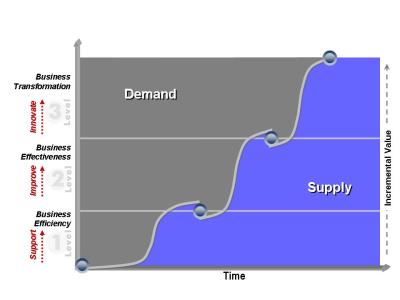
My esteemed colleague Vaughan Merlyn currently is on a quest (under the heading of the BSG Concours project Reaching Level Three) to further develop the already very useful framework of business-IT maturity. This framework (which has been around in many different guises the last 15 years or so) describes three levels of business-IT maturity – a basic one (level one), where the business asks and IT delivers, a more advanced relationship (level two) where IT is seen as a partner by the business, and a very advanced one (level three) where IT provides a platform for innovation to the business.
Lately we have been discussing ways to refine this framework in light of new technologies that have come along, as well as doing case research on companies that have reached level three. One thought that struck me is that there is a lot of similarity between these three levels and Clayton Christensen’s three types of decision-making. In the excellent article Why Hard-nosed Executives Should Care About Management Theory (HBSP), Christensen and Raynor posit three ways of making decisions:
To me it seems that the level one relationship works for problems that are largely rule-based (hence a focus on measures, formal decision-making and benchmarking). The partnership model works for problems that lend themselves to pattern-matching – you need a forum of experienced business and IT executives to discuss the problem and arrive at the solution through associative reasoning. The third level could be seen as a forum for answering those questions – or uses of the technology – that are so new that neither measures nor prior art exists. What is needed is a creative relationship, a theoretical (or, at least, abstracted) shared foundation, and a willingness to commit serious resources to trying to do things that may turn out not be possible.
Viewed this way, the maturity framework becomes a desciption of what kind of conversations the CIO and the CEO has – and what kind of problems the business wants help with, and the IT department can adress.
New article in ACM Ubiquity: Time to end laptop serfdom!
(available after the jump for the inevitable corrections and in-text links)…
According to this website, the highest paying adwords are:
In fact, the word "mesothelioma", a kind of cancer often caused by asbestos (which means you have a potentially lucrative lawsuit in your near future) dominates the list. Other popular words are "insurance", "lawyer", "attorney" and "quotes". Anyone doubting the economic impact of litigation on the American economy?
(And yes, it will be interesting to see what this posting does to my Adsense account. My hypothesis: Nothing at all.)

I am involved (board member) in an exciting startup, a company called Masterstudies.com. We offer potential students a way to find suitable MBA and other Master level programs, and universities and business schools a way to find good students.
So far it has been a fun little project which has involved helping to specify functionality and interface, interacting with the very competent management, and talking to investors.
I think the company has something very useful to offer – there are literally millions of people around the world trying to find their way among the thousands of MBA and other Master level programs in business and related areas. One of the ways we differentiate ourselves from the competition lies in the way universities can specify what kind of leads they want – if you want details, contact our CEO, Linus Murphy.
We have spent the Fall making sure the product is good enough (partially with input from some of my students) and the database large enough (currently at 6,700 different programs) and now is the time to softly launch. There are still bugs to work out, but prospective students can now sign up, fill in their details, select schools and programs based on their preferences. Even though we have not marketed it at all, the traffic figures are promising, the number of leads sent per day is in the hundreds and it is rather exciting to see the details flying by – we are getting leads from all over the world.
I am rather optimistic that this company will succeed in providing value both to universities and students. In the words of our intrepid chairwoman, the student-to-university market is one of the few inefficient markets left, and it is high time someone does something about that. That’s us!
So – why don’t you check it out and tell me what you think?
I have started fiddling with Adsense ads, in the beginning only on individual postings. This is mostly an experiment (justified by my participation in the iAD project) but I am also curious to see how many people visit this blog (checking traffic figures, I had a spike of 67,000 unique visitors last October, though I have no clue why) and what the practical implications of Adsense really are.
Adsense is funny in the sense that it generates ads based on content – a task which is made difficult by this blog’s apparent eclecticism. My wife has a blog dedicated to quilting and other fabric-oriented art forms, and her ads are relevant and interesting, both to her and others. I write about less specialized themes, and then the ads become rather generic. And, of course, if I should write about degree mills, guess what kind of ads show up.
Oh well, riches will eventually follow, I am sure….
….is the somewhat cryptic title of a research project I have been involved in for about a year. The project is financed by the Norwegian Research Board, led by FAST Search and Transfer, has Schibsted and Accenture as business partners and six research partner institutions (UiO, UiTø, NTNU, Cornell, DCU/UCD and NSM). The purpose is to do research in advanced search technology – and to try to understand the business implications of search technology (which, as you may surmise, is what I am involved in.)
All this to introduce a new category on this blog – iAD – and to say that I will start to write down various ideas within this research project whenever I think so. Plus, anything search-related will now be labelled iAD as well.
And in case you think search is not important – Microsoft acquired FAST two weeks ago, and today offered $44.6b for Yahoo (which uses FAST technology.) Hence, search is apparently important. At least to Microsoft.
I am off to FASTForward in Orlando in two weeks, so perhaps there will be time for a little conference-blogging under this heading as well. Until then….
I am currently re-reading Robert Pirsig’s Zen and the art of motorcycle maintenance, and came across this section, which is one of the best explanations of the scientific method I know of (explained in terms of motorcycle maintenance, of course). So, here goes:
My first real boss, Erling Iversen, used to say that there were two kinds of IT people: Those who had read Hofstadter’s Gödel, Escher, Bach and those who hadn’t gotten around to it yet. In his opinion, what you got out of that book said much about how you thought about technology. Which leads me to wonder – do we have a canon of technology writing?
A canon is a list of books that you have to read to consider yourself knowledgeable – or, rather, educated in the classical sense – within a field. Creating lists is always controversial, and canons are more controversial than anything (witness all the discussions when Harold Bloom wrote The Western Canon.
The list I would like to create, though, is rather specialized: It consists of the books any technology thinker should read. I am not sure what I mean by that, aside from wanting to put together a list of books I like and that have influenced me, but hopefully the criteria becomes clearer as the list grows. One criterion is that the book must have stood the test of time, to be relevant even though the technology has changed (and, consequently, a book that I will occasionally re-read). A second (or perhaps it is the same criterion) is that its lessons apply outside the technology it discusses, whihc is another way to say that it will be readable by non-technologists.
Here is a brief start, just off the top of my head:
…and probably others (a whole lot of Internet-oriented stuff missing here), but I am beginning to stray. Anyway, ideas for books that every technology thinker should have read.
Suggestions?
I don’t know where I came across this one, but since a significant and growing portion of emails and other material received these days seems to consists of longer and longer CYA notices, why not settle this once and for all:
Beware the academic with "gravitas", writes Philip Davis; all it means is that he can make a ten-second banality last ten minutes. A gravitas has "all the inner life of a bicycle pump."
I love it. As for comments on why – no comments. Aside from the fact that anyone connected to academia has met Professor Gravitas. Sometimes on self-reflection.
I am still formulating my thoughts here.

Absurdistan bears the same relationship to Russia that John Kennedy Toole’s Confederacy of Dunces bears to New Orleans: It paints a wildly satiric picture that somehow comes up more true than the original. The Ignatius O’Reilly of this book is Misha Vainberg, the grossly overweight, rich and rubbed son of a Jewish oligarch who eventually finds himself stranded in the rapidly disintegrating Republic of Absurdistan (known for its TV remote control factory), an oil-rich enclave by the Kaspian Sea. Misha wants to return to New York where went to Accidental college and learned to appreciate rap, junk food and assorted versions of psychoanalysis:
At Accidental College, we were taught that our dreams and our beliefs were all that mattered, that the world would eventually sway to our will, fall in step with our goodness, swoon right into our delicate white arms. All those Introduction to Striptease classes (apparently each of our ridiculous bodies had been made perfect in its own way), all those Advanced Memoir seminars, all those smposiums on Overcoming Shyness and Facilitating Self-Expression. And it wasn’t just Accidental College. All over America, the membrane between adulthood and childhood had been eroding, the fantastic and the personal melding into one, adult worries receding into a pink childhood haze.
It really is no point trying to explain the plot here, to the extent that there is one. The language and the casual kicks in many directions (the role of the Golly Burton company in instigating civil war to get various military contracts, for instance) is howlingly funny and yet oddly irritating. Misha Vainberg is a despicable character, but with enough money and borrowed cachet that nobody seems to care. he blunders through a disintegrating republic where people are shot in the streets and bombed for the benefit of television, returing to his hotel room to read today’s menu and seeking to escape on the American Express VIP train:
"Wow", I said in English. I turned around to look at my manservant. "Did you see that, Timofey? We did it. We saved a life. What does it say in the Tamud? ‘he who has saved a life has saved and entire world.’ I am not religious, but my God! What an accomplishment. how do you feel, Sakha?
But Sakha could not supply the words of gratitude I deserved. He merely breathed and drove. I decided to give him some time. I was already componsing an electronic message to Rouenna about the day’s exploits. What had she told me in that dream about the eight-dollar apple? Be a man. Make me proud. Done and done. […]
Respectful of the Hyatt sign, the soldiers waved us through, the locals banging on the sides of our vehicle, hoping we could enable their safe passage to the hotel. "Unfortunately we have to save our own hides first," I said to Sakha.
Unfortunately, Sakha, a local democracy advocate with uncertain background and appalling dress sense, gets shot about two minutes later. This eventually earns him a statue and Misha the post of Minister of Multicultural Affairs, with the job of trying to get Israel to finance a Holocaust center and the USA to invade.
And there you are – a novel impossible to classify, howlingly funny, and highly recommended.
 Nicholas Carr: The Big Switch: Rewiring the World, from Edison to Google.
In his excellent book Holidays in Hell, P. J. O’Rourke visits Future World (an attraction at Disney World) and says that it is "like opening a Chinese fortune cookie to read, ‘Soon you’ll be finished with dinner.’"
I get the same feeling reading Carr’s book (an advance copy) – it is well written, stylish and easily recognizeable like Disney World – and understandable to the masses. The main message of the book is that because of faster networks, computing will be centralized and made accessible like electric power. Carr even draws a line back to the history of electric power provisioning. All very well, we already see this happening with Google applications and Gmail. But I first heard this prediction in 1990, spoken not as a wild speculation of the future but as a likely and not particularly exciting outcome by my thesis advisor, professor Jim McKenney at the Harvard Business School.
The centralized and ubiquitous computing future Carr eloquently predicts is, in principle, a return to shared mainframes accessed over telephone lines, only cheaper and faster by orders of magnitude. The mainframe lost dominance to the PC because people wanted control of their own computing and their own data, so they chose a cheap, weak and unreliable computing platform over one that offered stability, performance (at least in the aggregate) and reliable backups. Otherwise known as a disruptive technology.
Many hard disk crashes and viruses later, a significant portion of the populace have not yet moved their files to Google Docs and are unlikely to do so. For that matter, I would venture that more information and computing is still done on mainframes than on Internet-accessible servers. That is not where the innovation is, true, but new computing platforms come in addition to other platforms, not as replacements.
So we will move into the Cloud, but for social computing, collaboration, and information lookup. People will still want their local storage and (at least perceived) local control. And will end up with a three-tiered personal computer architecture: Traditional centralized computers for transactional systems that demand global recalculation (like airline reservation systems), personal storage and processing for the very personal (where are you going to store those photos, you said?) and cloud-based computing for stuff we want to find and share.
Oh well. This is not news. I know Carr’s book is written for the great unwashed, and I admire his language and clarity of examples, but it is like Tom Friedman’s The World is Flat: If you have been reasonably awake and facing in the right direction the last 10 years or so, you will not find any surprises here.
And that’s a pity, for I read books for ideas, not for summaries. And this one, for all its elegance, had me dozing off more than switching on.
 Applied Abstractions