Author Archives: Espen

Unknown's avatar

About Espen

For details, see www.espen.com.

Interesting Wolfram Alpha statistics

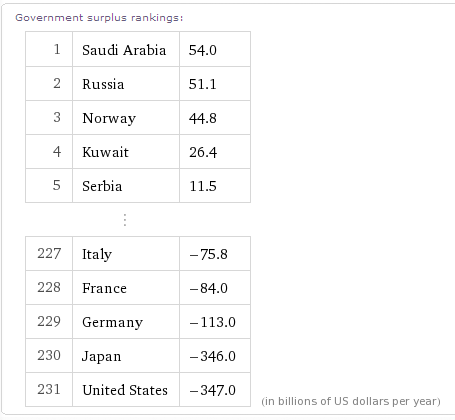
Here is the answer you get from entering "budget surplus" into Wolfram Alpha:

image 

Two things I did not know: The fifth largest government surplus in the world is held by Serbia, which surprises me, given that the country has 14% unemployment and a recovering economy, according to Wikipedia. And that Japan’s deficit is very close to the US’, indicating that things are not as bad in the US as you might think. Or perhaps that the numbers are a bit dated, but according to the source information, most of the numbers are from 2009.

Since May 17th is Norway’s national day, I think it behooves me to point out that of the five surplus states listed above, Norway is the nicest place to live, by most measures (weather, culture, politics, human rights, health care, etc. etc.). On the other hand, many of the countries with large deficits are nice places to live, so I wouldn’t read too much into the economics at all…

(Hat tip to Karthik, who retweeted one of my tweets, which I misunderstood and started researching….)

Stephen Fry and the Gutenberg press

This is a delightful program which explains how the Gutenberg press works – through the time-honored pedagogic technique of actually building one:

Someone goes on a hungry journey

City of Thieves City of Thieves by David Benioff

My review

rating: 5 of 5 stars
Bleak and terse but very likeable story about an orphaned adolescent and a soldier on an impossible quest in and around St.Petersburg (Leningrad) during the 900-day siege. The authenticity and details are moving, the language and plot fluid and there are moments of suspense and quite a bit of laconic humor. Highly recommended.

View all my reviews.

Gladwell on Goliath vs. the ever striving, socially unacceptable David

The New Yorker has a great article by Malcolm Gladwell on how David beats Goliath, largely by working harder and exploiting unanticipated weaknesses in the opponents defense. Examples include basketball, Lawrence of Arabia, Doug Lenat using an expert system, and, of course D vs. G.

The interesting point here, of course, is how Goliath reacts when David substitutes effort for talent and rule-bending (or, rather, rule exploitation) for tradition: By declaring that this is an unacceptable way of playing. During the 1990s, under the truly eccentric coach Egil "Drillo" Olsen" (pictured), the Norwegian national soccer team employed a strategy of putting the whole team in defense, and scoring all their goals on the occasional breakaway, when a long pass would find a single player (usually Jostein Flo) plugging a goal against a surprised defense. This strategy was highly effective (at one point, Norway beat Brazil and was ranked as number 2 in the world by FIFA) but raised the ire of commentators and players everywhere, because they were seen as destroying soccer as a spectator sport. Just like the protagonists in Gladwell’s article, Olsen was an analyzer and a highly controversial character.

Incidentally, after many failures on the field, the Norwegian national team has employed him as a coach again. And they have started winning. Just wait for the accusations to start…

(Come to think of it, the great Swedish Alpine skier Ingemar Stenmark was subject to the same mechanism: He never did downhill races (thinking them crude and dangerous), but won every slalom and grand slalom event on the tour, and thus the overall World Cup title (as well as a total of 7 Olympic medals). This led the powers that be to institute a rule that to be eligible for the overall title, you had to participate in at least one downhill race. Which Stenmark did, in an upright position like a Sunday skier. He finished dead last, and, of course, took the overall title. Again.)

Think about your own industry – what are the equivalent to Olsen strategy there? I am sure it involves something socially unacceptable which will allow the weakest player to win. May you find it before someone else does…

The future of TV reporting

PBS.com has an incredible page on the Madoff affair: The TV program, extra-length interviews, analysis of statements, timelines, the whole nine yards. Excellent work – this is the way to do a news show and combine TV and online channels.

(Via Twit from Ed Roche)

End user computing as vision and reality

My esteemed colleague and similarly jaded visionary Vaughan Merlyn has written rousing call for a new vision for the IT organization. While I do agree with everything he says – in principle – I think we still have a long way to go before the nitty gritty part of IT has moved from server room to cloud, leaving the users to creatively combine and automate their world in cooperation with their colleagues, customers and suppliers. While I do agree that the IT organization is better served by helping users help themselves than do their work for them, I am not sure all the users out there are ready to fish for themselves yet, no matter how easy to use the search engines, social communities and systems implementations tools become.

The enabling vision is not a new thing. I remember a video (or, rather film) from IBM from the mid-80s about End User Computing – a notion that the role of IT was to provide the tools for end users, and then they could build their own systems rather than wait for IT to build for them. (This, incidentally, was also the motivation behind COBOL in the 70s: The language was supposedly so intuitive that end users would be able to describe the processes they wanted automated directly into the computer, obviating the need for anyone in a white coat.) The movie showed an end user (for some reason a very short man in a suit) sitting in front of a 3270 terminal running VM/CMS. Next to him was a friendly person from the EUC group explaining how to use the friendly terminal, which towered over the slightly intimidated-looking end user like the ventilation shaft of an ocean liner.

It didn’t look very convincing to me. One reason for this was that at that time I was teaching (reasonably smart) business students how to do statistical analysis on an IBM 4381 and knew that many of them could not even operate the terminal, which had a tendency to jump between the various layers of the operating system and also had a mysterious button called SysRq, which still lingers, appendix-like, on the standard PC keyboard. Very few of those students were able to do much programming – but they were pretty good at filling in the blanks in programs someone already had written for them.

Of course, we now have gesture interfaces, endless storage, personal battery-powered devices and constant communication. But as the technology gets better, we cede more and more responsibility for how things work to the computer, meaning that we can use it until it breaks down (which it does) at which point we have no idea how things work. This is not the technology’s fault – it often contains everything you need to know to understand it rather than just use it. Take the wonderful new “computational search engine” Wolfram Alpha, for example: It can give you all kinds of answers to numerical questions, and will also (I haven’t seen it, but if the capabilities of Mathematica are anything to go by, it is great) allow you to explore, in a drill-down procedure, how it reached its answers.

This is wonderful – truly – but how many are going to use that feature? By extension: All of us have a spreadsheet program, but how many of an organization’s users can write a new spreadsheet rather than just use an already existing one?

For as long as I have worked with computers, each new leap in functionality and performance has been heralded as the necessary step to turn users from passive to active, from consumers of information to creators of knowledge. While each new technology generation, admittedly, has achieved some of this, it has always been less than was promised and much less than what was hoped for.

And so I think it is this time, too. Many people read Wikipedia, few write for it (though enough do). More importantly, many of Wikipedia’s users are unaware of how the knowledge therein is instantiated. Online forums have many more lurkers than contributors. And human ingenuity is unevenly distributed and will continue to be so.

So I think the IT department will continue to do what it is doing, in principle. It will be further from the metal and closer to the user, but as long as the world remains combinatorially complex and constantly changing, there will always be room for people who can see patterns, describe them, automate them and turn them into usable and connectable components. They will be fewer, think less of technology and more in terms of systems, and have less of a mismatch in terms of clothing and posture between themselves and their customers than before (much of it because the customers have embraced nerd chic, if not nerd knowledge).

The key for a continued IT career lies in taking charge of change rather than being affected by it. I think the future is great – and that we are still a long way from true end user computing. IT as a technology will be less interesting and more important in its invisible ubiquity. And Neal Stephenson’s analogy of a world of Elois and Morlocks, of the many that consume and the few that understand will still hold true.

I just hope I still will be a Morlock. With an Eloi pay and dress sense.

Base as solo instrument

Don’t know how I came across this one, but this is a truly awesome (in the original sense of the word) performance of "Summertime". That base player must have finger joints made out of pure titanium…..

After that, why not listen to their rendition of Air as well

Art that is genuinely difficult to understand

Much art is hard to understand, often, I suspect, because there is no underlying message, just the implication of one. In this fun article by Stephen Levy (who is one of those writers I just read everything I can of) shows a piece of art which both is very germane to its owner (the CIA) and really contains underlying messages.

Brilliant!

Stephen Wolfram talk on Wolphram Alpha

Enough said, watch it. As a colleague twittered: This will change computing.

(That being said, this is a very poor filming – there are no pictures of the screen, aside from a glimmer now and then.)

Notes from Stephen Wolfram webcast

These are my raw notes from the session with Stephen Wolfram on the pre-launch of the Wolfram Alpha service at the Berkman center. Unfortunately, I was on a really bad Internet connection and only got the sound, and missed the first 20 minutes or so running around trying to find something better.

Notes from Stephen Wolfram on Alpha debut

…discussion of queries:
– nutrition in a slice of cheddar
– height of Mount Everest divided by length of Golden Gate bridge
– what’s the next item in this sequence
– type in a random number, see what it knows about it
– "next total solar eclipse"

What is the technology?
– computes things, it is harder to find answers on the web the more specifically you ask
– instead, we try to compute using all kinds of formulas and models created from science and package it so that we can walk up to a web site and have it provide the answer

– four pieces of technology:
— data curation, trillions of pieces of curated data, free/licensed, feeds, verify and clean this (curate), built industrial data curation line, much of it requires human domain expertise, but you need curated data
— algorithms: methods and models, expressed in Mathematica, there is a finite number of methods and models, but it is a large number…. now 5-6 million lines of math code
— linguistic analysis to understand input, no manual or documentation, have to interpret natural language. This is a little bit different from trad NL processing. working with more limited set of symbols and words. Many new methods, has turned out that ambiguity is not such a bit problem once we have mapped it onto a symbolic representation
— ability to automate presentation of things. What do you show people so they can cognitively grasp what you are, requires computational esthetics, domain knowledge.

Will run on 10k CPUs, using Grid Mathematica.
90% of the shelves in a typical reference library we have a decent start on
provide something authoritative and then give references to something upstream that is
know about ranges of values for things, can deal with that
try to give footnotes as best we can

Q: how do you deal with keeping data current
– many people have data and want to make it available
– mechanism to contribute data and mechanism for us to audit it

first instance is for humans to interact with it
there will be a variance of APIs,
intention to have a personalizable version of Alpha
metadata standards: when we open up our data repository mechanism, wn we use that can make data available

Questions from audience:

Differences of opinion in science?
– we try to give a footnote
– Most people are not exposed to science and engineering, you can do this without being a scientist

How much will you charge for this?
– website will be free
– corporate sponsors will be there as well, in sidebars
– we will know what kind of questions people ask, how can we ingest vendor information and make it available, need a wall of auditing
– professional version, subscription service

Can you combine databases, for instance to compute total mass of people in England?
– probably not automatically…
– can derive it
– "mass of people in England"
– we are working on the splat page, what happens when it doesn’t know, tries to break the query down into manageable parts
300th largest country in Europe? – answers "no known countries"

Data sources? Population of Internet users. how do you choose?
– identifying good sources is a key problem
– we try do it well, use experts, compare
– US government typically does a really good job
– we provide source information
– have personally been on the phone with many experts, is the data knowable?
– "based on available mortality data" or something

Technology focus in the future, aside from data curation?
– all of them need to be pushed forward
– more, better, faster of what we have, deeper into the data
– being able to deal with longer and more complicated linguistics
– being able to take pseudocode
– being able to take raw data or image input
– it takes me 5-10 years to understand what the next step is in a project…

How do you see this in contrast with semantic web?
– if the semantic web had been there, this would be much easier
– most of our data is not from the web, but from databases
– within Wolfram Alpha we have a symbolic ontology, didn’t create this as top down, mostly bottom-up from domains, merged them together when we realized similarities
– would like to do some semantic web things, expose our ontological mechanisms

At what point can we look at the formal specs for these ontologies?
– good news: All in symbolic mathematical code
– injecting new knowledge is complicated – nl is surprisingly messy, such as new terms coming in, for instance putting in people and there is this guy called "50 cent"
– exposure of ontology will happen
– the more words you need to describe the question, the harder it is
– there are holes in the data, hope that people will be motivated to fill them in

Social network? Communities?
– interesting, don’t know yet

How about more popular knowledge?
– who is the tallest of Britney Spears and 50 cent
– popular knowledge is more shallowly computable than scientific information
– linguistic horrors, book names and such, much of it clashes
– will need some popularity index, use Wikipedia a lot, can determine whether a person is important or not

The meaning of life? 42….

Integration with CYC?
– CYC is most advanced common sense reasoning system
– CYC takes what they reason about things and make it computing strengths
– human reasoning not that good when it comes to physics, more like Newton and using math

Will you provide the code?
– in Mathematica, code tends to be succinct enough that you can read it
– state of the art of synthesizing human-readable theorems is not that good yet
– humans are less efficient than automated and quantitative qa methods
– in many cases you can just ask it for the formula
– our pride lies in the integration, not in the models, for they come from the world
– "show formula"

Will this be integrated into Mathematica?
– future version will have a special mode, linguistic analysis, pop it to the server, can use the computation

How much more work on the natural language side?
– we don’t know
– pretty good at removing linguistic fluff, have to be careful
– when you look at people interacting with the system, but pretty soon they get lazy, only type in the things they need to know
– word order irrelevant, queries get pared down, we see deep structure of language
– but we don’t know how much further we need to go

How does this change the landscape of public access to knowledge?
– proprietary databases: challenge is make the right kind of deal
– we have been pretty successful
– we can convince them to make it casually available, but we would have to be careful that the whole thing can’t be lifted out
– we have yet to learn all the issues here

– have been pleasantly surprised by the extent to which people have given access
– there is a lot of genuinely good public data out there

This is a proprietary system – how do you feel about a wiki solution outcompeting you?
– that would be great, but
– making this thing is not easy, many parts, not just shovel in a lot of data
– Wikipedia is fantastic, but it has gone in particular directions. If you are looking for systematic data, properties of chemicals, for instance, over the course of the next two years, they get modified and there is not consistency left
– the most useful thing about Wikipedia is the folk knowledge you get there, what are things called, what is popular
– have thought about how to franchise out, it is not that easy
– by the way, it is free anyway…
– will we be inundated by new data? Encouraged by good automated curation pipelines. I like to believe that an ecosystem will develop, we can scale up.
– if you want this to work well, you can’t have 10K people feeding things in, you need central leadership

Interesting queries?
– "map of the cat" (this is what I call artificial stupidity)
– does not know anatomy yet
– how realtime is stock data? One minute delayed, some limitations
– there will be many novelty queries, but after that dies down, we are left with people who will want to use this every day

How will you feel if Google presents your results as part of their results?
– there are synergies
– we are generating things on the fly, this is not exposable to search engines
– one way to do it could be to prescan the search stream and see if wolfram alpha can have a chance to answer this

Role for academia?
– academia no longer accumulates data, useful for the world, but not for the university
– it is a shame that this has been seen as less academically respectable
– when chemistry was young, people went out and looked at every possible molecule
– this is much to computer complicated for the typical libraries
– historical antecedents may be Leibniz’ mechanical and computational calculators, he had the idea, but 300 years too early

When do we go live?
… a few weeks
– maybe a webcast if we dare…

Young male Russians drink, whore and fight themselves to death

This rather frightening article by Nicholas Eberstadt from World Affairs looks into the causes of Russian depopulation and falling life expectancy over the last 50 years or so. Russia is depopulating at a rate only found in really troubled countries in Africa, and the cause is the high mortality, in particular, young men:

According to the U.S. Census Bureau International Data Base for 2007, Russia ranked 164 out of 226 globally in overall life expectancy. Russia is below Bolivia, South America’s poorest (and least healthy) country and lower than Iraq and India, but somewhat higher than Pakistan. For females, the Russian Federation life expectancy will not be as high as in Nicaragua, Morocco, or Egypt. For males, it will be in the same league as that of Cambodia, Ghana, and Eritrea.
In the face of today’s exceptionally elevated mortality levels for Russia’s young adults, it is no wonder that an unspecified proportion of the country’s would-be mothers and fathers respond by opting for fewer offspring than they would otherwise desire. To a degree not generally appreciated, Russia’s current fertility crisis is a consequence of its mortality crisis.

The reason is binge alcoholism (on average, one bottle of vodka per week, according to some experts), HIV, tuberculosis, accidents and violence: "No literate and urban society in the modern world faces a risk of deaths from injuries comparable to the one that Russia experiences." The consequences are dire:

In the contemporary international economy, one additional year of life expectancy at birth is associated with an increase in per capita output of about 8 percent. A decade of lost life expectancy improvement would correspond to the loss of a doubling of per capita income. By this standard, Russia’s economic as well as its demographic future is in jeopardy.

So, how to mitigate this – as the author sees few and recommends no solutions?

Management is fundamentally an oral culture and analytics a literate one

Great stuff from my old pal Jim McGee: Bridging managerial and analytic cultures, part 1 and part 2.

From part the first:

Technology professionals have long struggled with getting a complex message across to management. In our honest and unguarded moments, we talk of "dumbing it down for the suits." But the challenge is more subtle than that. We need to repackage the argument to work within the frame of oral thought.

And second:

In addition to helping the analytically biased see the value of creating a compelling story, you need to help them see how and why story works differently than analysis. The best stories to drive change are not complex, literary, novels. They are epic poetry; tapping into archetypes and cliché, acknowledging tradition, grounded in the particular.

…which, of course, is why personalized examples work so well. (And work so badly when not connected to a logical argument or important point.)

In other words – there should be plenty of work for all those laid-off journalists in companies, trying to find le mot juste that will transform the numbingly complex into the directionally intuitive.

Read the whole thing – if nothing else, for the language.

Steroids for the flighty-minded

An excellent and truly scary article by Margaret Talbot in the New Yorker about the use of neuroenhancers by people who are not ill. Which is comparable to recreational plastic surgery, which I don’t like either.

Is it just me, or is cheating seen as more and more normal and not to be punished or even held in contempt? When I catch students plagiarizing (which happens with a depressing frequency, partly because the tools for doing so have gotten so much better) their defense is more and more that this is normal, that you cannot expect them to come up with something original when everything is available out there on Google and Wikipedia. My retort is that I need to judge them on their own work, not others’, and that they therefore need to make it clear to me what they have done themselves and what they have found somewhere else. And their answer is that they put "Source: Wikipedia" at the bottom and therefore they are scot free, so there.

I would get angry if this wasn’t so depressing and so pointless. I am tempted to just fail them. Not for plagiarism – which entails disciplinary committees and all sorts of make-work. Rather an F for outright stupidity.

It is some consolation that creativity is one area where neuroenhancers don’t seem to work. But they might, as the article finds,  help these modern-day multitaskers concentrate on one specific task (hoping that it is a productive one and not, say, obsessively alphabetizing your library.) But neuroenhancers won’t make your ideas better – they won’t assist in spotting the prey, only in bringing it home. In the most dreary way possible:

Every era, it seems, has its own defining drug. Neuroenhancers are perfectly suited for the anxiety of white-collar competition in a floundering economy. And they have a synergistic relationship with our multiplying digital technologies: the more gadgets we own, the more distracted we become, and the more we need help in order to focus. The experience that neuroenhancement offers is not, for the most part, about opening the doors of perception, or about breaking the bonds of the self, or about experiencing a surge of genius. It’s about squeezing out an extra few hours to finish those sales figures when you’d really rather collapse into bed; getting a B instead of a B-minus on the final exam in a lecture class where you spent half your time texting; cramming for the G.R.E.s at night, because the information-industry job you got after college turned out to be deadening. Neuroenhancers don’t offer freedom. Rather, they facilitate a pinched, unromantic, grindingly efficient form of productivity.

If you find that tempting, be my guest. I am sure you can find directions via Google.

Jon Udell on observable work

Jon Udell has a great presentation over at Slideshare on how to work in observable spaces – something that should be done, to a much larger extent, by academics. I quite agree (and really need to get better at this myself):

Not sure if this is a good thing

Bill Schiano and I, between ourselves, solved this one pretty quickly. (That is, we found the computer names, not the extra thing, not mentioned on the site.)

(Incidentally, I also found SAGE, which was a pretty important computer system in its own right (as well as a computer company.). Also UNIX, CEC 80 (which at least sounds like a computer) and "rank" and "crib". Oh well.

England excpects you to write home. A lot.

Nelson: Love and Fame Nelson: Love and Fame by Edgar Vincent

My review

rating: 4 of 5 stars
Detailed biography based on Nelson’s correspondence, gives a good picture of Nelson as a person, his relationships with superiors, subordinates, his common-law wife Emma Hamilton and her husband. This book is widely regarded as one of the best Nelson biographies, but I would have liked to see a bit more on strategy and tactics of the battles themselves – as it is, the sheer number of anguished letters home for love, money and fame can be a bit overwhelming, though it gives a good indication of all the myriad things a captain and admiral had to deal with.

Great biography, but a little discipline and tightening up here and there wouldn’t hurt.

View all my reviews.

What if you could remember everything?

I was delighted when I found this video, where James May (the cerebral third of Top Gear) talks to professor Alan Smeaton of Dublin City University about lifelogging – the recording of everything that happens to a person over a period of time, coupled with the construction of tools for making sense of the data.

In this example, James May wears a Sensecam for three days. The camera records everything he does (well, not everything, I assume – if you want privacy, you can always stick it inside your sweater) by taking a picture every 30 seconds, or when something (temperature, IR rays in front (indicating a person) or GPS location) changes. As it is said in the video, some people have been wearing these cameras for years – in fact, one of my pals from the iAD project, Cathal Gurrin, has worn one for at least three years. (He wore it the first time we met, where it snapped a picture of me with my hand outstretched.)

The software demonstrated in the video groups the pictures into events, by comparing the pictures to each other. Of course, many of the pictures can be discarded in the interest of brevity – for instance, for anyone working in an office and driving to work, many of the pictures will be of two hands on a keyboard or a steering wheel, and can be discarded. But the rest remains, and with powerful computers you can spin through your day and see what you did on a certain date.

And here is the thing: This means that you will increasingly have the option of never forgetting anything again. You know how it is – you may have forgotten everything about some event, and then something – a smell, a movement, a particular color – makes you remember by triggering whatever part (or, more precisely, which strands of your intracranial network) of your brain this particular memory is stored. Memory is associative, meaning that if we have a few clues, we can access whatever is in there, even though it had been forgotten.

Now, a set of pictures taken at 30-second intervals, coupled together in an easy-to-use and powerful interface, that is a rather powerful aide-de-memoire.

Forgetting, however, is done for a purpose – to allow you to concentrate on what you are doing rather than using spare brain cycles in constant upkeep of enormous, but unimportant memories. For this system to be effective, I assume it would need to be helpful in forgetting as well as remembering – and since it would be stored, you would actually not have to expend so much remember things – given a decent interface, you could always look it up again, much as we look things up in a notebook.

Think about that – remembering everything – or, at least being able to recall it at will. Useful – or an unnecessary distraction?

Health care is about driving science forward, too

Virginia Postrel makes an excellent point in this article in the Atlantic: The US health care system, for all its flaws, drives research forward in a way that no other country can do:

Looking at the crazy-quilt American system, you might imagine that someone somewhere has figured out how to deliver the best possible health care to everyone, at no charge to patients and minimal cost to the insurer or the public treasury. But nobody has. In a public system, trade-offs don’t go away; if anything, they get harder.

The good thing about a decentralized, largely private system like ours is that health care constantly gets weighed against everything else in the economy. No single authority has to decide whether 15 percent or 20 percent or 25 percent is the “right” amount of GDP to spend on health care, just as no single authority has to decide how much to spend on food or clothing or entertainment. Different individuals and organizations can make different trade-offs. Centralized systems, by contrast, have one health budget. This treatment gets funded, and that one doesn’t.

In other words, markets drive innovation – sometimes in directions not deemed to be in the (whole) public’s interest, such as plastic surgery – in a way centralized coordination cannot. It is wasteful, but effective. And somewhere in the world there needs to be some slack for new things to come up, which can then be cost-effectively (or, rather, cost-efficiently) be implemented other places.

Which reminds me of Peter Drucker’s statement: "There is nothing so useless as doing efficiently that which should not be done at all." Not unknown in public health care systems…

(Via John Tierney)

Scouting for nerds

image The site Nerd Merit Badges sells, well, merit badges for nerds. Not sure what I would attach this to, but since this blog has been Boingboinged trice (here, here and here), I can at least attach an electronic copy, no?

(From Boingboing, of course).

Search and effectiveness in creativity

Effective creativity is often accomplished by copying, by the creation of certain templates that work well, which are then changed according to need and context. Digital technology makes copying trivial, and search technology makes finding usable templates easy. So how do we judge creativity when combintations and associations can be done semi-automatically?

One of my favorite quotes is supposedly by Fyodor Dostoyevsky: "There are only two books written: Someone goes on a journey, or a stranger comes to town." Thinking about it, it is surprisingly easy to divide the books you have read into one or the other. The interesting part, however, lies not in the copying, but in the abstraction: The creation of new categories, archetypes, models and templates from recognizing new dimensions of similarity in previously seemingly unrelated instances of creative work.

Here is a demonstration, fresh from Youtube, demonstrating how Disney reuses character movements, especially in dance scenes:

Of course, anyone who has seen Fantasia recognizes that there are similarities between Disney movies, even schools (the "angular" once represented by 101 Dalmatians, Sleeping Beauty and Mulan, and the more rounded, cutesy ones represented by Bambi, The Jungle Book and Robin Hood. (Tom Wolfe referred to this difference (he was talking about car design, but what the heck, as Apollonian versus Dionysian, and apparently borrowed that distinction from Nietsche. But I digress.)

This video, I suspect, was created by someone recognizing movements, and putting the demonstration together manually. But in the future, search and other information access technologies will allow us to find such dimensions simply by automatically exploring similarities in the digital representations of creative works – computers finding patterns were we do not.

One example (albeit aided by human categorization) of this is the Pandora music service, where the user enters a song or an artist, and Pandora finds music that sounds similar to the song or artist entered. This can produce interesting effects: I found, for instance, that there is a lot of similarity (at least Pandora seems to think so, and I agree, though I didn’t see it myself) between U2 and Pink Floyd. And imagine my surprise when, on my U2 channel (where the seed song was Still haven’t found what I’m looking for) when a song by Julio Iglesias popped up. Normally I wouldn’t be caught dead listening to Julio Iglesias, but apparently this one song was sufficiently similar in its musical makeup to make it into the U2 channel. (I don’t remember the name of the song now, but remember that I liked it.)

In other words, digital technology enables us to discover categorization schemes and visualize them. Categorization is power, because it shapes how we think about and find information. In business terms, new ways to categorize information can mean new business models or at least disruptions of the old. Pandora has interesting implications for artist brand equity, for instance: If I wanted to find music that sounded like U2 before, my best shot would be to buy a U2 record. Now I can listen to my Youtube channel on Pandora and get music from many musicians, most of whom are totally unknown to me, found based on technical comparisons of specific attributes of their music (effectively, a form of factor analysis) rather than the source of the creativity.

imageI am not sure how this will work for artists in general. On one hand, there is the argument that in order to make it in the digital world, you must be more predictable, findable, and (like newspaper headlines) not too ironic. On the other hand, is that if you create something new – a nugget of creativity, rather than a stream – this single instance will achieve wider distribution than before, especially if it is complex and hard to categorize (or, at least, rich in elements that can be categorized but inconclusive in itself.)

 Susan Boyle, the instant surprise on the Britain’s Got Talent show, is now past 20 million views on Youtube and is just that – an instant, rich and interesting nugget of information (and considerable enjoyment) which more or less explodes across the world. She’ll do just fine in this world, thank you very much. Search technology or not…