Yearly Archives: 2010

Dragon-dictated and happy about it

image About every fifth year, I purchase some dictation software. I do this because I am a firm believer in technology, in particular the use of technology to overcome personal limitations, such as writer’s block, carpal tunnel syndrome, a propensity for procrastination, and general laziness.

About two weeks after the initial purchase, I typically experience the disappointment familiar to any technology optimist: namely, that the technology does not live up to what it says on the box.

Dictation software, for instance, typically is slow and buggy and doesn’t understand my accent. It also tends to consume all the available processing power of my laptop, a scarce resource if there ever was one, and not play nice with my existing applications.

This time, that may not happen. I am writing this using Dragon dictate software, and not only does it recognize what I’m saying, but it responds quickly and naturally to the various editing and navigation commands that I utter, mostly without looking in the manual. As a matter of fact it is a little bit like dictating to an unfamiliar and not very personable secretary. There are still some problems in the recognition department, such as the software frequently choosing the wrong tense of a verb, but that is easily fixed simply by telling the software to go back and repaired the damage.

This is the fourth time I’m buying dictation software. My first test was in 1996 and simply did not work at all. I then tried again in 1998 and lastly, I think, sometime around 2007. The stuff is gotten better, but there is always been something missing. The difference now, I think, is that the software responds fast enough for you as a user to adjust your behavior to the software almost in real time. As I’ve written before, this almost tactile response is crucial for the usability of a technology, be it on screen via a keyboard or using some other input method.

With the previous versions of this software, I have not been able to experiment enough to properly learn the most useful features of the software, restricting myself to simply entering text, often by reading handwritten notes or other files into the computer. The quick, almost tactile response from the software, along with its seeming ability to learn as we go along leads me to think that this time, for sure, things will be different.

Of course, solving the problem of word recognition and flexible editing does nothing to help with a more fundamental problems that a writer, particularly a brother unsystematic one such as myself, faces. Academic output as a function of processor speed is a flat line, as far as I know, especially if the y-axis is one of quality. But the software might help with my aching underarms, and might prove to be a way of concentrating at the task at hand, because it is very hard to jump into another window and watch a few YouTube videos or check e-mail or twitter using nothing but voice commands.

Now, if it was only available in Norwegian…

(Yes, there are a few errors here. I will let them stand as a demonstration….)

Book nerd challenge

I normally don’t like blog challenges – distinctly 2006 – but this one is from daughter Julie, so I guess I am kind of obliged to…

Have you read more than 6 of these books? The BBC believes most people will have read only 6 of the 100 books listed here. Instructions: Copy this into your notes. Bold those books you’ve read in their entirety, italicise the ones you started but didn’t finish or read an excerpt. Tag other book nerds.

1 Pride and Prejudice – Jane Austen
2 The Lord of the Rings – JRR Tolkien
3 Jane Eyre – Charlotte Bronte
4 Harry Potter series – JK Rowling
5 To Kill a Mockingbird – Harper Lee
6 The Bible
7 Wuthering Heights – Emily Bronte
8 Nineteen Eighty Four – George Orwell
9 His Dark Materials – Philip Pullman
10 Great Expectations – Charles Dickens
11 Little Women – Louisa M Alcott
12 Tess of the D’Urbervilles – Thomas Hardy
13 Catch 22 – Joseph Heller
14 Complete Works of Shakespeare
15 Rebecca – Daphne Du Maurier
16 The Hobbit – JRR Tolkien
17 Birdsong – Sebastian Faulk
18 Catcher in the Rye – JD Salinger
19 The Time Traveller’s Wife – Audrey Niffenegger
20 Middlemarch – George Eliot
21 Gone With The Wind – Margaret Mitchell
22 The Great Gatsby – F Scott Fitzgerald
23 Bleak House – Charles Dickens
24 War and Peace – Leo Tolstoy
25 The Hitch Hiker’s Guide to the Galaxy – Douglas Adams
26 Brideshead Revisited – Evelyn Waugh
27 Crime and Punishment – Fyodor Dostoyevsky
28 Grapes of Wrath – John Steinbeck
29 Alice in Wonderland – Lewis Carroll
30 The Wind in the Willows – Kenneth Grahame
31 Anna Karenina – Leo Tolstoy
32 David Copperfield – Charles Dickens
33 Chronicles of Narnia – CS Lewis
34 Emma – Jane Austen
35 Persuasion – Jane Austen
36 The Lion, The Witch and The Wardrobe – CS Lewis
37 The Kite Runner – Khaled Hosseini
38 Captain Corelli’s Mandolin – Louis De Bernieres
39 Memoirs of a Geisha – Arthur Golden
40 Winnie the Pooh – AA Milne
41 Animal Farm – George Orwell
42 The Da Vinci Code – Dan Brown
43 One Hundred Years of Solitude – Gabriel Garcia Marquez
44 A Prayer for Owen Meany – John Irving
45 The Woman in White – Wilkie Collins
46 Anne of Green Gables – LM Montgomery
47 Far From The Madding Crowd – Thomas Hardy
48 The Handmaid’s Tale – Margaret Atwood
49 Lord of the Flies – William Golding
50 Atonement – Ian McEwan (on the night stand – never seem to get around to it)
51 Life of Pi – Yann Martel (yeah – good book!)
52 Dune – Frank Herbert
53 Cold Comfort Farm – Stella Gibbons
54 Sense and Sensibility – Jane Austen
55 A Suitable Boy – Vikram Seth
56 The Shadow of the Wind – Carlos Ruiz Zifon
57 A Tale Of Two Cities – Charles Dickens
58 Brave New World – Aldous Huxley
59 The Curious Incident of the Dog in the Night-time – Mark Haddon
60 Love In The Time Of Cholera – Gabriel Garcia Marquez
61 Of Mice and Men – John Steinbeck
62 Lolita – Vladimir Nabokov
63 The Secret History – Donna Tartt
64 The Lovely Bones – Alice Sebold
65 Count of Monte Cristo – Alexandre Dumas
66 On The Road – Jack Kerouac
67 Jude the Obscure – Thomas Hardy
68 Bridget Jones’s Diary – Helen Fielding
69 Midnight’s Children – Salman Rushdie
70 Moby Dick – Herman Melville
71 Oliver Twist – Charles Dickens
72 Dracula – Bram Stoker
73 The Secret Garden – Frances Hodgson Burnett
74 Notes From A Small Island – Bill Bryson
75 Ulysses – James Joyce
76 The Inferno – Dante
77 Swallows and Amazons – Arthur Ransome
78 Germinal – Emile Zola
79 Vanity Fair – William Makepeace Thackeray
80 Possession – AS Byatt
81 A Christmas Carol – Charles Dickens
82 Cloud Atlas – David Mitchell
83 The Color Purple – Alice Walker
84 The Remains of the Day – Kazuo Ishiguro
85 Madame Bovary – Gustave Flaubert
86 A Fine Balance – Rohinton Mistry
87 Charlotte’s Web – EB White
88 The Five People You Meet In Heaven – Mitch Albom
89 Adventures of Sherlock Holmes – Sir Arthur Conan Doyle
90 The Faraway Tree Collection – Enid Blyton
91 Heart of Darkness – Joseph Conrad
92 The Little Prince – Antoine De Saint-Exupery
93 The Wasp Factory – Iain Banks
94 Watership Down – Richard Adams
95 A Confederacy of Dunces – John Kennedy Toole
96 A Town Like Alice – Nevil Shute
97 The Three Musketeers – Alexandre Dumas
98 Hamlet – William Shakespeare
99 Charlie and the Chocolate Factory – Roald Dahl
100 Les Miserables – Victor Hugo

Sum total: 51 read, didn’t count the halfways… Hmmm. Wonder if that is good and bad. And why in the world is the Da Vinci garbage on the list?

Oh well, feel free to do your own. Or not.

(Incidentally, here is a much better list.)

FIAT 500 and Structural deepening

One aspect of technology evolution, according to W. Brian Arthur’s excellent The Nature of Technology, is structural deepening: How basic technology adds features over time. Structural deepening is actually one factor which often means we underestimate technology evolution – for instance, a car today costs about as much, in relative terms, as a car did 30 years ago. What you get for your money, however, is something completely different.

A couple of months ago I was walking through the parking garage at the Norwegian School of Management – and I spotted a case of structural deepening in practice. I just had to take a picture or two with my cell phone (which has a camera – an0ther instance of structural deepening, right?):

sep2010 060

The Fiat 500 on the left is from sometime in the 60s, has an engine of about half a liter and a weight of around half a ton. The Fiat Nuova 500 on the right has 2-3 times as much engine, double the weight, is (as can be seen) a lot bigger and also a lot faster. It also has lots more technology – not only headrests, but safety belts, 7 air bags (!), air conditioning, better stereo, steel bars, crumble zones, etc. etc.) It is, supposedly, still considered a small car…

(More pictures after the break)

Continue reading

Norwegian Air Shuttle: Using IT to lower costs, increase revenue, and start new businesses

(This case was written for an BSG Concours/nGenera report in March 2008, but never used. I found it while writing a report on the Norwegian IT industry, and publish it here because, well, I need a place to put it. And it is interesting – it succinctly exemplifies a company that uses IT for lowering cost (increasing the bottom line), for expanding in its current market (expanding the top line), and for creating new businesses.)

Norwegian Air Shuttle is the fastest growing low-cost airline in Europe. Its growth is built on smart market moves – supported by even smarter IT applications and use.

A Norwegian plane - white paint is cheap

Norwegian Air Shuttle was originally a small airline company leasing planes and crew – called a "wet lease" in the business – to Braathen’s, Norway’s second largest airline. When Braathen’s was acquired by industry leader SAS in 2001, it looked like the game was over for Norwegian – it had funding for less than three months’ operations.

clip_image005Bjørn Kjos, lawyer and former fighter pilot, had agreed to help the company through what everyone thought was going to be a managed bankruptcy. Instead, Kjos sought out new investors – Norwegian fishing fleet owners, accustomed to high risk and equally high rewards. With his background as a pilot and sanguine, jovial personality, Kjos personified opposition to the somewhat bureaucratic and monopolistic SAS and became popular both with his employees, the public and the regulating politicians.

The new company’s strategy was simple: To offer direct flights between city-pairs not served by SAS, and keep costs low through efficient processes and a flexible organization. Kjos was not a proponent of information technology, but knew he needed a CIO, and in 2002 hired Hans Petter Aanby, an experienced IT manager from SAS.

Hans Petter AanbyAanby needed to establish IT as a contributor to the business, and so set out to first harvest the low-hanging fruit. First of all, the company’s distribution costs were too high: Most sales came over the telephone or through travel agents, with average transaction cost of more than $35 per ticket. Aanby moved the whole process online in April 2003, removing anything confusing from the web site. The company was one of the first in the business to have customers print out their own (bar-coded) boarding passes, which simplified check-in and saved boarding time. Eventually, 85% of orders would come over the web, and only 1% through the call center. This was achieved with a small IT department and smart use of small consulting companies.

image Having demonstrated an ability to lower costs, Aanby now, with the title of CIO and EVP of Business Development, set out to increase sales. A new architecture that would allow growth in complexity without growth in costs was proposed to the board in late 2003. Airline prices vary, but it can be very hard for customers to see when it is cheap to fly. Many airlines make it hard for customers to find the cheap flights, but Aanby went the other way, giving the customers a calendar-based view of flights with prices shown. Since flight reservation systems are not set up for this kind of information extraction – each query is treated as a potential booking, thus influencing demand figures – Norwegian had to build their own database of flights and prices extracted from the transaction-oriented Amadeus reservation system. The customers responded enthusiastically, since it made it easy to change travel plans to take advantage of lower prices. The application was sold to Amadeus, and the competition eventually had to follow Norwegian’s lead and provide their own low-price calendars.

As Norwegian expanded (eventually flying more passengers outside Norway than inside,) the next step was to establish a new business out of their customer base and transaction platform: Bank Norwegian, an Internet bank that went into operation in the Fall of 2007. Drawing on a satisfied customer set, an experienced IT capability and a sophisticated, yet lean architecture, Norwegian figures it can take the transaction growth and reliability demands a banking application requires.

Kjos, now a converted IT buff, constantly talks about how Norwegian’s IT infrastructure allows the company to expand without growing costs. In August 2007, with a fleet of 22 airplanes, the company placed an order for 42 new Boeing 737 airplanes, for delivery over a five year period.

Norwegian continues to look for areas where IT can make a difference. The airline industry is extremely competitive, and the game is all about being low-cost, yet effective in how talent is employed. Norwegian consciously trains its employees to be capable of performing many tasks – any flight attendant can also do check-in or reservations, for instance, thus enabling the company to use the labor outside the 600-700 hours in the air regular flight personnel can work.

For Norwegian, the trick has to flood the company with IT support before anyone has had time to hire people. And as Aanby has put it: In Norwegian, there are really only two employee categories that are paid above market average: Pilots – and IT people.

In 2007, Hans-Petter Aanby was rewarded for his efforts by being awarded the title CIO of the Year by the Norwegian IT Magazine Computerworld.no – and Norwegian has continued to grow since, now profitably expanding its business while most of its competitors, particularly the traditional airlines, are struggling.

A screwdriver, please

image

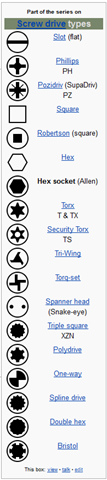
This is why I love the Wikipedia: It has not only an article on things like Allen keys, but a whole series (along with the enclosed diagram) of various kinds of screwdrivers.

Not what you would find in a regular encyclopedia, is it?


Record companies lose, artists gain

In early September, two of my M.Sc. students handed in their thesis, which has created quite a stir in the Norwegian music industry. I think this has applicability outside Norway, so here is a translation (and light edit) of the Norwegian-language press release and a link to the full report (PDF, 3,4Mb):

After 10 years of digitalization of music, the average (Norwegian) musician’s income has increased by 66%. As a group, the only losers in digital music seems to be the record companies. This is the conclusion of a M.Sc. study done by students Richard Bjerkøe and Anders Sørbo at the Norwegian School of Management BI in Oslo.

The thesis “The Norwegian Music Industry in the Age of Digitalization” shows that the musicians’ income increase is due to increased income from concerts, various collection agencies and stipends from the government in the period from 1999 to 2009. During the same period, record sales have decreased by about 50%. The fall in income from record sales is less important for the musicians, however, since, on average, they only receive 15% of record sales, whereas they receive on average 50% from concerts and 80% from collection agencies (who collects provisions from radio play and other uses of the artists’ productions.)

– In the interviews we have done with a number of musicians and music producers, the musicians say they are losing money on digitalization, but the numers show that it is the record companies, not the artists, who are losing, says Bjerkøe og Sørbo.

– The fall in record sales also means that record companies are becoming less important as launchpads for new artists, and that records to a larger degree become “business cards” – i.e., a marketing tool – to attract audiences to concerts.

Espen Andersen, associate professor at the Norwegian School of Management, has been the faculty advisor for the thesis. He thinks the results show that artists in the future will have more of their income from concerts and by being played on the radio, TV or Internet streaming services. Musicians will also, to a larger extent, have to take responsibility for their own marketing. The future of the record companies is uncertain and they will need to redefine their role in the music industry.

Facts:

  • Income from concerts has increased, on average, 136% from 1999 to 2009
  • Income from collection organizations such as TONO, Gramo and others has increased 108% from 1999 to 2009
  • stipends and other supports from the government has increased 154% from 1999 to 2009
  • The number of registered active musicians has increased by about 28% during this period
  • All figures have been adjusted for inflation.

For questions, please contact

  • Richard Bjerkøe, +47 9181 8686, rbjerkoe@gmail.com
  • Anders Sørbo, +47 9284 0098, anders.sorbo@no.experian.com
  • Espen Andersen, +47 4641 0452, self@espen.com

A Hitch-reader’s guide to a mindful galaxy

Hitch 22: Confessions and ContradictionsHitch 22: Confessions and Contradictions by Christopher Hitchens
My rating: 4 of 5 stars

The (almost) definitive word on Christopher Hitchens? No – more of a set of quickly and deftly executed watercolors of a life that, at least in the mind, defies any attempt at categorization.

It is rather ironic, but perfectly in script, that Hitchens spends quite a bit in the book discussing impending death and ever-present knowledge that "the party will continue without me", and then, virtually on the day of the book’s publications, discovers that he has contracted, if that is the word, cancer of the esophagus and will be "a very lucky man" if he lives another five years.

Anyway, read this, as much for the language and argument as for the story itself. It puts you in the presence of a mind that is not encyclopaedic (that would be rather boring) but uses literature, history, language and personal connections and experiences as an arsenal for painting the most multicolored, yet consistent canvases you can imagine.

(Incidentally, this is the first new book I bought for Kindle for PC, and the software works admirably, though I wish it was possible to clip out some text for citations.)

View all my reviews

Liberating the process followers

I highly recommend attending the following presentation at the Norwegian Polytechnic Society on Wednesday September 29th at 5 pm. In particular, I think anyone associated with creating systems for complex decision making, especially in the public sector, would find it interesting.

Update Oct.1: You will find a video of the talk here.

Innovative systems for public services: From process following to problem solving
Dr. Richard Pawson, Naked Objects Group

image Dr. Richard Pawson is founder of Naked Objects Group, and a former head of Research Services for Computer Sciences Corporation. He has 30 years experience in IT and related businesses, and has given presentations and consulted with companies all over the world. He holds a Ph.D. of computer science from Trinity University, Dublin, Ireland.

In this discussion, he will talk about how new innovative systems can change how case workers in public services do their job, transforming them from process followers to problem solvers. Richard has designed and implemented a large and very successful system for the Irish Department of Social and Family Affairs which, based on a Norwegian idea of object orientation, allows case workers ("saksbehandlere") to handle very complex problem situations under much larger degrees of freedom than previously possible.

Richard is a highly interesting and entertaining speaker with deep insight in the relationship between information technology and organizational issues. You can look forward to an eye-opening perspective on the organizational issues in public services and how innovative and advanced systems can contribute to solving them.

Notes on my new X201

image I was just about ready to prove my susceptibility to advertising and get a MacBook Pro, but our CIO refused to fund it (gotta standardize, you know) and offered me an X201 Tablet from Lenovo (for free) instead. I promptly demanded more RAM and a 125G SSD, and the matter was settled.

So – what is there to like? For a start:

  • It is about one cm shorter than my previous X61, which is important because it will fit into a standard A4 binder-style leather case
  • The screen is much brighter than the X61, including the wide-screen form factor which somehow seems more natural
  • The SSD really makes a difference. Word and other memory hogs start almost instantly, and the incessant restarts that for some reason still are necessary when configuring a new computer are a lot less patience-trying than before
  • Windows 7 is relatively stable (though my Matrox DualHead2Go has hung it a couple of times), is faster and has a more attractive interface than XP (BI has, rather smartly, avoided Vista), but it is a capable product, not the wonder some of my friends in Microsoft gab about. I do dislike the "switching between tasks" function on the alt-tab key – it will show the underlying applications on screen, but blanks out everything except the current task whiel you are still holding the keys down. The Windows-tab key combination gives you an animated lineup of active windows, but that literally makes me seasick if I used it fast.
  • The keyboard is about 2 cm wider than the X61, which makes it feel like a regular keyboard. Ihas a very nice feel for a laptop, though some of the keys are more noisy than others (an issue I also had with the X61, which could annoy people at conferences with two or three clicky keys.)

On the negative side: I am not impressed by the battery life, and there appears to be all kinds of issues with the suspend/standby/hibernate/whatever shut-down and startup routines, such as the wireless network shutting down at inopportune times. Hopefully this if fixable by fiddling with various settings.

All in all, the X201 looks to become a solid, rather boring but very capable "main working laptop" for me. I sometimes feel like I am the last person in the world actually using the tablet functionality – not, as was envisioned when it was introduced, for note-taking and text editing, but for teaching, especially for large audiences.

But, of course, if I had sprung for the MacBook Pro out of my research budget, I would have been able to get a BookBook. Oh well..

Bonus! I just discovered I can use my fingers to scroll and zoom, iPad-style, right off the screen. W00t! Coolness in a corporate package.

social Media, disruption, and Comic Sans

I gave a presentation at the RECORD seminar in Oslo today, with the title “Social media as a disruptive innovation”. The title was given to me – I do not think social media is much of a disruptive technology (with the possible exception of headhunting) but certain aspects of it, such as its ability to generate metadata and thereby organize information, certainly are.

Incidentally, speaking at an architecture and design school is always interesting – I feel like I really ought to shave my head, get a Steve Jobs mock turtleneck and a fake Mac to blend in with the natives. On Twitter, most comments (#recordseminar) were about my use of Comic Sans, which I do because a) I like it, and b) it is fun using it in front of designers since they are so predictably irritated by it.

Conference calling comedy

This sort of sums it up – I would be the guy from Europe, dialing in an hour early or late due to misunderstandings about summer time or US time zone variations.

Thanks, Jim, for bringing this to my attention!

How will the Internet change how we think?

image The Edge question this year is "How has the Internet changed the way you think?". The result is eminently readable – my favorite so far is George Dyson’s answer, which is quoted here in its entirety:

GEORGE DYSON
Science Historian; Author, Darwin Among the Machines

KAYAKS vs CANOES

In the North Pacific ocean, there were two approaches to boatbuilding. The Aleuts (and their kayak-building relatives) lived on barren, treeless islands and built their vessels by piecing together skeletal frameworks from fragments of beach-combed wood. The Tlingit (and their dugout canoe-building relatives) built their vessels by selecting entire trees out of the rainforest and removing wood until there was nothing left but a canoe.

The Aleut and the Tlingit achieved similar results — maximum boat / minimum material — by opposite means. The flood of information unleashed by the Internet has produced a similar cultural split. We used to be kayak builders, collecting all available fragments of information to assemble the framework that kept us afloat. Now, we have to learn to become dugout-canoe builders, discarding unneccessary information to reveal the shape of knowledge hidden within.

I was a hardened kayak builder, trained to collect every available stick. I resent having to learn the new skills. But those who don’t will be left paddling logs, not canoes.

Short and sweet, in other words. Now, where did I leave that informational adze, what P. J. O’Rourke referred to as the "brief-but-insightful-summary" button?

Does LinkedIn help or disrupt headhunters?

(I am looking for a M.Sc. student(s) to research this question for his/her/their thesis.)

The first users of LinkedIn were, as far as I can tell, headhunters (at least the first users with 500+ contacts and premium subscriptions.) It makes sense – after all, having a large network of professionals in many companies is a requirement for a headhunter, and LinkedIn certainly makes it easy not only to manage the contacts and keep in touch with them, but also allows access to each individual contact’s network. However, LinkedIn (and, of course, other services such as Facebook, Plaxo, etc.) offers its services to all, making connections visible and to a certain extent enabling anyone with a contact network and some patience to find people that might be candidates for a position.

I suspect that the evolution of the relationship between headhunters and LinkedIn is a bit like that of fixed-line telephone companies to cell phones: In the early days, they were welcomed because they extended the network and was an important source of additional traffic. Eventually, like a cuckoo’s egg, the new technology replaced the old one. Cell phones have now begun to replace fixed lines. Will LinkedIn and similar professional networks replace headhunters?

If you ask the headhunters, you will hear that finding contacts is only a small part of their value proposition – what you really pay for is the ability to find the right candidate, of making sure that this person is both competent, motivated and available, and that this kind of activity cannot be outsourced or automated via some computer network. They will grudgingly acknowledge that LinkedIn can help find candidates for lower-level and middle-management, but that for the really important positions, you will need the network, judgment and evaluative processes of a headhunting company.

On the other hand, if you has HR departments charged with finding people, they will tell you that LinkedIn and to a certain extent Facebook is the greatest thing since sliced bread when it comes to finding people quickly, to vet candidates (sometimes discovering youthful indiscretions) and to establish relationships. I have heard people enthuse over not having to use headhunters anymore.

So, the incumbents see it as a low-quality irrelevance, the users see it as a useful and cheap replacement. To me, this sounds suspiciously like a disruption in the making, especially since, in the wake of the financial crisis, companies are looking to save money and the HR departments dearly would like to provide more value for less money, since they are often marginalized in the corporation.

I would like to find out if this is the case – and am therefore looking for a student or two who would like to do their Master’s thesis on this topic, under my supervision. The research will be funded through the iAD Center for Research-based innovation. Ideally, I would want students who want to research this with a high degree of rigor (perhaps getting into network analysis tools) but I am also willing to talk to people who want to do it with more traditional research approaches – say, a combination of a questionnaire and interviews/case descriptions of how LinkedIn is used by headhunters, HR departments and candidates looking for new challenges.

So – if you are interested – please contact me via email at self@espen.com. Hope to hear from you!

Cases of Norwegian IT

Normally when I teach technology strategy (GRA6821), a term paper is part of the course evaluation. The students typically write about some technology, a technology company, or somesuch, normally in groups of three or less.

This year, things will be a little different. I am part of a research project called A Knowledge-based Norway, where the idea is to investigate various industries in Norway in terms of their knowledge generation – and, by extension, their technology evolution. As a part of this project, we will write case studies on various companies, and that is precisely what the students will do. However, rather than having the students chose the companies themselves, we will provide a list of companies, allowing the students, in pairs, to choose a company to write about. We will, of course, entertain suggestions to which companies to have on this list. Here is a start:

Large IT service companies:

  • Accenture (evolution, role of the Norwegian organization internationally)
  • Atea (evolution, mergers, change in role over time)
  • EDB Business Partner/Ergo Group (these companies are about to merge; topics are evolution, mergers, change in role)
  • IBM Norway (evolution, role of the Norwegian organization internationally)
  • Cap Gemini (large consulting company)
  • ?

Innovative technology companies/research groups

  • FAST/Microsoft Enterprise Search division (evolution, merger, technology impact)
  • Simula Research Laboratory (strong research group sprung out of the University of Oslo)
  • Trolltech (advanced technical programming company acquired by Nokia)
  • Opera (multi-platform browser company, still independent with a growing Asian market)
  • Tandberg (videoconferencing technology company, acquired by Cisco)

Academic/research institutions

  • Institute for Informatics, University of Oslo (grossly expanded technology program, new building)
  • NTNU (Norwegian University of Natural Sciences, Trondheim) (birthplace of many companies)
  • Sintef (research arm of NTNU)
  • Norsk regnesentral
  • College university, Grimstad (cluster anchor for interesting little technology area)
  • ?

Software companies focused on the Norwegian or Nordic market

  • Powel (software company focusing on applications for the energy industry)
  • Mamut (personal/SMB company accounting and tax preparation software)
  • Visma (amalgamated vertical ERP company, successful integration story)
  • SuperOffice (sales support software)
  • ?

Large and important IT projects and IT users

  • Telenor (architecture integration project, globalization of services)
  • DNB Nor (largest Norwegian bank, competes on technology platform and services)
  • Norwegian Tax Authority (pioneer in using digital technology to make tax services easier for the individual citizen)
  • Altinn.no (innovative generalized public interaction platform)
  • ?

Interesting startups/rapidly growing companies/interesting stuff

  • Integrasco (blog sentiment analysis, built on top of Amazon’s cloud platform)
  • Meltwater (global media search company, keeping a low profile)
  • EVO Fitness (health club without visible employees – based on remote monitoring and SMS transactions)
  • QuestBack (Internet-based survey company, now expanding outside Norway)
  • ?

This list will grow as I get new ideas – suggestions are welcome! (And yes, perhaps there is an idea to have something about spectacular computer failures as well…)

GRA6821 Fall 2010 – some pointers

To anyone taking (or thinking about taking) my GRA6821 (Technology Strategy, or whatever the name is) course this fall – here are a few things that, at least at this point, are going to happen:

  • Since there will be many students at the course (about 70 so far) it has been split into two sessions. The course will be on Thursdays in classroom C2-040. The students will be split into two groups (more about that later, I am looking for a good mix of backgrounds), one of which will start at 0800, and one at 1100. The groups will alternate every week. Teaching will be case-based, meaning that you as a student have to show up, have a name card, and be in the same seat for every class.
  • For some lectures, classes may be merged (for instance, if we have a guest lecturer, the first class may start an hour later, the second an hour earlier – and the guest lecturer will not have to do the same talk twice).
  • We will have a couple of "special" classes, so far two are relatively confirmed:
    • One (tentatively scheduled for September 16th) will involve the iAD project, an advanced search technology research project hosted by FAST/Microsoft Enterprise Search. Our visitors will be a team of researchers from UCD/DCU Ireland, demonstrating video search on Apple iPads. As part of the program, students will participate as experimental users of the system.
    • The second, probably towards the end of September, will involve McKinsey, the consulting company, with discussions about consulting in a technology-rich environment. McKinsey has a global practice of "business technology" and will use expertise from that area in an excercise involving technology case analysis.
    • Possibly we will have other, similar events. And definitely some exciting guest lecturers.
  • For those of you wishing to prepare early, take a look at the previous courses arranged (last year’s here). The two main books (Information Rules and The Innovator’s Solution) are available in paper and electronic form from many sources, and a good idea might be to get at them early and read them over the summer. The other literature will be either from web sources or made electronically available via BIs new learning platform, It’s Learning (more about this later) or another platform.
  • Evaluation will, as usual, be a combination of classroom participation, smaller assignments during the course, and a final paper. New this year is the form of the final paper – this will be a case description of a Norwegian technology company, which the students can chose from a list (provided later) and written up in a specified format. These case descriptions will go in as research material for the project "A Knowledge-based Norway", preferably under the "information technology" part study. They will by students in pairs and delivered in a collaborative context, using some form of social software such as Ning, WordPress, Google Docs or Origo.

I am very much looking forward to an course that hope and think will be fun, interesting and useful both to take and teach. And until August 19th, I wish you all a very good summer!

The economically ideal society

David S. Landes’ The Wealth and Poverty of Nations is my favorite book on economic evolution and economic history up to and including the industrial revolution. Its main question is “Why did England win world domination?” There were plenty of contenders – The Netherlands, France, Spain and Portugal all had colonies, military power and trade, for instance. But in the end it was the comparatively small island nation that won out and dominated until the first world war. Landes explores this in riveting detail, attributing the ascendancy of England to it being closer to an ideal growth-and-development state than the competition.

The central chapter, chapter 5, Landes lays out the ideal case on pages 217-218 – and quoting that is reason enough for a blog post (not to mention obligatory reading for anyone concerned with economic policy.):

Let us begin by delineating the ideal case, the society theoretically best suited to pursue material progress and general enrichment. Keep in mind that this is not necessarily a “better” or a “superior” society (words to be avoided), simply one fitter to produce goods and services. This ideal growth-and-development society would be one that

  1. Knew how to operate, manage, and build the instruments of production and to create, adapt and master new techniques on the technological frontier.
  2. Was able to impart this knowledge and know-how to the young, whether by formal education or apprenticeship training.
  3. Chose people for jobs by competence and relative merit; promoted and demoted on the basis of performance.
  4. Afforded opportunity to individual or collective enterprise; encouraged initiative, competition, and emulation.
  5. Allowed people to enjoy and employ the fruits of their labor and enterprise.

These standards imply corollaries: gender equality (thereby doubling the pool of talent); no discrimination on the basis of irrelevant criteria (race, sex, religion, etc.); also a preference for scientific (means-end) rationality over magic and superstition (irrationality).*

Such a society would also possess the kind of political and social institutions that favor the achievement of these larger goals; that would, for example,

  1. Secure rights of private property, the better to encourage saving and investment.
  2. Secure rights of personal liberty – secure them against both the abuse of tyranny and private disorder (crime and corruption).
  3. Enforce rights of contract, explicit and implicit.
  4. Provide stable government, not necessarily democratic, but itself governed by publicly known rules (a government of laws rather than men). If democratic, that is, based on periodic elections, the majority wins but does not violate the rights of the losers; while the losers accept their loss and look forward to another turn at the polls.
  5. Provide responsive government, one that will hear complaint and make redress.
  6. Provide honest government, such that economic actors are not moved to seek advantage and privilege inside or outside the marketplace. In economic jargon, there should be no rents to favor and position.
  7. Provide moderate, efficient, ungreedy government. The effect should be to hold taxes down, reduce the government’s claim on the social surplus, and avoid privilege.

This ideal society would also be honest. Such honesty would be enforced by law, but ideally, the law would not be needed. People would believe that honesty is right (also that it pays) and would live and act accordingly.

More corollaries: this society would be marked by geographical and social mobility. People would move about as they sought opportunity, and would rise and fall as they made something or nothing of themselves. This society would value new against old, youth as against experience, change and risk as against safety. It would not be a society of equal shares, because talents are not equal; but it would tend to a more even distribution of income than is found with privilege and favor. It would have a relatively large middle class. This greater equality would show in more homogeneous dress and easier manners across class lines.

No society on earth has ever matched this ideal. […]

————–

*The tenacity of superstition in an age of science and rationalism may surprise at first, bur insofar as it aims at controlling fate, it beats fatalism.  It is a resort of the hapless and incapable in the pursuit of good fortune and the avoidance of bad; also a psychological support for the insecure.  Hence persistent recourse to horoscopic readings and fortune telling, even in our day. […]

Sorry, I couldn’t resist including the footnote – direct language and linguistic surgical strikes abound – go get it! (And incidentally, the concluding paragraphs are highly quotable as well.)

Desperately seeking Black

Extremely Loud and Incredibly Close Extremely Loud and Incredibly Close by Jonathan Safran Foer

My rating: 4 of 5 stars

Heartbreaking and funny about nine year old (or so) Oscar, a precocious Upper East Side boy trying to find a secret of his father (who died in the 9/11 attack), interwoven with the history of his grandfather and grandmother, who survived the Dresden bombings.

Inventive and funny – I don’t normally like books that try to be creative with typography and pictures to tell a story, but it works here. And Oscar is a hoot, vaguely related to the protagonist in The curious incident with the dog in nighttime, with his idiosyncratic messages "José!" and convoluted, yet strangely logical thinking. My favorite sentence: "More people are live today than ever lived. That means that if they all wanted to play Hamlet at once, there wouldn’t be enough skulls."

View all my reviews >>

May 17: An explanation for non-Norwegians

Norwegian Constitution day today, an integral part of the annual productivity-dampening festival known as May. If you want to blend in with the natives, expect to wear your suit all day (including at 0800 flag hoisting at local school), eat ice cream and hot dogs (sold by brass-band parents, see below), and display a Norwegian flag prominently somewhere on your person.

image You will see brass bands of varying quality, women (and not a few men) wearing folk costumes, even more children carrying flags (upright in the morning, dragging along the pavement after lunch), and, should you go into Oslo or any medium-sized town, an increasing number of drunks (some of them still in folkloristic garb) towards dusk. Suffice is to say that "May 18" and "hangover" are synonyms in Norwegian, whether it is for the usual reason, or for lack of sleep and overexposure to plastic trumpets and sour, underage marching bands.

One excellent aspect, though: The almost complete absence of militaristic chest-beating – partly for tradition, partly for lack of chest. May 17th is a children’s celebration, by and large.

Enough of this, I need to, quite literally, hoist the flag. Man, it is early in the morning…

Winding through magical realism

The Wind-up Bird Chronicle The Wind-up Bird Chronicle by Haruki Murakami

My rating: 4 of 5 stars

On the back of this edition, there is a quote from a New York Times review: "Critics have variously likened him to Raymond Carver, Raymond Chandler, Arthur C. Clarke, Don DeLillo, Philip K. Dick, Bret Easton Ellis and Thomas Pynchon — a roster so ill assorted as to suggest that Murakami may in fact be an original."

I had to laugh at that, for I wanted to add another writher – Gabriel Garcia Marques, the originator of magical realism. Like Marques, Murakami’s stories are long and disjointed, with many characters, inhabiting a world where magic is present but never referred to. The Wind-Up Bird Chronicle is long and rambling, the main theme being a young suburbanite’s search for his wife (where he is aided or opposed by many characters, each with their own reality – or lack of it – to deal with.)

Sometimes the stories feel underdeveloped, and there is little attempt at closure, which at times can feel rather cloying (though not as bad as, say, Peter Høeg.) The overarching theme, if any, is the fight between good and bad, between "defilers" and "defiled", which is most visible in some of the stories, told in letters and found computer files, about soldiers in the little-known war between Japan and the Soviet Union before and at the end of WWII.

The saving grace of this book is the language, which can only be described as "poetic", and the individual stories, of which some are brilliant (such as the story of a group of Japanese soldiers trying to kill zoo animals and botching the job). I thought some of the evil characters – the protagonist’s brother-in-law politician, a Soviet camp commander, a creepy and threatening mafia enforcer – were underdeveloped. All the characters seem rather distanced from what is happening around them, which gives the novel a dream-like mode, as if they are all narrators seeing the world through a video camera while adding their own commentary and interpretation.

It works, and the narrative moves along sufficiently to make this an enjoyable read – but once, methinks, is enough.

View all my reviews >>

Cases: How to prepare for and learn from them

These videos have been updated: You find the new ones here.

My versatile and creative colleague Hanno Roberts and I have made a series of five videos on case learning and preparation, originally for students at the BI/Fudan MBA program. This teaching method is difficult both for teacher and student, but highly rewarding provided you give it proper attention – which means effective preparation. Hanno and I talk about the goal of case teaching, how students can prepare individually, how to prepare as a group, how to go through the case discussion in the classroom, and then we sum up with some strategies for how to retain what you have learned. Hanno and I did these videos against a green-screen, with little preparation – we basically met, outlined a structure with some keywords (displayed on the little computer on the table in front of us, decided broadly on who should say what, and dove right into it. Most of the videos were shot twice, and then the very capable Lars Holand picked the least bad clips, added the background and logos, and generated the files in .mp4 and .flv. The lack of scripting was intentional – we did not want the videos to be too formal and stultifying, though the format itself might be. We also wanted to be a bit formal, to make sure we got our main points across. The results is a bit stiff, there are a few repetitions (we intro each clip, to make them more embeddable), but given that these were created also to be understandable for students whose first language isn’t English, I think it kind of works. And it was fun to do, and not too much work. Anyway, the videos are there, free for all to use – and hopefully, our students will watch them carefully, and the result will be better case teaching, more learning, and an even more enjoyable experience teaching. Continue reading