Category Archives: Nerdy ruminations

Swinging beauty

I just love this pendulum demonstration:

The web page explains the details: The longest pendulum does 51 oscillations per minute. Each shorter pendulum does one more, up to 65 oscillations for the 15th and shortest pendulum. And the pattern repeats every minute.

Truth, time, context, and computation

A reference to Jeanne Ross’ exhortation to companies to find one agreed – or declared – one declared source of truth got me thinking this morning. Jeanne’s point is that in order to get organizations to start discussing solutions rather than bickering over descriptions, it is better to declare a version of the truth to be the real one. If there are inaccuracies in the source of the data, then people can do something about making them more precise, an exercise that in most cases is much more fruitful than trying to suggest alternative numbers.

I very much agree with Jeanne in the main of this statement (probably a smart move, given that I am her guest at MIT CISR this year), as well as the need for it in many organizations. But it got me thinking – what is the truth, and how has what we consider to be the truth been influenced by advances in computation? With Big Data increasingly available, we can now analyze our way to most things. How does this change our concept of what is truth? Moreover, at what level should a CIO declare the one source of truth?

Truth as a function of time and context

I remember a conversation sometime in the nineties with colleagues Richard Pawson and Paul Turton at CSC – the discussion was on how object orientation changed the nature of systems, from being a computationally limited representation (a function, if you will) to being a simulation of the organization. We saw three stages in this evolution:

VERNER Swivel chair, white Width: 24 3/8 " Depth: 27 1/2 " Min. height: 42 1/8 " Max. height: 47 1/4 " Seat width: 20 1/2 " Seat depth: 18 1/2 " Min. seat height: 16 7/8 " Max. seat height: 23 5/8 "  Width: 62 cm Depth: 70 cm Min. height: 107 cm Max. height: 120 cm Seat width: 52 cm Seat depth: 47 cm Min. seat height: 43 cm Max. seat height: 60 cm  First, truth as a stored value. The example we thought of was inventory level – what is inventory level for a certain product? In a world with limited computer resources, the simplest way to have this number would be to periodically calculate it, and then store it so people can have access to it. When you go to IKEA’s web site to search for a nice and cheap office chair (such as the pictured Verner), for instance, they will give you an estimated number in the store closest to you. I don’t know how IKEA calculates that number, but I doubt if they dip into the local POS system of each store to precisely check it each time you query. (If they do, more power to them.) If this number is calculated on an intermittent basis, it will of course be rather imprecise – but it is computationally easy to get to. Similarly, if you ask Google about the distance to the moon, they will come back with documents which have that number in them, generally agreeing on an average of 384,403 km (238,857 miles). However, that is an approximation, since the moon is can be as near as 363,104 km (225,622 miles) and as far as 405,696 km (252,088 miles) depending on where it is in its elliptical trajectory.

I suspect much of the discussion over which are right in most corporations are about these kinds of numbers – calculated after the fact, subject to interpretation because we just don’t know what the precise situation is, and very often we do not know how we got to that number.

However, computation comes to the rescue – with more powerful computers, sensors and faster networks, we can actually move to the second stage: Truth as a calculated number.

For the distance to the moon example, the simple answer is Wolfram Alpha, the mathematical search engine, which will give you the calculated distance to the moon at the time of the query. For the IKEA example, this would mean calculating the number of Verner chairs in the store each time a customer asks on the web. This can be done varying levels of precision. The simplest way would be to get it from the POS system, which records when a chair is purchased and can subtract it from the inventory. A more precise method, given the length of IKEA’s checkout lines, would be to have a sensor on the chair and track when it is taken out of the shelf and placed on the customer’s cart. Precision is largely a question of how much you are willing to spend. For a physical store, tracking cart volumes is expensive, for an online store, it is, in theory, cheap, since a customer moving an item from inventory to cart is done digitally.

This kind of number is much closer to the truth, and much more operationally useful – and the job of the CIO is to declare how this number should be found, tracked and displayed. It may seem somewhat simple to say this, but this is where there should be no question of the source of the truth – every company should have one and only one, and much of the work of CIOs and their organizations in the last 10-15 years has been in moving companies along until they are capable of calculating the one true number.

Then, we move to the next (and so far last) stage: Truth as a calculated number in context. Context very gets more difficult as the need for precision goes up (which, I suppose, blatantly ignoring the quantum mechanical context, is a sort of business version of the Heisenberg uncertainty principle.)

For the distance to the moon example there is little room for context. You could argue that it be different based on where on earth you are, or for what you are going to do with the information (launching a satellite or calibrating your telescope, for instance) but for most uses, there is little need for contextual customization.

For the IKEA example, the situation is rather different for different parts of the organization, and for different types of customer. If I am a customer looking up the number from my smartphone while close to the store, the POS number might be OK, since I would get to the product in short time and the consequences of imprecision would be small. If the nearest IKEA store is several hours’ driving away, then I might want a different number, one that incorporates not just the current situation but also the likelihood that the number would be zero before I get there. Or, I might want a reservation function, either setting the product aside or at least allowing me to report that I aim to buy one within the next x hours and thus would like the number shown as available to be reduced until I can make it to the store. In an online store, the problem is the diametrical opposite – there, customers can have carts sitting for days and it becomes an operational necessity to have some policy declaring at what point the products in the cart will have to be made available to other customers.

Similarly, the very concept of inventory level itself means different things to different parts of the organization. For a store manager, it is a cost concept, something to be optimized in a balancing act between capital costs and stock-outs. For a supply chain manager, it is also a flow concept, something to be optimized between stores. For someone managing the physical space of the warehouse, it is a physical concept – goods that have been sold to a customer but not yet picked up are very much something you need to manage. And for a sales person, inventory levels is an availability concept, often subject to negotiations and transfers within the organization.

So, what is a CIO to do?

I think the declaration of a source of truth is a question of hitting the right level, navigating between the simplicity of simple numbers and the complexity of inferred context. In most cases, I suspect, the optimum lies in providing the ability to find the truth, giving customers (i.e., of the IT organization) their numbers at the source – which should be the one, declared one – but also giving them the tools to interpret them in light of their own context.

The key here is not to try to move from the first phase to the third without missing the second. Unfortunately, in my view, many IT organizations have done just that, by responding to requests for customized reports, systems and views from archival rather than current, operational data. As each number becomes institutionalized through use within its context, transitioning to a declared truth can become an exercise in power rather than rationalism. Better to promise context after speed and precision has been provided – and even better, provide the context in a format the end consumer can relate to within their own context.

For IKEA, that might be giving me the number of chairs available plus a prediction (based on history and, say, number of cars in IKEA’s parking lot) as to how many chairs are likely to be sold, with variance, within the next x hours. For the rest of organization, well – it depends. But ones you provide real-time access to well defined operational data, you can safely leave the question of what it depends on to the person wanting to use it.

Throwable panoramic camera

This seems like just the thing for the enterprising tourist – not to mention journalists in danger zones, or just in crowded situations. Nothing like a little overview, especially with high-res cameras. Would have loved to see someone do this at the Rose March in Oslo, for instance.

Via Extremetech, more at the creator’s web site.

Tim Minchin’s Stormy dinner conversation

This video by the rather hard-to-control Tim Minchin is so brilliant that I just have to have it grace my unworthy and insignificant corner of the blogosphere:

And now I know where to point people who tells me I don’t know everything…

(via Gunnar’s excellent Norwegian blog). And here is a live, text-based version.

Dragon-dictated and happy about it

image About every fifth year, I purchase some dictation software. I do this because I am a firm believer in technology, in particular the use of technology to overcome personal limitations, such as writer’s block, carpal tunnel syndrome, a propensity for procrastination, and general laziness.

About two weeks after the initial purchase, I typically experience the disappointment familiar to any technology optimist: namely, that the technology does not live up to what it says on the box.

Dictation software, for instance, typically is slow and buggy and doesn’t understand my accent. It also tends to consume all the available processing power of my laptop, a scarce resource if there ever was one, and not play nice with my existing applications.

This time, that may not happen. I am writing this using Dragon dictate software, and not only does it recognize what I’m saying, but it responds quickly and naturally to the various editing and navigation commands that I utter, mostly without looking in the manual. As a matter of fact it is a little bit like dictating to an unfamiliar and not very personable secretary. There are still some problems in the recognition department, such as the software frequently choosing the wrong tense of a verb, but that is easily fixed simply by telling the software to go back and repaired the damage.

This is the fourth time I’m buying dictation software. My first test was in 1996 and simply did not work at all. I then tried again in 1998 and lastly, I think, sometime around 2007. The stuff is gotten better, but there is always been something missing. The difference now, I think, is that the software responds fast enough for you as a user to adjust your behavior to the software almost in real time. As I’ve written before, this almost tactile response is crucial for the usability of a technology, be it on screen via a keyboard or using some other input method.

With the previous versions of this software, I have not been able to experiment enough to properly learn the most useful features of the software, restricting myself to simply entering text, often by reading handwritten notes or other files into the computer. The quick, almost tactile response from the software, along with its seeming ability to learn as we go along leads me to think that this time, for sure, things will be different.

Of course, solving the problem of word recognition and flexible editing does nothing to help with a more fundamental problems that a writer, particularly a brother unsystematic one such as myself, faces. Academic output as a function of processor speed is a flat line, as far as I know, especially if the y-axis is one of quality. But the software might help with my aching underarms, and might prove to be a way of concentrating at the task at hand, because it is very hard to jump into another window and watch a few YouTube videos or check e-mail or twitter using nothing but voice commands.

Now, if it was only available in Norwegian…

(Yes, there are a few errors here. I will let them stand as a demonstration….)

Book nerd challenge

I normally don’t like blog challenges – distinctly 2006 – but this one is from daughter Julie, so I guess I am kind of obliged to…

Have you read more than 6 of these books? The BBC believes most people will have read only 6 of the 100 books listed here. Instructions: Copy this into your notes. Bold those books you’ve read in their entirety, italicise the ones you started but didn’t finish or read an excerpt. Tag other book nerds.

1 Pride and Prejudice – Jane Austen
2 The Lord of the Rings – JRR Tolkien
3 Jane Eyre – Charlotte Bronte
4 Harry Potter series – JK Rowling
5 To Kill a Mockingbird – Harper Lee
6 The Bible
7 Wuthering Heights – Emily Bronte
8 Nineteen Eighty Four – George Orwell
9 His Dark Materials – Philip Pullman
10 Great Expectations – Charles Dickens
11 Little Women – Louisa M Alcott
12 Tess of the D’Urbervilles – Thomas Hardy
13 Catch 22 – Joseph Heller
14 Complete Works of Shakespeare
15 Rebecca – Daphne Du Maurier
16 The Hobbit – JRR Tolkien
17 Birdsong – Sebastian Faulk
18 Catcher in the Rye – JD Salinger
19 The Time Traveller’s Wife – Audrey Niffenegger
20 Middlemarch – George Eliot
21 Gone With The Wind – Margaret Mitchell
22 The Great Gatsby – F Scott Fitzgerald
23 Bleak House – Charles Dickens
24 War and Peace – Leo Tolstoy
25 The Hitch Hiker’s Guide to the Galaxy – Douglas Adams
26 Brideshead Revisited – Evelyn Waugh
27 Crime and Punishment – Fyodor Dostoyevsky
28 Grapes of Wrath – John Steinbeck
29 Alice in Wonderland – Lewis Carroll
30 The Wind in the Willows – Kenneth Grahame
31 Anna Karenina – Leo Tolstoy
32 David Copperfield – Charles Dickens
33 Chronicles of Narnia – CS Lewis
34 Emma – Jane Austen
35 Persuasion – Jane Austen
36 The Lion, The Witch and The Wardrobe – CS Lewis
37 The Kite Runner – Khaled Hosseini
38 Captain Corelli’s Mandolin – Louis De Bernieres
39 Memoirs of a Geisha – Arthur Golden
40 Winnie the Pooh – AA Milne
41 Animal Farm – George Orwell
42 The Da Vinci Code – Dan Brown
43 One Hundred Years of Solitude – Gabriel Garcia Marquez
44 A Prayer for Owen Meany – John Irving
45 The Woman in White – Wilkie Collins
46 Anne of Green Gables – LM Montgomery
47 Far From The Madding Crowd – Thomas Hardy
48 The Handmaid’s Tale – Margaret Atwood
49 Lord of the Flies – William Golding
50 Atonement – Ian McEwan (on the night stand – never seem to get around to it)
51 Life of Pi – Yann Martel (yeah – good book!)
52 Dune – Frank Herbert
53 Cold Comfort Farm – Stella Gibbons
54 Sense and Sensibility – Jane Austen
55 A Suitable Boy – Vikram Seth
56 The Shadow of the Wind – Carlos Ruiz Zifon
57 A Tale Of Two Cities – Charles Dickens
58 Brave New World – Aldous Huxley
59 The Curious Incident of the Dog in the Night-time – Mark Haddon
60 Love In The Time Of Cholera – Gabriel Garcia Marquez
61 Of Mice and Men – John Steinbeck
62 Lolita – Vladimir Nabokov
63 The Secret History – Donna Tartt
64 The Lovely Bones – Alice Sebold
65 Count of Monte Cristo – Alexandre Dumas
66 On The Road – Jack Kerouac
67 Jude the Obscure – Thomas Hardy
68 Bridget Jones’s Diary – Helen Fielding
69 Midnight’s Children – Salman Rushdie
70 Moby Dick – Herman Melville
71 Oliver Twist – Charles Dickens
72 Dracula – Bram Stoker
73 The Secret Garden – Frances Hodgson Burnett
74 Notes From A Small Island – Bill Bryson
75 Ulysses – James Joyce
76 The Inferno – Dante
77 Swallows and Amazons – Arthur Ransome
78 Germinal – Emile Zola
79 Vanity Fair – William Makepeace Thackeray
80 Possession – AS Byatt
81 A Christmas Carol – Charles Dickens
82 Cloud Atlas – David Mitchell
83 The Color Purple – Alice Walker
84 The Remains of the Day – Kazuo Ishiguro
85 Madame Bovary – Gustave Flaubert
86 A Fine Balance – Rohinton Mistry
87 Charlotte’s Web – EB White
88 The Five People You Meet In Heaven – Mitch Albom
89 Adventures of Sherlock Holmes – Sir Arthur Conan Doyle
90 The Faraway Tree Collection – Enid Blyton
91 Heart of Darkness – Joseph Conrad
92 The Little Prince – Antoine De Saint-Exupery
93 The Wasp Factory – Iain Banks
94 Watership Down – Richard Adams
95 A Confederacy of Dunces – John Kennedy Toole
96 A Town Like Alice – Nevil Shute
97 The Three Musketeers – Alexandre Dumas
98 Hamlet – William Shakespeare
99 Charlie and the Chocolate Factory – Roald Dahl
100 Les Miserables – Victor Hugo

Sum total: 51 read, didn’t count the halfways… Hmmm. Wonder if that is good and bad. And why in the world is the Da Vinci garbage on the list?

Oh well, feel free to do your own. Or not.

(Incidentally, here is a much better list.)

FIAT 500 and Structural deepening

One aspect of technology evolution, according to W. Brian Arthur’s excellent The Nature of Technology, is structural deepening: How basic technology adds features over time. Structural deepening is actually one factor which often means we underestimate technology evolution – for instance, a car today costs about as much, in relative terms, as a car did 30 years ago. What you get for your money, however, is something completely different.

A couple of months ago I was walking through the parking garage at the Norwegian School of Management – and I spotted a case of structural deepening in practice. I just had to take a picture or two with my cell phone (which has a camera – an0ther instance of structural deepening, right?):

sep2010 060

The Fiat 500 on the left is from sometime in the 60s, has an engine of about half a liter and a weight of around half a ton. The Fiat Nuova 500 on the right has 2-3 times as much engine, double the weight, is (as can be seen) a lot bigger and also a lot faster. It also has lots more technology – not only headrests, but safety belts, 7 air bags (!), air conditioning, better stereo, steel bars, crumble zones, etc. etc.) It is, supposedly, still considered a small car…

(More pictures after the break)

Continue reading

A screwdriver, please

image

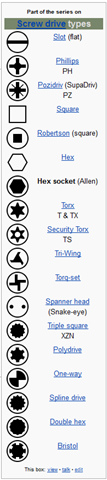
This is why I love the Wikipedia: It has not only an article on things like Allen keys, but a whole series (along with the enclosed diagram) of various kinds of screwdrivers.

Not what you would find in a regular encyclopedia, is it?


Notes on my new X201

image I was just about ready to prove my susceptibility to advertising and get a MacBook Pro, but our CIO refused to fund it (gotta standardize, you know) and offered me an X201 Tablet from Lenovo (for free) instead. I promptly demanded more RAM and a 125G SSD, and the matter was settled.

So – what is there to like? For a start:

  • It is about one cm shorter than my previous X61, which is important because it will fit into a standard A4 binder-style leather case
  • The screen is much brighter than the X61, including the wide-screen form factor which somehow seems more natural
  • The SSD really makes a difference. Word and other memory hogs start almost instantly, and the incessant restarts that for some reason still are necessary when configuring a new computer are a lot less patience-trying than before
  • Windows 7 is relatively stable (though my Matrox DualHead2Go has hung it a couple of times), is faster and has a more attractive interface than XP (BI has, rather smartly, avoided Vista), but it is a capable product, not the wonder some of my friends in Microsoft gab about. I do dislike the "switching between tasks" function on the alt-tab key – it will show the underlying applications on screen, but blanks out everything except the current task whiel you are still holding the keys down. The Windows-tab key combination gives you an animated lineup of active windows, but that literally makes me seasick if I used it fast.
  • The keyboard is about 2 cm wider than the X61, which makes it feel like a regular keyboard. Ihas a very nice feel for a laptop, though some of the keys are more noisy than others (an issue I also had with the X61, which could annoy people at conferences with two or three clicky keys.)

On the negative side: I am not impressed by the battery life, and there appears to be all kinds of issues with the suspend/standby/hibernate/whatever shut-down and startup routines, such as the wireless network shutting down at inopportune times. Hopefully this if fixable by fiddling with various settings.

All in all, the X201 looks to become a solid, rather boring but very capable "main working laptop" for me. I sometimes feel like I am the last person in the world actually using the tablet functionality – not, as was envisioned when it was introduced, for note-taking and text editing, but for teaching, especially for large audiences.

But, of course, if I had sprung for the MacBook Pro out of my research budget, I would have been able to get a BookBook. Oh well..

Bonus! I just discovered I can use my fingers to scroll and zoom, iPad-style, right off the screen. W00t! Coolness in a corporate package.

social Media, disruption, and Comic Sans

I gave a presentation at the RECORD seminar in Oslo today, with the title “Social media as a disruptive innovation”. The title was given to me – I do not think social media is much of a disruptive technology (with the possible exception of headhunting) but certain aspects of it, such as its ability to generate metadata and thereby organize information, certainly are.

Incidentally, speaking at an architecture and design school is always interesting – I feel like I really ought to shave my head, get a Steve Jobs mock turtleneck and a fake Mac to blend in with the natives. On Twitter, most comments (#recordseminar) were about my use of Comic Sans, which I do because a) I like it, and b) it is fun using it in front of designers since they are so predictably irritated by it.

How will the Internet change how we think?

image The Edge question this year is "How has the Internet changed the way you think?". The result is eminently readable – my favorite so far is George Dyson’s answer, which is quoted here in its entirety:

GEORGE DYSON
Science Historian; Author, Darwin Among the Machines

KAYAKS vs CANOES

In the North Pacific ocean, there were two approaches to boatbuilding. The Aleuts (and their kayak-building relatives) lived on barren, treeless islands and built their vessels by piecing together skeletal frameworks from fragments of beach-combed wood. The Tlingit (and their dugout canoe-building relatives) built their vessels by selecting entire trees out of the rainforest and removing wood until there was nothing left but a canoe.

The Aleut and the Tlingit achieved similar results — maximum boat / minimum material — by opposite means. The flood of information unleashed by the Internet has produced a similar cultural split. We used to be kayak builders, collecting all available fragments of information to assemble the framework that kept us afloat. Now, we have to learn to become dugout-canoe builders, discarding unneccessary information to reveal the shape of knowledge hidden within.

I was a hardened kayak builder, trained to collect every available stick. I resent having to learn the new skills. But those who don’t will be left paddling logs, not canoes.

Short and sweet, in other words. Now, where did I leave that informational adze, what P. J. O’Rourke referred to as the "brief-but-insightful-summary" button?

Stephen Wolfram’s computable universe

I love Wolfram Alpha and think it has deep implications for our relationship with information, indeed our use of language both in a human-computer interaction sense and as a vehicle for passing information to each other.

In this video from TED2010, Stephen Wolfram lays out (and his language and presentation had developed considerably since Alpha was launched a year ago) where Alpha fits as an exploration of a computable universe, enabling the experimental marriage of the precision of mathematics with the messiness of the real world.

This video is both radical and incremental: Radical in its bold statement that a thought experiment such as computable universes (see Neal Stephenson’s In the beginning was…the command line, specifically the last chapter, for an entertaining explanation) actually could be generated and investigated is as radical as anything Wolfram has ever proposed. The idea of democratization of programming, on the other hand, is as old as COBOL – and I don’t think Alpha or Mathematica is going to provide it – though it might go some way, particularly if Alpha gains some market share and the idea of computing things in real time rather than accessing stored computations takes hold.

Anyway – see the video, enjoy the spark of ideas you get from it – and try out Wolfram Alpha. My best candidate for the "insert brief insightful summary research" button I always have been looking for on my keyboard.

Pixel invasion

I like this video, just the thing for a geeky Friday:

(Via Boingboing.)

GTD

Getting Things Done: The Art of Stress-Free Productivity Getting Things Done: The Art of Stress-Free Productivity by David Allen

My rating: 4 of 5 stars I normally don’t like self-help books, but this one is low-key, immensely practical, and not tied to paying the author money or hiring him as a personal consultant (though the option is available). I have tried to implement some of his thoughts, using Evernote, and it is sort of working, at least when I force myself to be a little bit disciplined. I like the way David Allen leaves options open for individual variations – and his almost complete lack of self-promotion (for instance, he says that quite a few of his customers have become successful leaders, but attributes it more to their organizing and self-discipline skills than to his method, which he regards as a technology.

View all my reviews >>

Cringely bows out (with predictions)

Bob Cringely has written his last column for PBS, and bows out after 11 years. I for one will miss his long, mostly insightful and always readable columns. He predictably comes up with ideas that are different from what other pundits write, is frequently wrong (4 for 11 in the prediction market is not wonderful, exactly) but always interesting.

And I do like his latest prediction: That VCs will channel money into starting small banks that can extend credit to the very creditworthy companies currently cash-strapped because most of the incentives and the focus is on mortgages. Might not happen, but deserves to.

Bob will, of course, not stop writing (he has his own website, of course, like any professional tech writer) but I particularly like the long essays he has been posting at PBS.org and hope he will continue that format, in some highly visible channel.

Mac vs. PC, iteration 13004…

http://www.liveleak.com/e/adf_1245828170

Cool, though probably not endorsed by Steve Jobs…. (Thanks, @eriksyring)

Yet another argument for CC books

IMG_3019 I bought Cory Doctorow’s Little Brother sometime this Spring, don’t quite remember where (think it was Amazon). When I read it, I discovered that half of page 198 was torn out. This is rather irritating, especially when you are into the book and would like to continue. Previously, my two solutions would have been: Skip the missing page(s) and continue reading; or exchange the book for a new one (which entails taking a break until the new book is back.)

This time, I just found Cory’s full text on craphound.com and printed those pages out on my printer. Then I left them in the book. I saved time and kept the continuity, the bookseller saved time and money not having to exchange my book, and the publisher saved the cost of another copy.

Simple, isn’t it?

Notes from Cory Doctorow talk in Oslo

Cory was here to launch the (New) Norwegian version of his book Little Brother, but, of course, this meeting is not as much about the book as about issues of intellectual property, DRM, legislation thereof, as well as the future of information industries such as publishing.

Cory started with “his usual talk” – interesting, as always – about how encryption works, how it is really strong but easily broken from the outside since the key must be distributed, and then on about how the publishing industry is locking up the work of artists in complicated and, given the technology evolution, largely self-defeating.

Cory structures this around three claims by the industry – that DRM works, that extensions of copyright is necessary to preserve artist’s income, and that the industry should have extra-judiciary powers to shut people out from the Internet upon accusation of copyright infringements. The last one is rather interesting, given all the things people do on the Internet today.

The issue is that we are all copyright infringers, because the rules are arcane and really geared towards the relationship between industry and professional artists, with lawyers and everything. That means that we are all vulnerable to capricious accusations, especially given today’s search technology.

(Not really a point in writing this down in detail, I guess, it will be all over Youtube and other places anyway.)

The debate featured Bjarne Buset, Bente Kalsnes, Eirik Newth and Cory. Bjarne Buset, head of digital strategy at Gyldendal (a large publisher) had the hardest task, since he argues in favor of DRM. Bente Kalsnes from origo.no, an online community, pointed out that the publishing industry has been very slow in developing alternative business models. Eirik Newth talked about how we need to sit down and do a typical Scandinavian solution, stepping off the rhetoric and focusing on privacy, users’ rights, and creators’ right.

I tried to make the point that this debate is getting too politicized. The market will fix this, it is called a disruptive innovation, and there will be a lot of noise and then some of the players will make it across and others won’t. secondly, the the debate is being polluted by a lot of idiots who say that stealing is OK, because music should be cheaper or Microsoft is evil. Like some of my (business school!) students, who copy Microsoft Office and justifies it by saying that Microsoft makes so much money and the product is too expensive.

Anyway, I had an interesting discussion afterwards with some of the usual suspects as well as Bjarne Buset. At some point him and I need to enter into a highly publicized bet as to the future of the publishing industry. In the meantime, it is rather depressing to watch the publishing industry go down the oh-so-noble road to self-destruction, just like the record industry.

Update Sept. 17: Forteller has a good post and a recording of the debate (86Mb mp3).

Update Sept. 20: Here is a (rather fuzzy) video of Cory’s talk, as usual he speaks (seemingly) ex tempore:

http://vimeo.com/moogaloop.swf?clip_id=6657959&server=vimeo.com&show_title=1&show_byline=1&show_portrait=0&color=&fullscreen=1

Doctorow @ Litteraturhuset from Veslebror Serdeg on Vimeo.

Gödel, Escher and Bach’s Crab Canon

This piece of youtubery illustrates the fascinating properties of Johann Sebastian Bach‘s Crab Canon (or, more precisely, the first of ten canons in The Musical Offering) where he takes a complicated theme and then proceeds to play it backwards, forwards, and both in unison.

This little piece is well known to anyone who has read Gödel, Escher, Bach: An eternal golden braid, which should be required literature on, well, any course, really. As my old boss Erling Iversen used to say, there are two kinds of IT people: Those who had read Hofstadter’s Gödel, Escher, Bach and those who should. Consider yourself tapped.

(Hat tip to Joho).

Adirondacks! (or, what I did for a summer diversion)

Vacation is doing something you don’t normally do, and since I tend to be stuck in front of a computer at all times, I decided to engage in some work with my hands and build Adirondack chairs this summer. You can buy these in stores, of course, but they are expensive (up to $1000 for one chair in Norway,) and the store ones aren’t really Adirondacks, which need a curved back, an anatomically becoming seat and armrests wide enough for coffee, wine, and a computer.

I found drawings from Popular Mechanics, and modified the design a bit to cater for taste and European lumber dimensions. Then I made the pieces – having a wife with quilting and sewing expertise helps a lot – and made one chair (which took three days). The chair was tested by family members and modified (back angle, seat shape) according to their feedback and anatomy. Then I went industrial and made four chairs with good help from my equally theoretically inclined colleague Bill Schiano, then five on my own.

Painting turned out to be tricky. On the advice of a neighbor I invested in a compressor and a paint gun, and first coated the chairs with an impregnating wood treatment. Then I used high-quality house paint, which turned out to be difficult because it needed to be thinned to go through the paint gun. Eventually I ended up with window frame paint. At the suggestion of a reader of my Norwegian blog, I might add a top coat of boat paint later, to get a hard and shiny surface that repels water.

Cost of materials came to about $50 per chair, plus paint. I would not have taken the project on if I couldn’t buy cheap Chinese tools (table saw, band saw) as well as a cheap compressor. If I was going to do it again, I would get a table mounted band/circular sander and used a handheld electric saw rather than the band saw, which uses blades rather freely.

Anyway, I now have 10 chairs to distribute around the garden and porch. They are very comfortable – you really don’t need pillows or blankets. As noted elsewhere, doing a project like this allows you to reflect on how you think in your more theoretical work as well, although a wise colleague warned me that theoretically oriented teachers who do a practical project and try to expound on it in general makes asses of themselves, so I will refrain from elaborating. At least I have understood that a good woodworker is one that not only knows how to follow plans but also can come up with solutions to the inevitable blunders. And that an effective sander can fix a lot of mistakes.

As for kindling, we are well supplied for the winter…