Author Archives: Espen

Unknown's avatar

About Espen

For details, see www.espen.com.

Merry Christmas, dammit

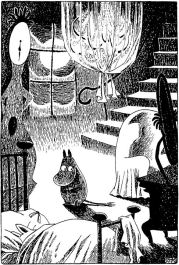
Political correctness hasn’t hit Norway quite as hard as the US, so I will take my chances wishing you all a Merry Christmas and a Happy New Year, offered here with a few pictures from Tove Jansson’s “Trollvinter“, perhaps the most beautiful book ever written about winter, alienation and friendship. Incidentally, don’t confuse this wonderful book with theMummitrollet og v�rl�sningen latter cartoon characters – it bears the same. relationship to those as A.A. Milne’s Winnie the Pooh bears to Disney’s version.

In Norway, Christmas starts early – for us, at least, on December 23 with the traditional “julegrøt” – rice porridge. In the porridge, eaten with sugar, cinnamon and an “eye” of butter, goes a few almonds – and the one who finds the most almonds gets a prize.

Tomorrow, the 24th, is the big day, with a slow morning and, for the children, an even slower afternoon until (after church around 2pm) it is time for the big Christmas dinner. (Incidentally, I don’t go to church myself, so I have the house to myself and get to put on Swedish television with Disney’s Christmas – largely unchanged since the 1960s – prepare the potatoes and sample the wine until the family returns, which for me is the best possible start of Christmas.) After dinner, when the younger children are close to exploding from repressed anticipation, comes the unpacking of gifts – always done slowly, one gift after another – from under the Christmas tree. This takes a while, during which heaps of cakes, wine, and other goodies are consumed until everyone drifts off to sleep, to awake on Christmas morning to prepare for a late and very large breakfast.

Until then, not a word will be heard from here – may your Christmas be peaceful and quiet, the food delicious, the gastrointestinal apparatus in capital shape and the gifts well thought out (or, failing that, returnable.)

GM and IT outsourcing

Tony D. has some reflections to offer on GM’s current IT sourcing process – essentially saying that they are trying to copy BPX’s famous "divide and conquer" strategy without taking into consideration that the implementation part of that deal was a qualified success, at best. I wasn’t really surprised that BPX had had problems with their very creative deal, but confess to not having followed it after the initial story was published.

Tony is the man on outsourcing deals: His article gives some idea on how complex such a decision really is, and how much the history of the corporation shapes the thinking. As Click and Clack once said, when you have had a very small car for a while, you get so frustrated that you err on the other side, getting a huge monster just to make up for all those years with a mailbox-on-wheels. I wonder if GM is doing something similar: Setting up a deal that will give them total power to squeeze their multiple outsourcers – a position that looks great when the contract is signed but turns out to be untenable in the long run. In an outsourcing relationship, you need to worry about the long-term economic health of your partners. There, too.

Mobile blogging

This entry is written from my mobile phone, a Sony Ericsson P910, using a ThinkOutside Stowaway bluetooth keyboard and Opera for mobiles. It is actually pretty simple – the keyboard is not as good as the one I used to have for my PalmPilot, but it is usable for a slow kind of almost-touch writing. Haven’t tried anything fancy such as links or pictures, but you have to crawl before you can leap. Anyway, blogging and surfing is now mobile for me – I can feel freedom from my laptop and 1.5 hour battery life approaching….

NY Times on a self-made child pornographer

Incredible reporting in Kurt Eichenwald’s story about a boy who started his own live porn site on the web, with excellent side stories on the analysis of the customers’ credit cards, child pornography as a growing business, how the story came to be (including what can only be described as a rescue operation for the protagonist), and how it was documented.

Although the story is rather simple, and nobody should be surprised that this goes on, I was very impressed by this reportage – not only did the reporter take considerable personal risk, but The NY Times had to thread very carefully to avoid doing anything untoward.

The story poses problems for a number of online companies, such as Amazon.com (who enable transactions through their online wishlists) and creditcard handlers such as Neova.net. Messages boards and webcam manufacturers could also get scrutinized – I suppose we will see all kinds of calls for filtering software and identification of individuals before they sign up for common electronic commerce sites.

I like the fact that the articles don’t discuss how this traffic should be stopped, and mercifully does not blame the technology for child pornography. They let the story speak for itself – for instance, the journalist documents how vital the credit card operation is to a porn site, which shuts down within hours of losing its credit card agreement.

Once again, technology is neutral in itself, but not in its uses. We want wish lists at Amazon, we want easy payment through Paypal, we want eBay as a channel to market for our few transactions. When it becomes easy to transmit content and set up a payment structure, it becomes easier to satisfy all kinds of demands – also the unsavory ones. Somehow we as a society need to figure this one – an operational way to stop illegal online activity – out without discarding the baby with the bathwater. I for one don’t know how, though I suspect it would involve using normative rather than instrumental initiatives – for instance, exposing the customers, making a trip to a child porn website as dangerous as pursuing that kind of activity would be in the physical world.

John Quelch on business schools

John Quelch, senior associate Dean at HBS and former dean of the London Business School, has an essay in The Chronicle of Higher Education (subscription required) called A New Agenda for Business Schools. In it, he describes an evolution in business schools that is all too recognizeable:

To meet expanding student demand, many business schools had to hire Ph.D.’s in disciplines such as economics or psychology with little interest or experience in administration, management, or leadership. Determined to command the respect of their peers in the faculty of arts and scienses, most of those specialists engage in narrow research that has little or no relevance to or impact on practicing managers, and they seek to publish in journals with the word "science" in the title.

The ensuing lack of interest in teaching and business contact has an effect:

The bright, enthusiastic students who clamor for admission are not being well served, and they know it. They pick up a credential but invariably learn little about how to analyze and solve the complex, messy probelms that confront today’s business managers and leaders as they seek to navigate the global economy.

Quelch argues that what is needed is not the either-or of soft vs. hard or empirical vs. clinical research. What is needed is a balance, especially within broad themes of leadership, ethics, global thinking, management skills, and technological innovation. Currently, the faculty is fragmented :

[…] with their narrow functional expertise, most business-school professors can offer only the individual building blocks. Students are therefore left to integrate what the faculty cannot.

Quelch argues for broad-based capstone courses and field projects to integrate these specialities. He also want business schools to practice the leadership they preach within a the larger university community, especially since they (at least in the USA) are better financed than most other parts of the university and can spread some of the wealth around.

I find little to disagree on in this article, though I recognize the argument as somewhat Harvard-centric, in the sense that many other business schools are either independent of a university or more loosely connected to than what is the case in the top-tier US schools. I agree wholeheartedly in his observation that the pendulum has swung too far over towards specialty and rigor, particularly in Europe, and that it is time to pipe up for the messy realities of imprecise observations, equivocal data, and conflicting priorities and motivations. A good manager is comfortable with ambiguity and change – that should go for business school professors as well.

Wikis and blogs and CLOs

I just did a presentation to a Concours Group teleconference called the CLO Staff Meeting, with a number of large companies in the US and Europe participating. I talked about wikis, blogs, and other new technologies and how they both are new elements in the external environment – using blogs to address customers and suppliers, for instance – and very powerful tools for internal knowledge sharing and communication.

I was very encouraged by the lively discussion and good commentary – several of the companies, both in the US and Europe, were using wikis internally, and were considering blogs. They were wrestling with such issues as to what extent the wikis or blogs should be public or not, as well as how people’s concept of ownership of information was being challenged.

One reflection I made after the call was that blogs, in addition to the increasing use as communication tools with end consumers, will be great tools for shared services organizations to communicate with their internal customers – the relationship between an internal IT provider and their customers is more collaborative, there is less of a "leak" issue, and a blog might just be the tool to move the relationship from a transactional, user-provider relationship to a partnership where provider and customer are exploring new opportunities together.

If they are used honestly and creatively, of course.

Anyway – great fun!

PS: Here is a link to my paper Using Wikis in a corporate context, which discusses some of these issues.

Those who help themselves….

Message from a Concours colleague who works from home (name withheld to protect him from the telco union…):

FYI – I’m back online. My connection is precarious, at best, but that’s because I rigged it myself. I talked to BellSouth twice, and they said that they may not be able to fix it until the 19th of December, which seemed unfathomable to me. After a little investigation, it appears that a truck pulled through the wire in my alley, yanking the connection out of the box attached to the house. I managed to untangle the wire from a tree and then used nail clippers (guess it helped to watch so much MacGyver when I was a kid) to strip the wires so I could re-connect. Anyhow, I’m up and running. Hope BellSouth won’t mind my meddling. 

Nail clippers. Good for him – if he had had fiber to the home, he would have to reach for the vanity mirror…

Firefox Scholar plugin (under development)

Firefox scholarAccording to an article in the Chronicle of Higher Education (subscription required), a team at George Mason University is developing Firefox Scholar, an academically oriented reference harvester for Firefox. Boy, would this be a godsend – I spend way too much time entering references by hand into my Endnote database. The tool is meant to replace Endnote – I am not sure I am ready to replace that very useful tool, but I sure would like to have some interoperability.

Bonus: When looking up Dan Cohen, I found this great history site with a list of what seems to me very interesting research tools.Not to mention that Dan has one of the best designs for an academic web page I have ever seen – excellent combination of blog and archive site. Something to emulate.

(Via Edupage)

And the winner is…

…not me, but Eirik Solheim, whose blog has a mixture of technical stuff (it is a real technology blog) as well as delights such as this year set of photos through a window as well as a cartoon explanation of why the media industry needs a rethink in their approach to strategic marketing.

Thanks to those, from Australia (The Skau family) to California (Jim Ware) via many places in between, who responded to my plea for votes. And I can revel in nice comments, such as this one:

Yours is definitely the best Norwegian-language blog that I have ever looked at

Come to think of it, he is monolingual….

The innovation-hindering IT organization?

Tim O’Reilly and Paul Kedrosky are both pointing to an article in Financial Times about how many private users now have access to much better equipment and services from home than at work, because the IT department has locked down the infrastructure and are slow to upgrade (for very financially sound reasons, I should say.)

This is not new. I remember interviewing IT executives in the late 90s who sheepishly conceded, when I asked them to send me an email, that they had to go home to do that. The corporate email was within-company only (this was a large international oil company).

The job of an IT department is to act as an intermediator between technology and business, and in doing so, it frequently takes on the role of UN soldier – insulating the two sides from each other to keep the peace, in the process inadvertently limiting the degree of interaction and integration between the two.

I think this is a continuing challenge for CIOs – they are expected to be the technology expert, but their day-to-day information needs leeds them away from the rapid and chaotic innovation that happens in the consumer-oriented market. It used to be that the military developed technology, which then companies bought. Then companies drove the evolution, during the mainframe and mini-computer era. With PCs and then with the Internet innovation became first individual and then consumer-oriented. Now the consumer-market drives innovation, and the traditional CIO better take a study tour to the nearest electronics store.

I am just waiting for the first CIO to implement an entire infrastructure on, say, MS Xboxes running Linux. With iPods instead of dictation machines and corporate accounting done in Quicken (don’t laugh, I have seen departmental accounting done that way.) How about corporate email on Gmail, online office solutions, and the corporate web page via Typepad. It is not only possible, it might in fact be the future. As soon as the consumers have been served….

Pancaked Kansas

Kansas and pancakeAccording to this little article in the Annals of Improbable Research, Kansas is flatter than a pancake. I dunno. Seems to be a bounding problem, since the edges of the pancake are included. Since Kansas has a politically, rather than naturally set boundary, I think the border values of the pancake should have been excluded. That is, the edges should not be trimmed off, an action which physcially depresses the pancake, but mathematically removed from the analysis. This introduces a different problem – how far in should you cut?  Since Kansas is part of the American plains, should you trim off until the area of the pancake specimen equals the relative area that Kansas occupies in the Western Plain?

Inquiring minds would like to know. Or maybe not.

And with that, we return to our regularly scheduled programming. (via Volokh)

Rebates of ill repute

There is an interesting little thread over at Slashdot about computer rebates and how good or bad they are. Everybody likes the discount but hates the paperwork, and some pretty sinister conspiracy theories are bandied about, which, of course, is the way we have come to like it at Slashdot.

What gets me, though, is the marketing consultant quoted in the point article, who says that there are rebates because "unlike regular sales, people perceive them as a one-time opportunity to get a product at a lower price than it would normally be sold at."

What utter rubbish. The simple reason rebates and coupons exist is that they allow price discrimination. They are a way of offering a price reduction only to those customers who want it. If they didn’t exist, the seller would have to discount the price for everyone, losing revenue from the customer who would be willing to pay more.

I live in a pricy country on a pricy continent, and tend to buy electronics and other things when in the US. I get the rebate coupons but often don’t bother sending them in – both because of the hassle (the rebates often can be redeemed to US addresses only, adding extra complexity), but also because the price already is significantly lower than in Europe and I just want the product. I can easily imagine many rich and/or busy Americans buying things and not bothering about the rebate – which means that the seller gets more total revenue.

Price discrimination works to the benefit of both the spendthrift and the miser: The former gets the product he wants at a price he is willing to pay. This allows the seller to increase the amount on the rebate, making it cheaper for the miser, who is willing to spend the time and do the paperwork.

Rebates and coupons are outlawed in Norway and in many other European countries, less, I suspect, because they are seen as tricking the consumer than because the wage differentials are smaller in Europe, making price discrimination less effective.

Anyway: To all those carping about how much work the coupons are and the 60% fulfillment rate: If all rebate coupons were redeemed, the rebates wouldn’t be so good. So keep quiet and keep filling in those forms. They are good for you precisely because they are a mechanism allowing you even lower prices than you would get without them.

Vote early, vote often…

My Norwegian language blog, Tversover, has been nominated for a prize of "Best technology blog" in Norway. If you would like to vote for it (I think the voting is open until Dec. 5, but am not sure, so vote early…)  you can do that here.

It is in Norwegian, so for "Kategori", choose "Techno", then choose "Tversover" (the word means both "across" and "bowtie" in Norwegian). Assuming you want to vote for me, of course. Then fill in name, email (non-spam) and type in the spam-stopping security thing, and I will be eternally grateful. Or maybe not.

That will take the stuffing out of them…

Tony D.My good friend Tony Diromualdo is frothing at the mouth over The Wall Street Journal’s article "An MBA Thanksgiving."

I had the good fortune of being at Tony’s house for dinner the day after the article was printed, and got to listen to his opinions on it directly – less polished but with the added benefit of audio and calistenics. Since he and his lovely Nancy also prepared 7 dishes with matching vines, I certainly wasn’t complaining.

I suggest the WSJ, next time an analysis of a business event that involves most of America’s populace is imminent, consult Tony and a number of other serious foodies for their implementation suggestions. How about "Eat yourself happy through your tax preparation" or "Bonfire of the Budget Preparation Brunches?"

With wine suggestions, of course. 

YABHTU

Eric Mack is writing about how the term he coined, YABHTU (Yet Another Blissfully Happy Tablet User)  becoming a term (a YANTUTAO – Yet Another Nerdy Term Unknown To Any Others – I suppose.) His commenters, and the general market direction, despite the Scobleizer’s hard work, seems to not have taken Tablets to their heart, though.

I for one am a not infrequent Tablet user (not sure if the blissfully happy label would stick, though.) I use my Toshiba tablet both for making quick pen drawings when verbal description doesn’t work and where doing a proper vector drawing just isn’t worth the bother. I use it for presentations, to draw ink circles and lines on Powerpoint slides and to make drawings in lieu of a proper whiteboard. And I use it to take notes in situations when typing wouldn’t be appropriate (as when I was listening to a talk by Elie Wiesel last week). The Tablet feature is a very useful tool, but not something I use every day. It adds a very much appreciated layer of functionality.

For a while I was irritated that tableting didn’t integrate well into many programs, but since I don’t use the text recognition program anyway and I write much slower long-hand than I touch-type, the tablet is the thing. I think Tablet functionality is destined to become a niche functionality, offered on high-end PCs. It might disappear altogether, though, in which case I would have to get a Wacom tablet board, since direct on-screen drawing is hard to retrofit on a laptop.

I do hope Microsoft and the laptop vendors have some staying power on this one. I like this feature, and it would be sad to see such an enabler of effortless expression disappear.

The flat and the unflattened

image Friedman, T. L. (2005). The World Is Flat: A Brief History of the Twenty-first Century . New York, Farrar, Strauss Giroux. (link is updated to version 3.0)

I have long used chapters from Tom Friedman’s The Lexus and the Olive Tree in my classes to explain the impact of information technology and globalized capital markets on the world economy. Friedman’s ability to find entertaining and highly relevant examples, and his gift for creative labels (in that book he coined two: The electronic herd to denote the legions of day-traders and other small traders who represent the volatile private capital countries now must attract, rather than the much more stable large bank loans of yore; and the golden straight-jacket, how politicians are forced to refrain from cronyism, populism and personal enrichment in order to attract and maintain the good will of the electronic herd. In Lexus, Friedman showed how politicians are becoming CEOs of their countries, managing them to compete in a global economy that cares less about color and location than education and infrastructure. I was eagerly looking forward to his next book on globalization, and, to judge from the response, so has many others.

That being said, my feelings are mixed on this one. Don’t misunderstand me – everyone, from politicians to business leaders to students – should read this book, but perhaps less for the first 10 chapters, where Friedman describes how the world is going “flat” (that is, small and interconnected) than for the latter part of the book, starting with chapter 11, “The Unflat World”, where he dives into the difficulties of globalization and the dangers of holding it up. While the first 10 chapters are interesting because Friedman writes extremely lively and documents relevant, if well known cases with clarity and wit, it is in the latter part of the book, where Friedman shows why he is the New York Times leading foreign affairs journalist and not their technology or business writer. In that part, the book starts to shine and really deserve the accolades heaped on it.

His key message is very similar to the closing passages of Landes’ The Wealth and Poverty of Nations , (indeed, the whole book can be taken as a popularization of Landes with more imminent examples, with a an seasoning of Theodore Dalrymple and Ernst Luttwak, but writen up more in the style of BusinessWeek than The Economist. If that is what it takes to get people to read about and understand globalization, I’m all for it.

That being said, the weakest chapter of the book is the one about business – aside from the brilliant example of Aramex, a Jordanian rapid delivery company, most of the advice there is trite to business researchers and, I suspect, not exactly news to the common reader. Friedman’s saving grace is that he can and does travel, has an incredibly knack not only for picking the relevant examples (most of the companies mentioned, such as UPS, eBay, Wal-Mart, are overused in many other contexts but appear fresh here) but for writing them up in a style that makes them interesting. The best example by far is Dell Computer, where he simply traces (or, rather, gets Dell to trace for him) in minute but fascinating detail how the computer he wrote most of the book on came to be – showing that if China and Taiwan cannot agree politically, they are pretty good at supplying parts and know-how to each other and to the world.

Friedman has a great gift for the poignant expression (On the need to not shut the world out for fear of terrorism: “Leave the cave-dwelling to Osama.”) but sometimes veers over towards the saccarine (On the India-Pakistan sabre rattling in 2002 and how big companies lobbied to get India to stand down: “The [India-Pakistani 2000] cease-fire was brought to us not by General Powell but by General Electric. We bring good things to life.”)

His suggestion that the United States embark on a “man on the moon” project aimed at making the country energy-independent in ten years is nothing short of brilliant – it addresses a serious problem, is doable, would further research towards a great goal, and help the American and the world economy no end. And it would lessen the world’s dependence on oil and thereby reduce the danger of future fallouts over access to energy. Go for it. It’s a no-brainer.

Friedman also answers his critics, cheerfully admitting that he is a technological determinist – “guilty as charged” – but not a historical one. And his analysis of how the anti-globalization movement – which he thinks is extremely important  – has been shanghaied by anti-Americanism and geriatric leftist ideology is both cooly rational but also heartfelt: Friedman is honest and world-wise enough to know that globalization, to be a beneficial evolution, needs a fact-based and rational opposition – focused on how we globalize rather than whether we are. Too many critics of globalization see it in terms of conspiracy theories – it is an evolution enabled by freedom of information, capital and to a certain extent people, and attempts to put the djinnie back in the bottle are not likely to be successful, to put it mildly. (Incidentally, Jared Diamond’s Collapse, which I am halfway through at the moment, provides a much better foundation for this opposition than Naomi Klein’s populistic but theoretically incoherent No Logo.) As Friedman says it: “What the world doesn’t need is the anti-globalization movement to go away. We just need it to grow up. […] You don’t help the world’s poor by dressing up in a turtle outfit and throwing a stone through a McDonald’s window. You help them by getting them the tools and instutions to help themselves. […] Just ask any Indian villager.”

His best writing – and underlying anger – comes out when writing about the people for whom globalization is not as much a negative influence as a distant mirage. They constitute half the world’s population, they will get restless unless as soon as they see what they can get, and if that isn’t good enough reason to start thinking about how to use globalization beneficially rather than try to stop it from happening, I don’t know what is.

—–

Possible error: On page 268, Friedman refers to a study of “leading universities” creating 4000 companies with 1.1m jobs and $232b in revenues, refers to the “Task Force on the future of American Innovation” On page 244, however, the same figures are repeated, but instead of “leading universities” it is MIT, and the reference is to a study by BankBoston.

—–

Notes after the jump, taken as I read through the book, offered here, caveat emptor, typos and all:

Continue reading

ADD history of technology and capital markets

Kessler, A. (2005). How we got here: A slightly irreverent history of technology and markets. New York, HarperCollins.

The title is accurate – this is a short history of how technology and capital markets evolved to where we are today (and, given the evolution of the Internet, the two will merge). Kessler connects many events in a very short format, sprinkling the text with a bit too many one-liner jokes. He does better on technolology history than financial markets, but I still enjoyed it. Quickly written and quickly read, with some good little tidbits here and there (such as the account of B.F. Skinner, psychologist and pigeon trainer, creating a bomb guidance system with pigeons inside the bomb nose cone trained to peck at outlines of Japanese war ships.

Not sure if I would recommend this – too quickie unless you already know the history (but then it is fun.) The definitive book on these topics is yet to be written. Notes:

Continue reading

WiFi at HBS

From a comment at a Slashdot discussion on the use of WiFi in classrooms:

How they handle it at Harvard Business School (jwachter) on Saturday November 19, @01:53PM :
I’m a student at Harvard Business School, where they have a fairly interesting solution for handling this problem. While every campus building has wireless access, all the access points in the classroom buildings require a web based log-in that checks your student ID versus your class schedule. If you’re scheduled to be in class at that moment, you are denied wireless access to the internet (in any classroom building).

Draconian, perhaps, but very effective at keeping us focused in class.

Case teaching at HBS is a pretty intense experience, but this access system surprises me. – I have always held that if you cannot get the students to concentrate in class because they are surfing, then you don’t have a technical problem. This means students cannot google for updated information while in class, which I see as useful, not disturbing. Anyway, another person further down nails it:

[Georgia] Tech has a good solution to this problem too: they let you do whatever you want, but if you don’t understand the material they fail you and kick you out. It’s effective at keeping us focused (enough) in class, and also isn’t draconian. (mrchaotica)

That net porn thing

Nick Carr has an interesting post about porn on the web, and the slow change of what we consider normal. Since I have

  1. recently read Theodore Dalrymple on our sliding standards and what it does for us (or, at least, for some segments of the population), and
  2. this morning cleared out the junk trackbacks (Spamlookup let 8 through and caught 341 in a week, bravo) which all point to the same kind of sites he is talking about, and
  3. three daughters who all have net access and use it all the time (they are 11, 16 and 19, and very smart kids, so it is not that I am very worried, but, as Edward Oakes says, "[…] a neoconservative is a liberal with a teenage daughter.")

…I am tentatively beginning to wonder where the end point in this evolution is. The right-wing crazies and naivist doogooders want to shut down the net and/or impose controls, which, of course, is an unworkable solution that is much worse than the problem. But the sort of "this is not a problem and even discussing it is the thin end of the wedge" answer isn’t helping much, either.

Aaahhh, the vagaries of the human existence… 

Update: Interesting discussion between Matt Asay and Tim O’Reilly over at Infoworld Open Resource. I agree with the Matt in one thing: It is not the existence, but the intrusion, that is the problem.